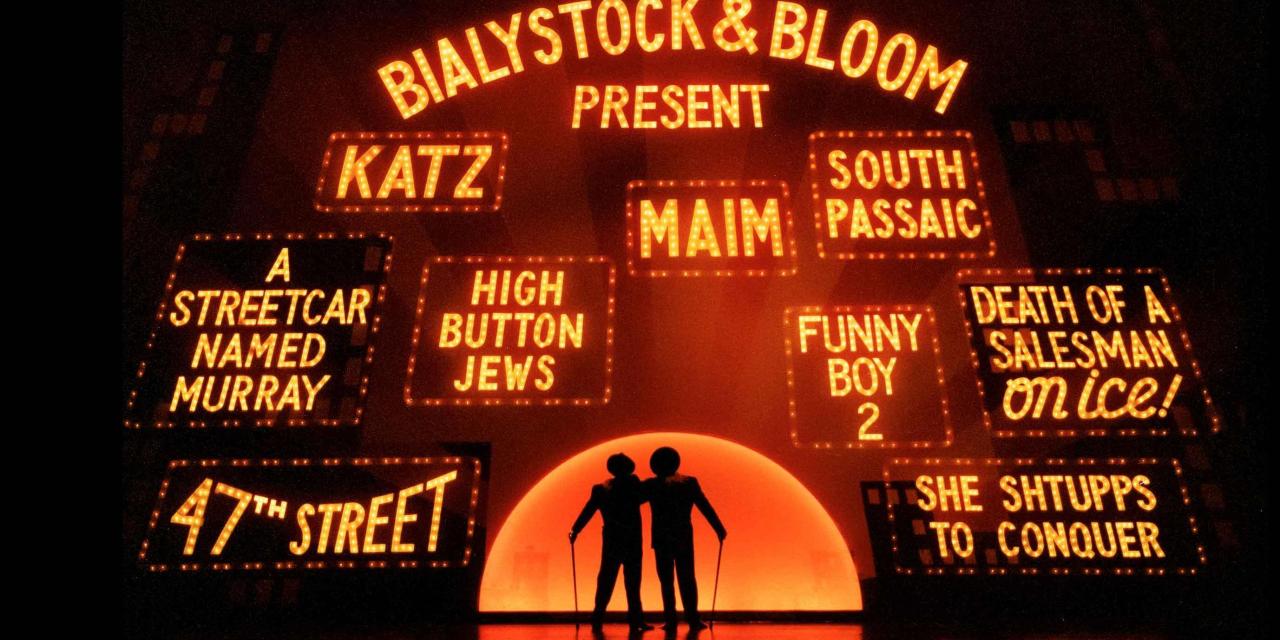
Dedicated to the 25th anniversary of the Broadway premiere of the Musical ‘The Producers’ and the 100th anniversary of Mel Brooks
This year, film director, comedian, playwright, actor, and songwriter Mel Brooks celebrated his 100th anniversary! This is a momentous occasion in itself, but it is truly unique for the select group known as EGOTs—distinguished figures in show business who have won the industry’s four major awards: the Emmy, Grammy, Oscar, and Tony. Among the holders of this “prestigious quartet,” Mel Brooks is currently the only centenarian to have crossed the hundred-year mark.
This year also marks the 25th anniversary of the Broadway premiere of his famous musical The Producers, based on his own 1968 film of the same name. Brooks’ directorial film debut won an Oscar for its screenplay.
The jury recognized not only the author’s dramatic talent but also the high quality of the direction. Audiences fell in love with the vivid, comedic characters of Max Bialystock (Zero Mostel), Leo Bloom (Gene Wilder), Franz Liebkind (Kenneth Mars), Lorenzo St. DuBois/ L.S.D. (Dick Shawn), and Ulla (Lee Meredith)—who perfectly complemented one another and demonstrated their characters’ transformations throughout the performance.
Although the film initially received polarized reactions, it later gained recognition for its “cultural, historical, and aesthetic significance.” It was included in the American Film Institute’s list of the 100 Funniest American Movies of the last century. Martin Scorsese once said:
Mel has made his own tradition of greatness, and it’s that tradition – drawing from the past, honoring it, toying with it, vamping on it, extending it to places wise men, very funny men previously feared to go…
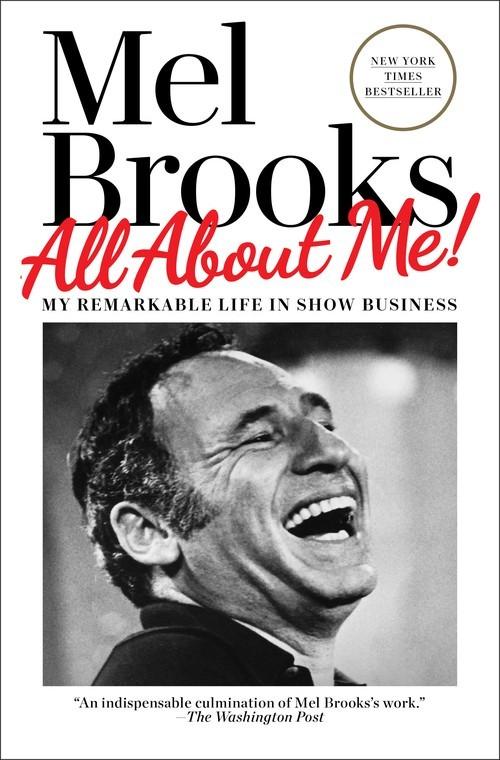
Cover of the Book by Mel Brooks, All About Me! My Remarkable Life in Show Business. Ballantine Books, 2022.
Two chapters of Mel Brooks’s book All About Me! My Remarkable Life in Show Business (2022) are dedicated to the making of the film and the musical The Producers. The idea of writing a satirical novel or play about Adolf Hitler emerged around the turn of the 1960s. As a World War II veteran, Brooks—who was Jewish—aimed to expose the absurdity of Nazi ideology itself. By blending absurdity, parody, the grotesque, dark humor, and satire into a single cocktail, he elevated the comic effect to such heights that the “painful” subject of the war—which had ended only a short time before—no longer felt like a provocation.
Not afraid to tackle the subjects of gender identity and homosexual relationships, Mel Brooks played on subverted expectations. Ask any ordinary person whether a comedy about Hitler could succeed, and the answer is unequivocal: it’s a recipe for failure. And turning the director of Springtime for Hitler—and the Führer himself—into gay men? That would be like shooting oneself in the foot. Brooks concocts a story about the deliberate creation of a play, Springtime for Hitler, that is destined to fail.
To this end, a deranged playwright—a Nazi and Hitler fanatic—is recruited, along with the worst director imaginable (whose every previous production closed after a single performance) and a cast of utterly incompetent actors. Two Jewish underdogs—producer Max Bialystock and accountant Leo Bloom—join forces and successfully raise funds for the show. They are confident that if the production fails, none of the investors will seek a refund, given that the project was marketed from the start as a high-risk venture. Unexpectedly, however, the show becomes a smash hit, and the investors demand their money back. The hapless producers land behind bars. There, they repeat their experiment, staging the musical Prisoners of Love with fellow inmates and promising dividends to sponsors drawn from the prison population.
Initially, Brooks planned to write a three-act play titled Springtime for Hitler, and later a musical called Springtime for Hitler: A Gay Romp with Adolf and Eva at Berchtesgaden. Mel tried to sell the project to Broadway producers. Acting on a producer’s recommendation, Brooks set about writing a screenplay. He even ventured to compose the music and lyrics for Springtime for Hitler—”the most offensive song in the world that would have Jews looking for the exit doors“—as well as the song Prisoners of Love.
I can’t tell you how thrilled I was to see the first copies of the sheet music of mу songs and the credit in the upper-right-hand corner: Words & Music by Mel Brooks.
Many years after the film’s release and success, and at the urging of American film producer David Geffen, Mel decided to revisit the original idea: creating a Broadway show—specifically a musical, rather than a musical play. Jerry Herman was expected to write the score but declined, believing that no one could do it better than Brooks himself. Mel then brought in Tom Meehan to write the book. He, in turn, recommended bringing in Mike Ockrent as director. Mike and his wife, choreographer Susan Stroman, were the first to hear the new songs Brooks had composed. “When you write a song for a Broadway musical, the song not only has to work as a song but also has to move the story forward,” wrote Mel Brooks. Starting with Leo Bloom’s song I Wanna Be a Producer, Brooks collaborated with Glen Kelly on the arrangements. For help with the lyrics, Brooks turned to his longtime friend Ronny Graham. Doug Besterman, the orchestrator and conductor, joined the team last. “The first time I heard the full orchestra playing my score, I burst into tears,” Mel Brooks recalled.
During the creation of the project, Mike Ockrent passed away suddenly, and Mel did everything possible to convince Susan Stroman “to continue Mike’s work and direct the show.” The team’s close collaboration contributed significantly to its success. Everyone agreed that “the musical was at least as good as the movie and, if possible, even better.”
Song lyrics were reworked, transitions added, and sometimes new layers of meaning introduced—all in real time. Mel even earned praise from Stephen Sondheim himself for rhyming “Delaware” with “well aware”—an achievement he took great pride in. Sondheim, who genuinely wondered why two authors—one for music and one for lyrics—were needed to write a single song, served as a beacon for Brooks: a source of light too distant to offer warmth, yet one that inevitably held him spellbound.
Knowing exactly what his main characters were like, Mel personally sought out the actors for the lead roles, just as he had done for the film’s casting. He had no doubts about Max Bialystock—Nathan Lane was the obvious choice from the start. Mel recounts the fascinating story of how Lane came on board and worked on the show in his book, All About Me!. The role of Leo Bloom—the accountant who dreamed of becoming a Broadway producer—remained unfilled the longest. Incidentally, Mel openly admits that he “…stole the name Leo Bloom from Ulysses [by James Joyce].”
Mel described the character’s transformation metaphorically: “A caterpillar who dreams of one day becoming a butterfly.” Ultimately, Matthew Broderick was cast in the role. The lead actors developed a chemistry that Brooks described as nothing short of “magical.” The rest of the cast included Brad Oscar as Franz Liebkind, Cady Huffman as Ulla, Gary Beach as Roger De Bris (and Adolf Hitler), Roger Bart as Carmen Ghia (Roger De Bris’s boyfriend), and Madeleine Doherty as Hold Me-Touch Me (one of the elderly ladies). According to the script, the actor playing Roger De Bris—a “flamboyant director”—also takes on the role of Adolf Hitler following an incident on opening night.
Ron Orbach was originally slated to play Franz Liebkind, but an injury kept him from performing.
The musical premiered at Chicago’s Cadillac Palace Theatre. Although the show needed trimming, only minimal changes were made before its Broadway premiere. A funny Goodbye Song was also added, which ended like this:
We’re glad you came, but we have to shout
Adios, au revoir, wiedersehen, ta-ta-ta
Goodbye…get lost…get out!
Despite his busy schedule—including work on the movie Spaceballs: The New One, expected to hit theatres in 2027—Mel Brooks kindly agreed to answer a few questions about The Producers.

Mel Brooks / The Producers Musical Opening Night in Hollywood, CA, 2003/ Photo Credit by ZUMA Press, Inc./ Alamy.
Lisa Monde: The Producers as a project lives in the world of “transmedia:” a play—a film—a musical—a film adaptation of a musical. While we know a lot about the film and the musical, the question of whether there actually exists a published play, Springtime for Hitler or The Producers, remains unclear. Was the play written from the start, or was the idea quickly reoriented into a film script?
Mel Brooks: I sent an outline of the play to Kermit Bloomgarden, a Broadway producer who did Death of a Salesman. He said, “There’s an old saying on Broadway — one set, five actors. You have twenty sets and forty actors… I think it might do better as a film.” So there never was a finished play; I pivoted from that outline to a screenplay.
LM: Which media format do you personally consider the most suitable for ‘The Producers?’
MB: It turns out that a Broadway musical suits the story best—because of the score and the production numbers, it all adds to it, and you can have a lot more entertainment.
LM: In today’s landscape, where it’s popular to add immersive elements to a musical, could you imagine an immersive version of The Producers? What would it be like?
MB: I don’t think an immersive version would work for it. I’m not sure anyone wants to sing and dance on stage with Hitler.
LM: The musical The Producers has had—and, I am sure, will continue to have—quite a few adaptations. How important is it to you that adapters convey your creative vision and main message faithfully?
MB: Yes, I think most authors would want their work done more or less as originally envisioned — especially when the original has had so much success.
LM: Almost twenty years ago, German audiences witnessed the musical The Producers for the first time. The German audience was a tough crowd, weren’t they?
MB: Actually, we played Germany and Austria, and it went surprisingly well. For the costuming, they replaced the swastikas with pretzels!
LM: The French—who usually respect only their own musicals, specifically those that don’t “smell of Broadway”—suddenly gave the adaptation of The Producers such a warm reception. Do you have your own explanation for this phenomenon?
MB: All I can say is that a good show is a good show. It got standing ovations at the Champs-Élysées, which makes me very happy.
LM: What was the most important aspect of the casting process for you? Did the candidates need to resemble the envisioned characters? Or was the priority their understanding of the character and their ability to develop the role in the subsequent work fully?
MB: There was an actor named Andreas Voutsinas who was in the original film; he played Roger De Bris’ “roommate.” He was very bright and once said to me, “Or you got it or you ain’t!” I never corrected his English and was grateful for his insight and advice. So as far as casting was concerned—either they had it, or they didn’t!
LM: You created the characters on paper yourself. Then you chose the performers. When working with the actors, what kind of tasks did you set for them? Did you give them the creative freedom, or did you set specific boundaries?
MB: I generally had only one basic rule as far as the actors were concerned: Play the script as written. And for the most part, they did!

The Producers Musical, We Can Do It, Broadway / (L)-Matthew Broderick as Leo Bloom, (R)- Nathan Lane as Max Bialystock/ Photo Credit by Paul Kolnik.
The Producers became not just a hit but a “bona fide Broadway phenomenon.” A month after its premiere, the 55th Annual Tony Awards took place, and the musical received a record-breaking fifteen nominations. When Mel Brooks was invited to the stage to accept the award for Best Original Score, he said, “I want to thank Stephen Sondheim for not writing a show this year. Thanks, Steve!” That got a big laugh.
After the judges announced the winner in the Best Musical category—an award The Producers claimed for the twelfth time that evening—Brooks thanked “the most important person in the show”: “Well, I want to thank Hitler. For being such a funny guy on stage.”
The New York production was followed by a West End run that Brooks considered even more successful. “The Producers was the most wonderful and at the same time most challenging thing that ever happened to me—reaching heights that seemed impossible…” Mel Brooks would later say, reflecting on the show’s success in London.
It is safe to say that the musical The Producers has stood the test of time and won over audiences worldwide. It has been staged in more than thirty cities, with multiple national tours across the US, Great Britain, and Ireland, as well as various international productions. In total, The Producers has been translated into fifteen languages, including Hebrew; Mel Brooks was delighted that his “Hitler spoke Hebrew,” and the production in Tel Aviv played to sold-out houses for several months.
The musical was still running on Broadway and the West End when international licensed productions began to appear. The first took place in Buenos Aires, Argentina (2005), followed by Milan, Italy (2006). Each translated adaptation made specific changes to ensure Brooks’ satire resonated with local audiences. Success depended largely on the quality of the translation and the adaptation of the American humor, puns, and double entendres characteristic of Mel Brooks’ style. When the comic effect and meaning of the jokes were successfully preserved, audiences saw the story as relevant.

The Producers: The Movie Musical, 2005/ Nathan Lane as Max Bialystock and Little Old Ladies/ Photo Credit by Moviestore Collection Ltd/ Alamy.
The German adaptation—an official franchise production—premiered in Vienna, Austria, in 2008. Audience reactions following the initial performances were mixed: some were outraged by the sight of a singing Hitler and tap-dancing Nazis, while others laughed heartily. A year later, the show opened in Germany, a country where the public display of the swastika is prohibited by law.
For proper and safe advertising, the swastikas were replaced with pretzels. On the theatre staff’s armbands, one could see a thick sausage instead of a swastika. The inner courtyard of the Admiralspalast Theatre in Berlin was lavishly decorated with portraits of the Führer. Newspapers were filled with headlines such as “Hitler Returns!”, “Hitler Back in Berlin?”, and the like. Much was also written about the venue’s specific history: a special box had been constructed at the Admiralspalast for Hitler—a great fan of operetta—where he frequently appeared. On stage, the Nazi symbol could be displayed legally as part of the artistic concept.
Brooks did not attend the premiere. “Mel didn’t go over, though. Mel wouldn’t go over. He was afraid that someone would throw him in the back of a van and he’d be out of there. But I went, and they did a great job and were very respectful of Mel’s work,” recounted Susan Stroman [director]. Interest in the show was accompanied by a heated public debate about the boundaries of acceptable humor, political correctness around historical events, and the appropriateness of reviving the memory of a dictator like Hitler—albeit in a satirical, Chaplin-esque style.
German audiences’ predominantly wary attitude toward the show led to its relatively quick closure: it ran for about a hundred performances. Yet, as Susan Stroman noted, “…at the end of the show it was triumphant applause and cheers and standing ovations. Just after the number Springtime for Hitler there was dead silence. And that was something that never happened before.”
A Russian-language adaptation was being prepared almost simultaneously with the German version; however, it’s better described as an interpretation, given how little of the original remained. It premiered in 2009 at the Et Cetera Drama Theatre, led by Alexander Kalyagin (directed by Dmitry Belov, with choreography by Zhanna Shmakova). In Russia, the subject of World War II, the name Hitler, and Nazi symbolism are highly sensitive issues. True, by that time, more than sixty years had passed since the victory over Nazism—a victory in which Russia played a pivotal role. As in Germany, one could reasonably expect a wide range of reactions, including sharply negative ones. Overall, the show made a dazzling impression on the Moscow theatre scene.
The Russian production of The Producers was a hit! The show ran for over four and a half years in the Et Cetera Theatre’s repertoire. Audience reactions ranged from bewilderment and indignation to sharp criticism of the show’s central theme. Yet many delighted in the unique opportunity to “experience Broadway.” After all, when this musical about “the worst Broadway show” first appeared, Russian audiences had no frame of reference for the subject matter; they came to know the best of Broadway later.
The authors responsible for the linguistic adaptation (Irina Lychagina and Alexey Kortnev) radically reworked the American elements. Because of major differences between theatrical and pop-culture stereotypes, the Russian version shifted the thematic emphasis: the show became more about the profession and less about society. The production team successfully toned down the original’s provocative aspects, earning high praise from the professional juries of Russia’s prestigious theatre awards.
A later French adaptation of Les Producteurs (2021)—directed and choreographed by Alexis Michalik, with a libretto and lyrics adapted by Nicolas Engel—stayed closer to the original Broadway production than other versions and was well received by conservative French audiences, who are known for their “dislike” of Broadway musicals. Nevertheless, the creator noted, “It got standing ovations at the Champs-Élysées, which makes me very happy.” The French production retained the Nazi imagery, while the translation of puns and jokes—adapted for a French-speaking audience—preserved the scenes’ essence.
In other words, the production preserved Mel Brooks’ original concept, with greater emphasis on the absurd and the grotesque. The production retained the original’s wit and parodic nature, while certain musical numbers (such as I’m Here! and There’s Nothing Like a Show on Broadway) felt authentically suited to the French stage. It enjoyed two sold-out seasons and won two prestigious Molière Awards, including Best Musical.
A few years later, the production returned to the Théâtre de Paris (2025). Critics and audiences alike were unanimous in their enthusiastic praise, noting that a certain “French charm” suited Mel Brooks’ work perfectly, while the updated set design significantly enhanced the visual experience. Some reviews did raise the question of whether one can laugh at anything or if there are moral boundaries; however, the search for an answer shifted to a different plane, suggesting that in today’s absurd world, laughing at dictators and their henchmen is not only permissible but necessary – serving to expose corrupt ideologies and shatter the aura of “greatness” surrounding such figures.
“Reframing” serious matters as something funny helps society release tension and view a problem from a different perspective. The French have fully appreciated the show’s therapeutic effect.
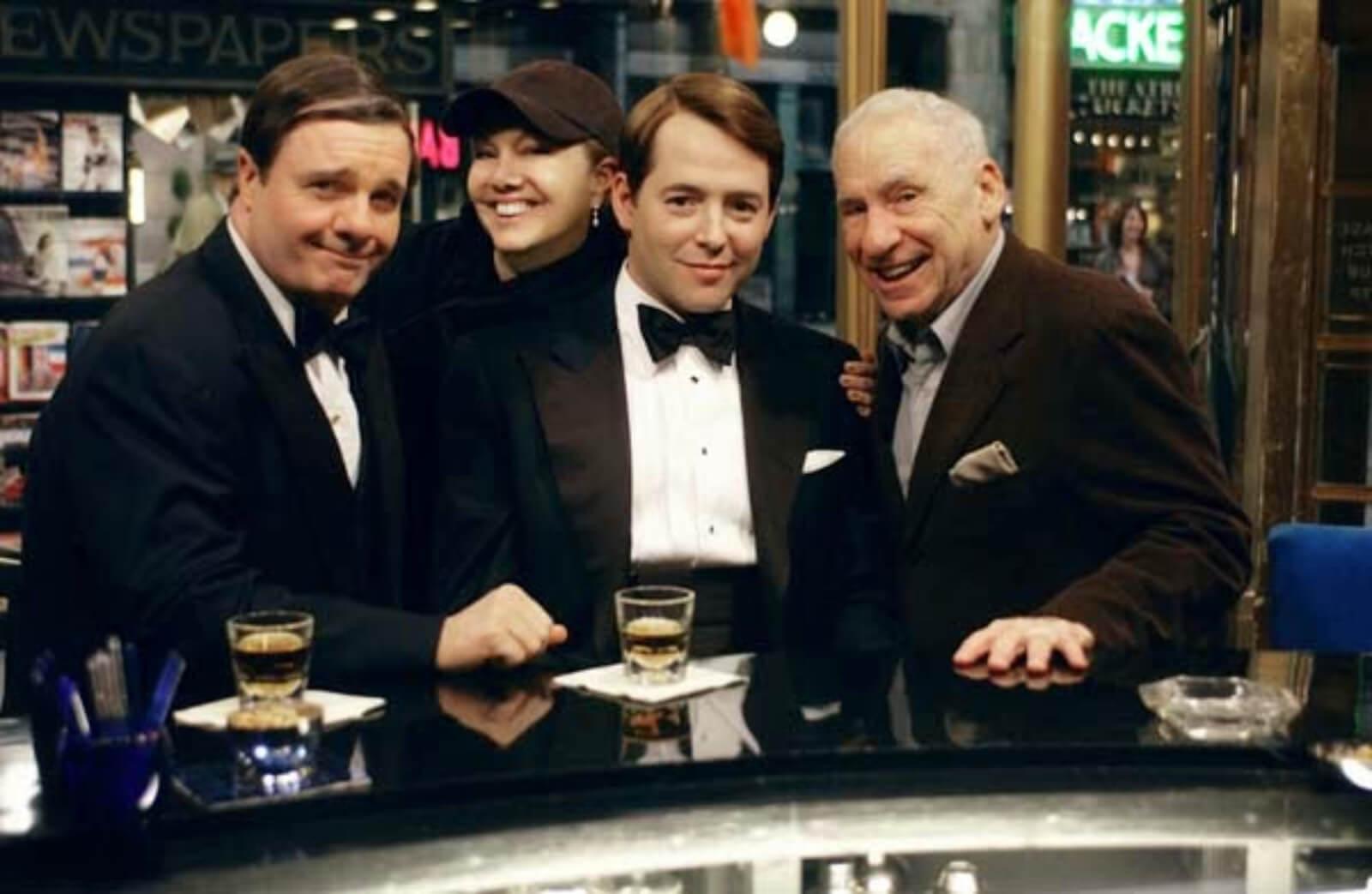
The Producers: The Movie Musical, During Rehearsal / (L)-(R)- Nathan Lane, Susan Stroman, Matthew Broderick and Mel Brooks/ Photo Credit by Andrew Schwartz.
When comparing the film The Producers (1968) with the musical, two main differences stand out. While the film portrays Hitler as a grotesque figure defined by absurd situations and ridiculous antics, the musical makes the dictator a central element of the satire. The Führer is depicted as a shy gay man with distinctive mannerisms and behavior; he peppers his speech with double entendres—interspersed with cries of “Hail Hitler!”—and exhorts the audience to “Hail Myself, Hail to Me!”
A second significant addition was the introduction of a love story into the musical. Chemistry develops between Leo Bloom and Ulla, the Swedish secretary. This gave rise to the songs The Face (Leo Bloom) and When You Got It, Flaunt It (Ulla). The creative partnership between Max and Leo, along with Leo and Ulla’s relationship, leads the characters to re-evaluate their outlooks on life and fosters their personal growth. While imprisoned on fraud charges, Max, Leo, and Franz stage a new musical—Prisoners of Love—featuring a cast of fellow inmates.
In the finale, the show opens on Broadway with Roger and Ulla in the lead roles. All in all, it is a happy ending—unlike the original film, which concludes with scenes from Sing Sing Prison, where the “incorrigible” con men are staging a new musical, Prisoners of Love. What fate awaits them next is left for the audience to imagine.
Susan Stroman directed and choreographed the 2005 film adaptation of the musical The Producers, with Glen Kelly handling the musical arrangements. The film’s runtime was reduced by an hour; the songs King of Broadway, In Old Bavaria, and Where Did We Go Right? were cut. Certain musical numbers from the stage version had to be removed, and Ulla’s role was scaled back. Nathan Lane, playing Max Bialystock, drew heavily on the performance of his predecessor, Zero Mostel, who had starred in the original film. Matthew Broderick (Leo Bloom), having initially decided against emulating Gene Wilder, portrayed his character just as he appeared in the stage version—albeit adapted for the screen.
Uma Thurman’s portrayal of Ulla felt overly predictable, and the characterization came across as grotesque. Despite the excellent acting, the film adaptation disappointed many fans of the original. Critics noted the loss of the driving rhythm that kept the audience constantly engaged, as well as a diminished sense of the adventurous spirit that had made the source material so captivating. On the upside, the happy ending was even more elaborate than in the stage version: every character got what they wanted, and everyone emerged triumphant.
Some might prefer the original film The Producers, in which the con artists remain con artists, turning prison into a new market for their scams. Others might favor the film adaptation of The Producers: The Movie Musical, which grants the characters redemption: they achieve genuine success on Broadway. Thanks to Mel Brooks for giving us the choice between the beautifully cynical original and the optimistic remake!

Mel Brooks with a Camera, Rome, 1990/ Photo Credit by Marcello Mencarini/Lebrecht Music and Arts/ Alamy.
While countless examples exist of films being adapted into musicals or musicals into films, very few instances in show business involve a screenplay transforming into a film, then into a musical, and finally into a film adaptation of that musical.
Today, we can analyze the nearly seventy-year journey of The Producers—a work presented in three different media formats by a single creator, a true “jack of all trades” who served as the originator, playwright, composer, librettist, director, and producer.
A lifelong saga. Over the years, the project has only grown in popularity and public acclaim. Like a fine Burgundy Pinot Noir—a wine that improves with age—it reveals subtle tertiary aromas. The dictator’s story has become increasingly relevant in today’s political climate.
The topic of Western spiritual values, self-identification, anti-Semitic discourse, and tolerance in society is more relevant than ever. And the parody of double standards and the substitution of concepts evoke a genuinely lively reaction. After the Holocaust, it became clear that society’s moral values cannot be taken for granted. Without a critical understanding of the past, shared humanistic values for the present and future will not form.
Mel Brooks clearly distinguished his attitudes toward Nazism and the Holocaust, saying, “You could make a comedy about the Germans, you could make a comedy about the Nazis. But not the Holocaust…. I’m originally politically incorrect, but I would never.” [Oct 11, 2011, Moment Magazine, “Mel Brooks: King of the Politically Incorrect” by Lynda Gorov]. To those who were outraged, he responded, “…the way to bring down Hitler and his ideology is not by getting on a soapbox with him, but if you can reduce him to something laughable, you win.”
Brooks suggested laughing at Nazism because laughter is the most terrifying weapon for such regimes. For every Führer, appearing ridiculous means “deflation,” losing his hypnotic hold on the average person’s psyche. A successful joke can almost instantly shift perspective, transforming the regime’s “historical mission” into absurdity.
Today, in an era of clashes between right and left discourse, many can’t shake the feeling that they’re witnessing a poorly staged production, created by less-than-competent people. Meanwhile, everyone is assured that the show itself is magnificent, but not everyone understands this. Mel Brooks may be the only person capable of creating a dark comedy about compromise between supporters of right and left views. The show could be called something fashionable, like “Consensus,” and depict a society where complete unanimity reigns, and everyone lives comfortably. Funny, right?
Happy centenary to the unrivaled author of parodies and farces in film and musical theatre, Mel Brooks! Please follow your own advice: the secret to a long life – “Don’t die!”
This post was written by the author in their personal capacity.The opinions expressed in this article are the author’s own and do not reflect the view of The Theatre Times, their staff or collaborators.
This post was written by Lisa Monde.
The views expressed here belong to the author and do not necessarily reflect our views and opinions.