Switzerland, for me, is a kind of dream. You know, mountains, lakes, rivers; clean streets, clean people, clean air. Sun, ice and snow. A dream of a society where things actually work. But, yes, I know. There’s also the other side of any dream: a nightmare of banks, big pharma and cuckoo clocks. Designer brands that choke the high streets, designer SUVs that choke the roads. Yes, this is the world of Eurotrash, the bestselling 2021 autofictional novel by Christian Kracht, which has now been adapted for the stage by Colin Teevan, and given an all-star cast by the Young Vic: Kathryn Hunter and Ben Whishaw no less. So what’s it all about?
Set in Zurich, the story begins with 50-something Christian (Whishaw), a novelist who’s blocked and hates this “city of charlatans and showoffs and humiliation”, visiting his 80-year-old Mother (Hunter), who has just been discharged from a psychiatric institution. She’s addicted to vodka and phenobarbital, needs a colostomy bag, uses a mobility stroller, and is pretty uninhibited. And she’s a crafty old girl who plays games with her son, pretending she hasn’t just phoned him, and being sharp in her putdowns. While she expresses her disappointment in his lack of interest in her, he feels guilty, his default position. Being very rich, Mother gets CHF 600,000 in cash from the bank, puts it in a plastic bag, hires a cab and the two go on a road trip.
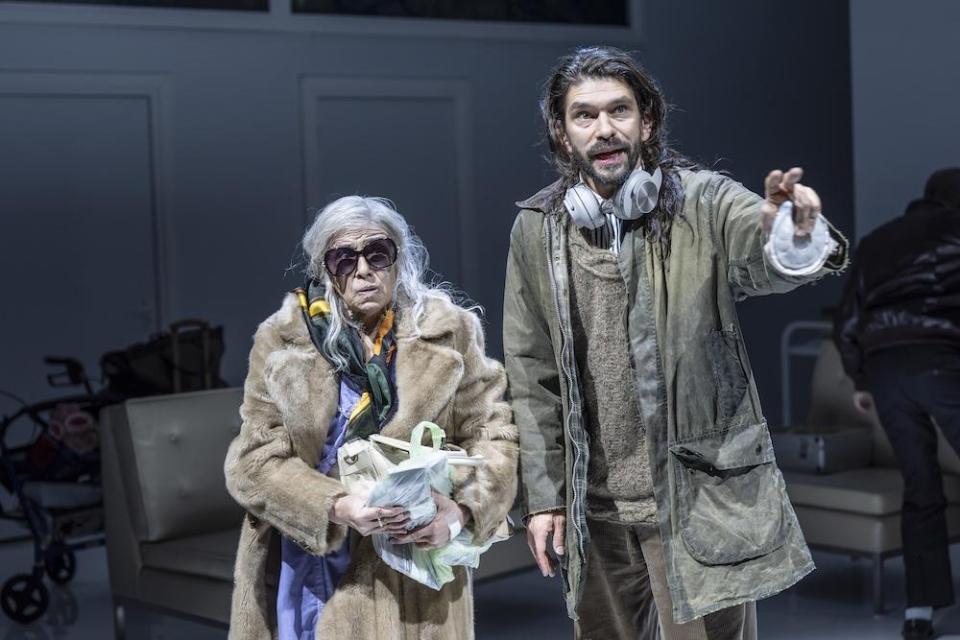
Ostensibly, Mother wants to give her money away, to strangers. And to visit Africa. So in a dreamlike way, as Christian remembers episodes from his childhood, they travel first to a grubby vegetarian commune, which Christian insists is a five-star hotel, then to a trout restaurant from the family’s past, then to search for edelweiss using a cable car which gets stuck on the way back from a mountain-top gift shop, then to the grave of Jorge Luis Borges. Everywhere they go, there is evidence of a rich society which contrasts with their impoverished appearance: Mother wears her nightgown under a fur coat, Christian a scratchy brown pullover made from sheep’s wool. They look like fugitives from a Beckett play.
The nightmare side of this dreamlike satire comes from the fact that the family has a Nazi past, and has made most of their money from the sale of arms. On designer Lizzie Clachan’s perfectly buffed white set, with its images of snowy mountain tops behind glass panels, Switzerland’s riches are visualised as a line of designer handbags, posh shoes and other consumer goods which travel along a conveyor belt before dropping into a rubbish bin. Yet the black humour of the story, and its social satire, is constantly overwhelmed by the surreal comedy of this production, directed by Walter Meierjohann. As is most of its dark material.
Christian is both narrator and protagonist in what is basically a two-hander that examines his relationship with his Mother. The mutual exasperations and antagonisms are serious, but usually defused by comic capers. Her colostomy bag symbolizes the care she needs to be kept alive, and there are moments when he has to engage with her bodily needs, but then all this serious stuff turns into a visual joke about a huge dump of shit. Very funny. However miserable, Christian is a Bowie fan, and here gets the chance to perform a crowd-pleasing version of “Five Years” from 1972’s classic album, The Rise and Fall of Ziggy Stardust and the Spiders from Mars. And somewhere on the edge of the dreamscape there’s a Starman…
Both Mother and son tell lots of stories, each of which plays more games with the real and unreal, truth and fiction, or should that be “friction”? When they finally confide in each other the traumas that happened to them in childhood, there’s a real moment of emotional anguish. But the wider European significance of Germany’s long silence about Nazism, Switzerland’s wartime neutrality but subsequent profiting from capitalism’s less attractive commodities (not to mention secretive banking), and the terrible exploitation of Africa by the West, float by without much impact in what is frankly a delightful farce.
Despite the hilarity, Eurotrash is a story with more than a touch of meaning: the rich are not immune to mental breakdown, to the effects of drink and drugs (even if these are prescription meds). The rich, like the rest of us, require care when age encroaches (even if they are more able to pay for it). Giving away money at random is not a good idea (even if your family has a Nazi past), nor is travelling without adequate preparation. All of this is shown. Likewise, family relationships, rich or not, are usually a battleground, in which memories are a contested territory and no one side is right. Or wrong. And storytelling is a great way to communicate.
Meierjohann’s thoroughly enjoyable production is a kind of dream of European theatre, happy to mess with naturalism, comfortable with direct address to the audience and full of surreal touches, like a model cable car, on Clachan’s strikingly sterile set, which could be a hospital, a hospice or a laboratory. A kind of Marc Augé-ish “non-place”. In a booth which feels like a railway station ticket office, and doubles as a guest room and a gift shop, sits composer Deanna H Choi, who contributes violin chords and other sound effects, beginning the show with airport-style tannoy announcements while Glyn Pritchard starts off as an office cleaner meticulously preparing the space. He then changes into several minor characters, from cab driver to waiter, as mother and son cross the country.
Of course, Kathryn Hunter and Ben Whishaw are magnetic: you can’t take your eyes off them, and they repay your attention with detailed and beautifully intelligent performances. Yes, they are dream grotesques in a dreamy story, but still. Whishaw is an exaggeratedly awkward narrator, hands constantly flapping, face usually grimacing in disgust or dejection. Eyebrows emphasizing every word. His fabulous version of the Bowie song is a highpoint. Similarly, Hunter plays the Monster Mother of every man’s nightmares with enormous energy and intensity. Every now and then, the mask slips to reveal her vulnerable heart beneath the imperious exterior, and, when she does the splits, it’s a comic masterstroke. This hilarious Euro-style show is a dream come true.
- Eurotrash is at the Young Vic until 9 January.
This post was written by the author in their personal capacity.The opinions expressed in this article are the author’s own and do not reflect the view of The Theatre Times, their staff or collaborators.
This post was written by Aleks Sierz.
The views expressed here belong to the author and do not necessarily reflect our views and opinions.