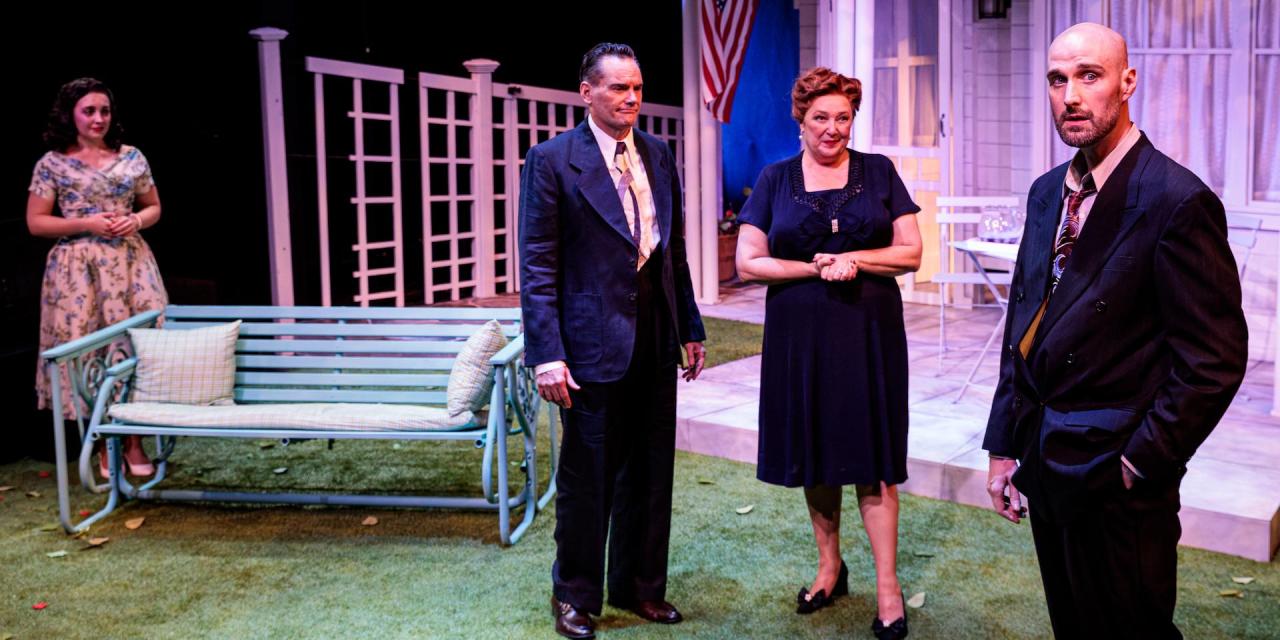
As I was reading this early play of Arthur Miller’s before attending the performance I was immediately struck by how dated the play was, not only in terms of dialogue and setting, but in terms of its moral posture. We are living in a time when here, in this country, one of the most important issues for people who will vote in the midterm elections is corruption. We hear about a new pay for play scandal almost every day.
I wondered if the production might address what purports to be a more innocent time. I’ll return to this, but first the story:
Arthur Miller’s play All My Sons, written in 1947. Joe Keller, a successful factory owner lives with his wife Kate and their son Chris. Their other son, Larry, a pilot, has been missing since the war. Kate, the mother, refuses to believe he is dead. Ann Deever, Larry’s former fiancée visits the Kellers. Chris, who has been exchanging letters with Ann, intends to propose to her, but Kate opposes the match, believing Larry will return. Ann’s father, Steve Deever is in prison for approving a shipment of cracked airplane parts that brought down 21 pilots. Joe was his business partner, but was exonerated. Steve Deever’s son, George comes to visit after many years, having just visited his father in prison (also after many years), and reveals that his father has just told him that he tried to tell Joe about the flaws in the material but that he never returned his phone call. Therefore, Joe is culpable and has been lying for years.
In addition to the play feeling dated, another difficulty with the script is that no real conflict begins until ten pages into the play. In the beginning, we get a lot of atmosphere. It reminded me of the German director, Thomas Ostermeier, who in his essay, Reading and Staging Ibsen, discussed the need to cut some of the long exposition when adapting Ibsen’s work. Though the performers acquitted themselves well, for me, all the chatting about the weather, the want ads and a little boy saying a bad word, did not add anything to the drama.
Further, there are so many plot points that are not fully developed. It was as if Miller came up with the characters and then wrote a scene showing each characteristic he wanted for each character and pasted all of them together instead of allowing the script to unfold, scene by scene, organically. A good example is when Sue Baylis, the wife of Dr. Baylis asks Chris not to live nearby because he is so idealistic that he will influence her husband to do medical research instead of the more lucrative clinical work. There is no other information in the play about how idealistic Chris is. Its sole purpose is to tell the audience that Chris is an idealist. Another example is when Chris tells his fiancée about losing most of his company of men during the war.
This is some major PTSD, yet it is only mentioned during this monologue and doesn’t seem to permeate his behavior in the rest of the play. It’s as if Miller wrote that scene to give extra motivation for Chris to be outraged by his father’s actions, but again it seems tacked on as opposed to being integrated into the narrative.
For me, the most serious flaw in the writing is the main character of Joe Keller. At the end of the play, after finding out his son Larry crashed his plane because of shame at his father being implicated in the crime, he realizes “They were all my sons.” This realization would have been more plausible had he presented with guilt, shame and self-hate for what he had done before that. The only time he talks about being conflicted at all is a short section where he tells his son that he was hoping he would have had time to stop the shipments. There’s no sense before this that he has any conflict. In fact, he boasts about being acquitted. There are no indications of cracks in his armor.
Despite my difficulties with the script, I found the performances good across the board. I found the proposal scene, with Mark Sousa as Chris Keller, and Josephine Moshiri Elwood as Ann, endearing. There was a wonderful scene between Cara Clough as Lydia and Quinton Kappel as George Deever. They were once smitten with each other. She is excited to see him again after all these years and she asks him if he wants to see her children, but he declines. It is clear in the actress’s complicated expression that she is both disappointed by his response but that she also understands that their connection is now only something that might have been. Bill Mootos’ monologue about how he came back to the neighborhood after prison was powerfully acted.
There are many considerations a theatre has when compiling a season and I am not privy to what those were for The Lyric Stage of Boston, but the choice of this play set firmly in its time period with its message about the evils of money over morality felt to me quaint, like a museum piece; something mainly of historical value. While plays by Shakespeare, Chekhov, and Ibsen still need a little interpretive help, they speak to our times in a way this early play of Miller’s, very much of its time, doesn’t. Whether through directorial intervention or written adaptation, I wanted to see this world set in relief to our own. The actors and production team were clearly skilled, so I hope that I have a chance to see them again in either a better Miller play, or just a better play. And, if a historical play, one that speaks articulately to the present moment in a way that makes us reflect on our own time.
This post was written by the author in their personal capacity.The opinions expressed in this article are the author’s own and do not reflect the view of The Theatre Times, their staff or collaborators.