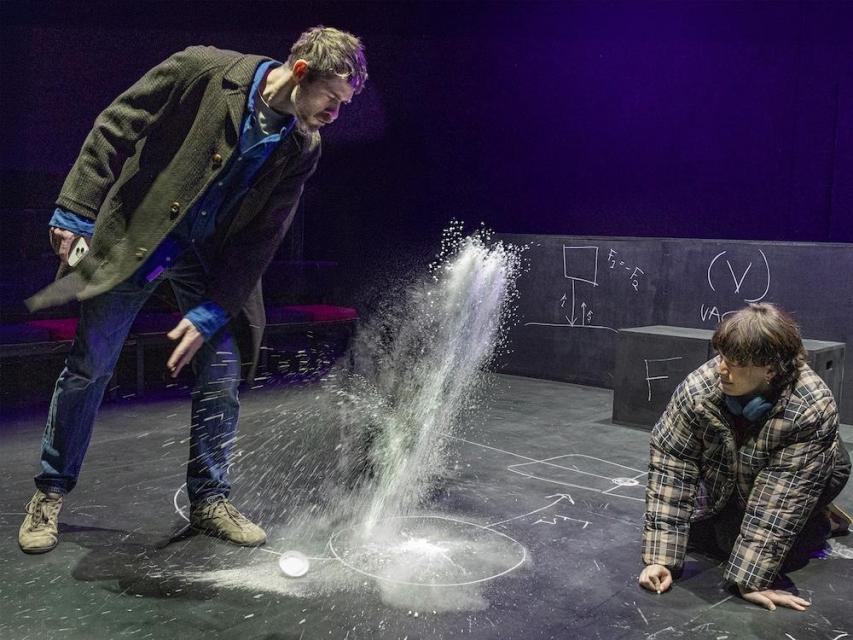
Isaac Newton does have a place in my heart. How so? Well, many years ago I was on holiday in Prague, a city where magical things happen, and just as I was talking about Newton an apple dropped from a tree above me, grazing my head. Science or magic? Or both? Anyway, Stephanie Greenwood has a similar interest in Newton’s laws of physics — and they feature explicitly in her new play, Relative Motion, which premieres at Southwark Theatre Borough, a two-hander which features the playwright as one half of a couple.
After a meet-cute on a train, Sam (Greenwood), a spiky and intelligent physics PhD student, forms a relationship with Paul, a writer who has just got an advance on his new novel. The play then charts the ups and downs of their love affair, but with a formal twist: most of the scenes between them happen on trains or the tube or train stations, those liminal in-between places when we are, as the title indicates, in motion relative to other people and to the places we have left and are arriving at. I have to say that I’m quite excited by this metaphor, with its sense of change and movement, psychological as well as physical.
At the same time, a story like this depends a lot on how the two characters are imagined. Greenwood’s Sam is an enthusiastic student and teacher, fired by ambition, at one point crushed by rejection, but always embracing the thrill of physics, not only Newtonian mechanics, but also the mysteries of dark matter. She’s close to her mother, who’s been diagnosed with cancer, has a sister Maggie and several friends including a guy named Dan. Her favourite book is Jane Austen’s Persuasion, but she’s less keen on James Joyce’s The Dubliners. When she sees a film of Persuasion with Paul, and he criticises it, she feels upset.
Compared to Sam, Paul (played by Sean Hart) is a bit less well imagined. For a start, he is more of a solitary figure, a writer who lives by himself and whose only relative is a father who suffers from Alzheimer’s. When he introduces Sam to his mates, he’s embarrassed by her friendly behaviour, but in a very exaggerated way. When she gets some difficult medical news, he reacts with no empathy. Okay, I know that this play is all about relative views of reality, but — to me at least — he seems to be so much less rounded as a character than Sam is. Is this a comment on male emotional unintelligence, or just poor playwriting?
Sadly, the playwright provides her own answer to this question: in the programme, she candidly says that Relative Motion is the first play she ever wrote, although she has had other work staged before now. She’s frank about the challenges of writing, saying she has been happier writing solo shows and that “the idea of writing dialogue terrified me: I was convinced I couldn’t do it.” Well, she can write dialogue, but that doesn’t mean that the way Sam and Paul talk to each other is always convincing. Often it isn’t. I can’t believe that they are truthfully articulating their emotions.
Perhaps this is the point. Greenwood wants to show how her characters struggle to connect with each other, and how this often results in brutal confrontations. But, as her title suggests, there’s more: she also uses Sam as a vehicle to explain Newton’s three laws of motion. These are all about inertia, force and action and reaction. The trouble is that while it seems to be an intriguing idea to map these propositions onto an account of a real relationship, it doesn’t really work. And, having chosen to do this, why confine yourself to a 75-minute format? Which means there’s not enough time to get under the skin of the characters, who remain oddly distant.
Still, the narrative of the love affair, fragmented by being composed of episodes on trains and frequently interrupted by explanations of Newton’s laws, is clear. And so is the message: initially attractive men have flaws, which sometimes you can’t see, even if others can. Coercive control emerges as a strong theme, which is not very original, even if it is powerfully portrayed here. As usual, even nice men have a violent side. Although I respect this side of the story, I’m not convinced by the psychology of the cheesy start of the affair then developing into human angst. I’m sure it happens, but not in this way. I just need to know more.
That said, Wiebke Green’s production, designed by Kit Hinchcliffe, is well put together. Instead of having Sam and Paul sitting in railway carriages, or on a crowded tube, she lets them roam over the bare stage, pausing occasionally to get a prop from a box, their distance or closeness being emotional rather than literal. Likewise, both Greenwood and Hart have a good stage presence: they interact well, especially during the more intense second half of the show when the temperature rises. But my feeling is that too much is crammed into too small a space — a bit like a typical tube journey.
- Relative Motion is at Southwark Playhouse Borough until 5 December.
This post was written by the author in their personal capacity.The opinions expressed in this article are the author’s own and do not reflect the view of The Theatre Times, their staff or collaborators.
This post was written by Aleks Sierz.
The views expressed here belong to the author and do not necessarily reflect our views and opinions.