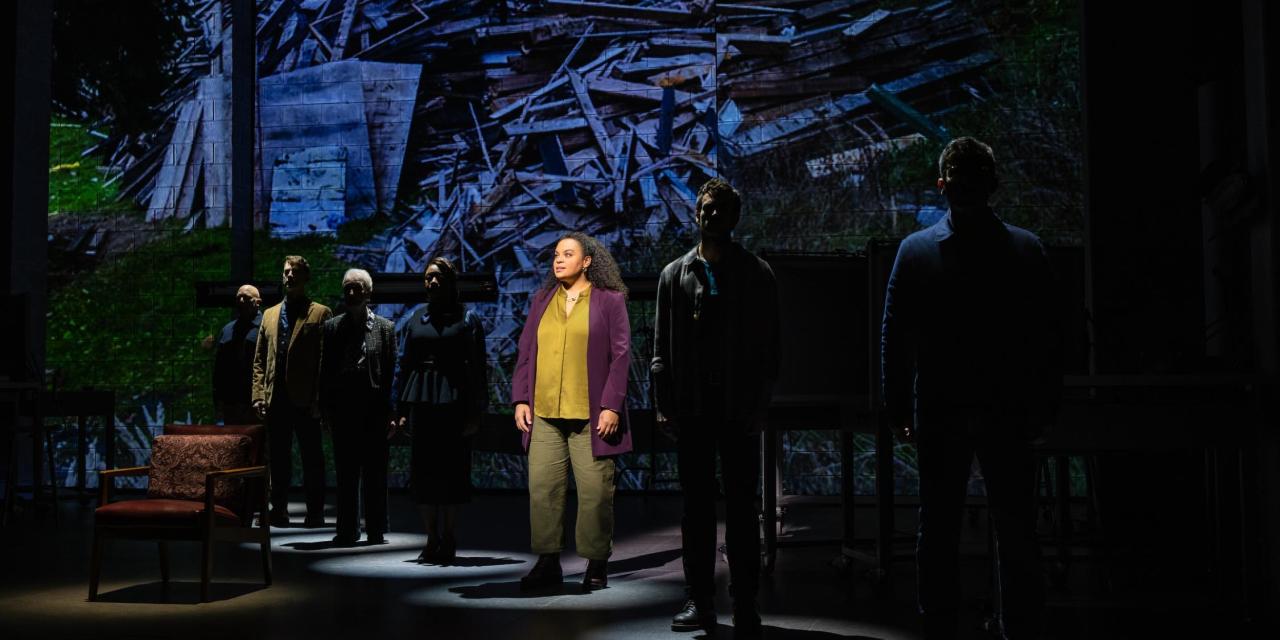
One of 2026’s must-watch plays, Here There Are Blueberries, tells the story behind a collection of Auschwitz photographs capturing the everyday lives of Nazis. The chilling contrast between these carefree moments and the unimaginable cruelty of the Holocaust lies at the heart of the docudrama.
Watching the new play by Tectonic Theater Project’s Moisés Kaufman and Amanda Gronich is like opening a matryoshka doll: each layer reveals how ordinary people become monsters.
It’s a story of Nazi officers and staff at Auschwitz who simply “did their jobs,” then relaxed in the sunshine and enjoyed blueberries. It’s a story of their descendants, forced to confront their family’s dark past and the monsters within themselves. And it’s a story of researchers wrestling with a moral dilemma: whether to expose the disturbingly ordinary, human face of evil.
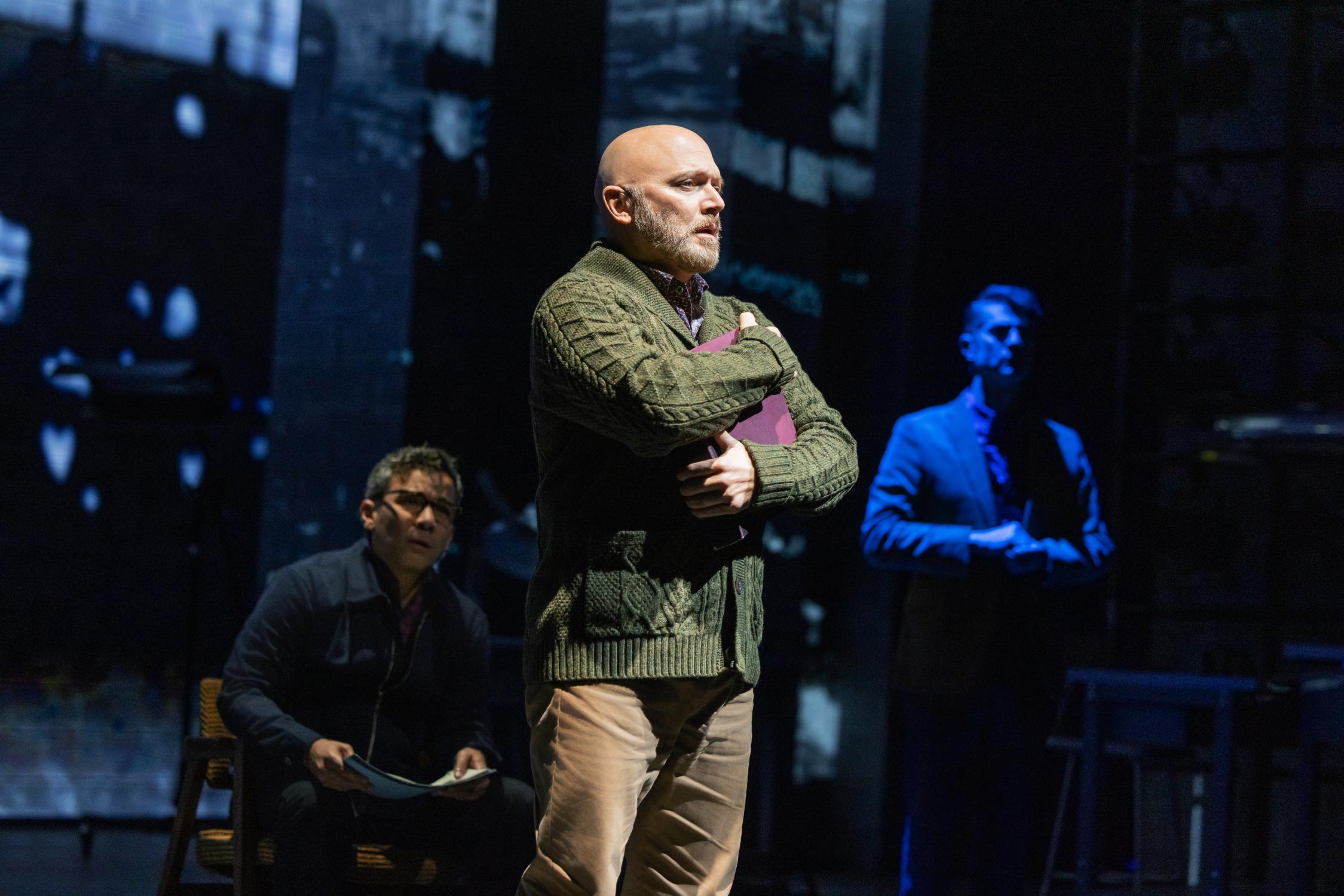
Michael Cerveris in Here There Are Blueberries, by Moisés Kaufman and Amanda Gronich, conceived and directed by Moisés Kaufman, at Barrymore Theatre. Photo credits: Matthew Murphy.
The play, based on the real events, begins in 2007, when a photo album arrives at the U.S. Holocaust Memorial Museum in Washington, D.C. Archivist Rebecca Erbelding (Delia Cunningham) begins investigating its origins.
What initially appears to be a collection of ordinary snapshots turns out to be a rare visual record of the private lives of Nazis at Auschwitz.
The photographs, constantly shifting and reappearing in the background, show Nazi officers and young female SS auxiliaries laughing, relaxing, and enjoying the countryside scenery.
The images invite the audience to examine every detail. Every smile, every casual interaction becomes unsettling in light of the horrors unfolding just beyond the camera’s frame.
The album belonged to Karl Höcker, an SS officer who served as adjutant to the commandant of Auschwitz. As Erbelding and her colleagues investigate, the collection raises a troubling question: Should a Holocaust museum display photographs that humanize the perpetrators?
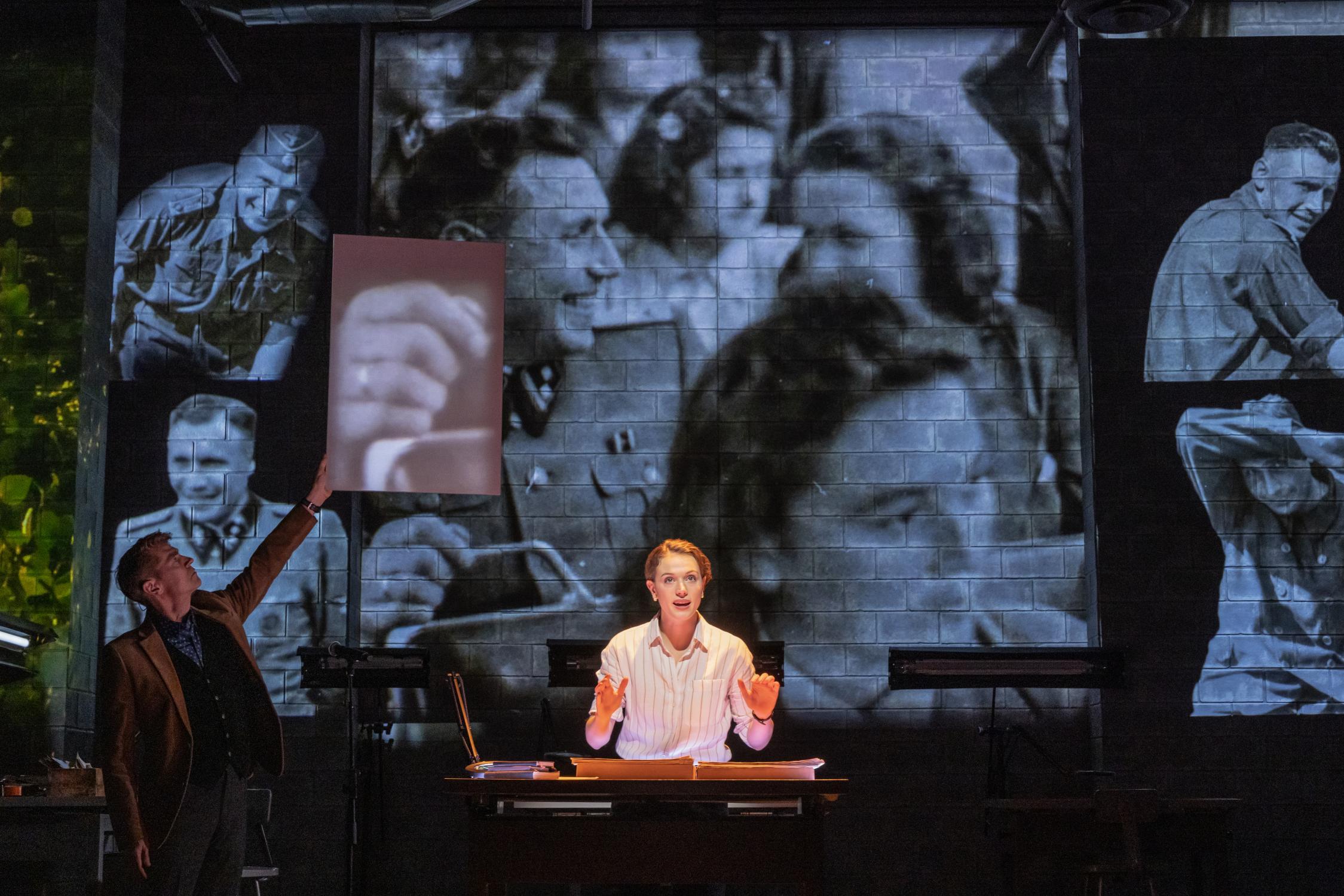
Delia Cunningham in Here There Are Blueberries, by Moisés Kaufman and Amanda Gronich, conceived and directed by Moisés Kaufman, at Barrymore Theatre. Photo credits: Matthew Murphy.
Museum officials Judy Cohen (Kathleen Chalfant) and Sara Bloomfield (Montego Glover) debate the danger of portraying Nazi officers as ordinary people.
The investigation takes an unexpected turn when German businessman Tilman Taube (Conrad Ricamora) recognizes his grandfather, Heinz Baumkötter, among the Nazi officers pictured. He confronts his family’s dark past, seeking answers and reaching out to other descendants to hear their stories.
In one of the play’s most chilling moments, Taube recalls his grandfather reminiscing with a twinkle in his eye that those were the best years of his life.
Brandon Flynn portrays Rainer Höss, grandson of Rudolf Höss, the commandant of Auschwitz. He grows up filled with anger and rage, but the prospect of becoming a father forces him to change.

Brandon Flynn in Here There Are Blueberries, by Moisés Kaufman and Amanda Gronich, conceived and directed by Moisés Kaufman, at Barrymore Theatre. Photo credits: Matthew Murphy.
Höss realizes that believing cruelty is genetic would mean embracing the very ideology that justified Nazi atrocities. His story offers one of the play’s few moments of hope: we can choose who we become.
Here There Are Blueberries challenges the comforting assumption that those who commit atrocities are fundamentally different from the rest of us. But can there be good in evil? The play offers no easy answer.
One of the most powerful responses comes from Peter Wirths, whose father, Eduard Wirths, was the chief SS doctor at Auschwitz.
Wirths recalls how his father improved sanitary conditions, fought a typhus epidemic, and was credited with saving thousands of prisoners’ lives. Yet he was also among the doctors who selected arriving prisoners for forced labor or the gas chambers.
Delia Cunningham in Here There Are Blueberries, by Moisés Kaufman and Amanda Gronich, conceived and directed by Moisés Kaufman, at Barrymore Theatre. Photo credits: Matthew Murphy.
Years later, standing on the same railway ramp where his father had made those life-and-death decisions, Wirths asked himself what he would have done in his place. His answer was devastating: “When a train comes, throw yourself on the tracks.”
For Wirths, his father’s acts of compassion could never outweigh his participation in mass murder or his role in sustaining a system of unimaginable evil.
Here There Are Blueberries is a disturbing reminder that evil does not always wear a monstrous face. As the audience is moved to tears, the most unsettling question is not how ordinary people could commit extraordinary acts of cruelty, but what happens when cruelty is normalized.
This post was written by the author in their personal capacity.The opinions expressed in this article are the author’s own and do not reflect the view of The Theatre Times, their staff or collaborators.
This post was written by Victoria Zavyalova.
The views expressed here belong to the author and do not necessarily reflect our views and opinions.