
Juan Mayorga began writing El jardín quemado (The Scorched Garden) in 1996, completing it the following year. Close to thirty years on, Mayorga directs it at Madrid’s Teatro de la Abadía. It’s the fourth of his plays he’s staged there since taking over the artistic directorship of the theatre in 2022 – he presented La colección (The Collection) in 2024 and Los yugoslavos (The Yugoslavs) in 2025. A Mayorga production of a Mayorga play feels like a welcome annual event at the Abadía.
El jardín quemado is set in the late 1970s as Spain is negotiating its transition to democracy. This is the island of San Miguel where promising young medic Dr Benet has come to visit Dr Garay, an experienced psychiatrist she much admires, who oversees a specialist mental health facility. The sound of a ship’s horn and the sound of seagulls suggest a coastal location. The arrival of an outsider, Benet, is the catalyst for the unravelling of a series of secrets held within the institution – secrets that Garay has protected, but which Benet is keen to unravel and expose as injustices. Garay wants to keep things as they are. This is in many ways a classic conflict play, with an outsider coming in to question the established order. There is unity of time, place and action which keeps the argument focused. Crucially, however, El jardín quemado is also a wider allegory of Spain’s transition to democracy.
Elisa Sanz’s set offers a near empty stage with a tree stage left; two seats rest under the tree. A bench stage right. It’s a space that has a sense of anonymity, difficult to pin down. Its openness is a signal not to read this play too literally. Juan Gómez-Cornejo’s lighting provides pockets of action – Garay’s office, the coastline where Benet encounters the enigmatic Periquito who poses as a statue in a type of performance gesture, the scorched garden where inmates play.
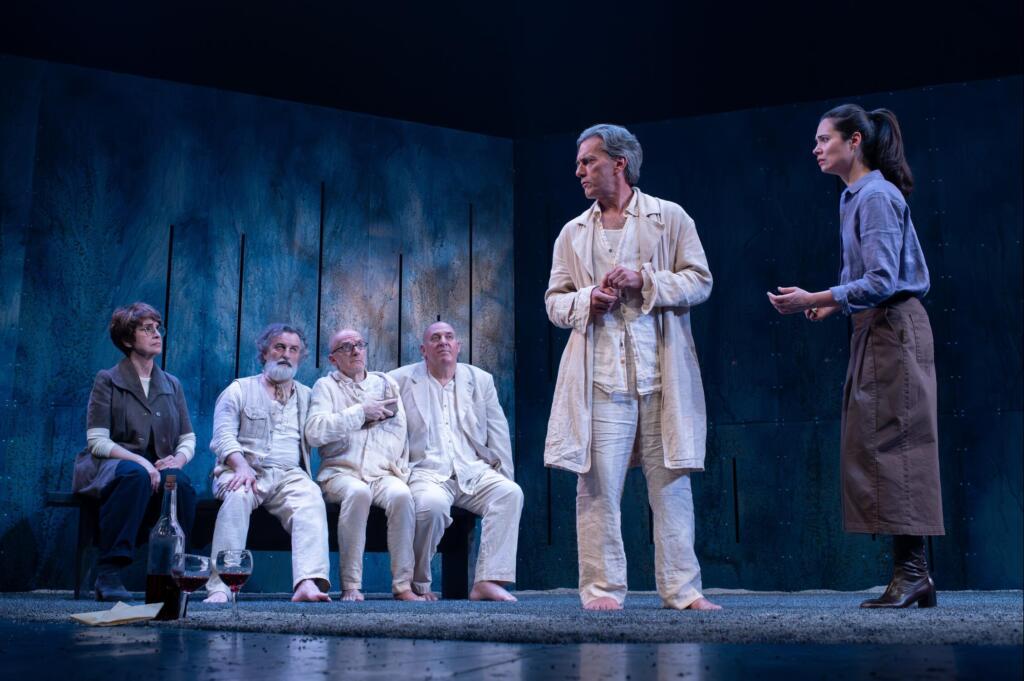
The patients are caught between Dr Garay and Dr Benet in Juan Mayorga’s El jardín quemado (The Scorched Garden). Photo: Javier Naval
At the core of the play is the mystery of what happened to twelve healthy men who were institutionalized during an unspecified war. The twelve patients whose unknown pasts so fascinate Benet are objects that are fought over. Each of the doctors may claim to see them as subjects but each want to impose their version of what needs to be addressed. The four patients the audience see float across the stage like ghosts. Dressed in white, they wander as like lost children: Osvaldo breeds imaginary dogs. Calatrava, sings opera to an imagined audience while Nestor and Pepe are trapped in an endless game of chess (with an invisible board and pieces) that has no beginning or end. All are Quixotic figures who seek refuge in imaginary worlds, curiously disengaged from their environment. The lone tree that rests in the garden with a few oranges, suggests something of Beckett’s Waiting for Godot. The men wait not knowing what is to come. They might also be a reincarnation of Segismundo, the Prince of Poland of Calderón’s Life is a Dream who doesn’t understand the boundaries between the real and the imagined. They don’t speak of their pain or their situation, but their presence dominates the stage and while they may not be as vocal as Garay or Benet, Mayorga makes them in many ways the pivot of the play.
Early scenes between Benet and Garay navigate pleasantries, but these are soon put to one side. Benet wants to suggest some changes for the running of the institution. Garay keeps trying to change the conversation. Garay has run the institution since the civil war and feels a responsibility to the men in her care. Benet wants to know what happened in the past – she wants to “uncover” the truth, convinced that the twelve men were political prisoners shot by opposition forces during the unnamed war. But each of these women hold a different version of the truth and the men refuse to provide any kind of answers. Benet and Garay’s increasingly heated debates, rooted in suspicion rather than trust, provide a veritable contrast to the dreamlike demeanour of the patients.
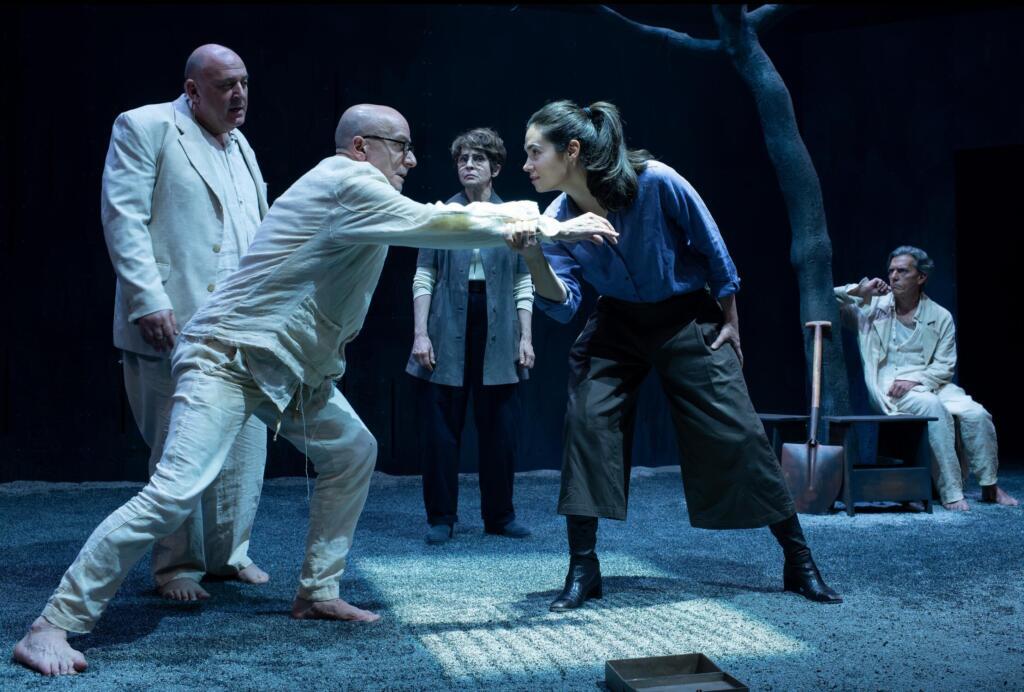
Confrontation in Juan Mayorga’s El jardín quemado (The Scorched Garden). Photo: Javier Naval
Benet is insistent she wants answers; she presses and persists: what happened to the poet Blas Ferrater who was one of the twelve patients? She is keen to look forensically through the archives to search for clues, but the past cannot be reconstituted. Garay advocates for forgetting: “Deje a los muertos enterrados” (Leave the dead buried). Benet can’t do that. At a time when the debates around the unmarked mass graves of the Spanish Civil War, including that of the poet and playwright Federico García Lorca, remain so prescient, Mayorga’s play provides a means of reflecting on issues of memory, exhumation and history. Blas Ferrater might be seen as a proxy for Lorca, a disappeared poet that functions as a symbol of what was lost with the coup d’état that led to the Civil War, but this is no simplistic parallel. There are indications that Blas may have harmed and disfigured Periquito. Did he disdain his working-class colleagues in the institution? Who can we believe? The poet that Benet so idolises may not have been such a kind person. Idols rarely live up to the expectations placed on them.
There is nothing to immediately suggest the location is Spain – the island is unnamed, there are references to a civil war, rather than the Spanish Civil War, but as in the work of Antonio Buero Vallejo, the context and conversations leave little doubt that this is a play about Spain’s past and its continuing impact on the present. Mayorga’s changes to the text are subtle but important. References to Spain (to the Battle of the Ebro or the dictatorship) have been cut; there is no exhumation – just words that signal and suggest.
Indeed, this is a play that will not give up its mysteries: were the men placed in the institution to protect them from the forces of the right? Were they effectively kept as political prisoners? Or were they in need of help? Mayorga has described this as a play about the “grey zone” – the uncertainties of what can never be known. Garay and Benet each hold on to particular certainties, but their inflexibilities lead to an impasse where collaboration and concessions seem increasingly impossible. At a time when political positions seem increasingly rigid, El jardín quemado makes a case for listening and the possibilities of what it might mean to compromise. What is worth fighting over and why?

Dr Benet (Loreto Mauleón) and Dr Garay (Adriana Ozores) in Juan Mayorga’s El jardín quemado (The Scorched Garden). Photo: Javier Naval
Adriana Ozores and Loreto Mauleón are excellent as the warring doctors – both roles initially conceived as male. Ozores is younger than the elderly figure that was conceived in the original 1997 draft. She imbues Garay with a jovial quality, a sense of a woman at ease in her role who knows how to keep the authorities at bay. There may not be demonstrative compassion but there is care, resilience and a sense of pragmatism. Her approach doesn’t cut much success with the more restless and impatient Benet, who charges in filled with ideas that she will not budge on, and who will not take no for an answer.
This is a philosophical play, one where the staging invites us to listen with care and empathy. Mayorga directs to keep the pacing consistent and unhurried. Jaume Manresa’s score – percussive music almost operating like a metronome to keep time – encourages the audience to pay attention to what they hear. Mayorga doesn’t give us a theatre of action; his is a dramaturgy of contemplation and reflection – one where the nuances of language come to the fore. Where Garay sees a garden, Benet sees a patio – the same space conjures a different reality for each woman; and it is in the negotiation of these differences that our capacity for empathy lies. This is a tragedy that carries the weight of Spain’s recent history without ever opting for cathartic closure or an easy ending. Navigating a difficult past isn’t easy. Mayorga’s theatre reminds audiences of the complexities involved in navigating a grey zone where absolutes rarely provide an effective strategy towards reconciliation.
El jardín quemado runs from 27 May to 12 July at Teatro de la Abadía, Madrid, then touring.
This post was written by the author in their personal capacity.The opinions expressed in this article are the author’s own and do not reflect the view of The Theatre Times, their staff or collaborators.
This post was written by Maria Delgado.
The views expressed here belong to the author and do not necessarily reflect our views and opinions.