An interview with Mrs. Gabriela Abrasowicz (Slavist, translator, and theatre scholar, Poland).
Gabriela Abrasowicz is a Polish Slavist, translator, and theatre scholar. She graduated from the Faculty of Philology at the University of Wrocław, Poland. In 2015, she completed her PhD dissertation entitled Drama of the Body, the Body in Drama: The Works of Serbian and Croatian Women Playwrights (1990–2010) under the supervision of Professor Magdalena Koch. She is also the author of the monograph of the same title, dedicated to contemporary women’s dramatic writing in Croatia and Serbia, examined through the perspectives of body anthropology, gender studies, and feminist criticism (ATUT, Wrocław, 2016), as well as the book (Trans)positions of Ideas in Post-Yugoslav Drama and Theatre, 1990–2020 (University of Silesia Press, Katowice, 2021). She has published numerous scholarly articles presenting the results of her research into transcultural practices in post-Yugoslav drama and theatre production. At the University of Silesia in Katowice, she completed the research project (Trans)positions of Ideas in Croatian and Serbian Drama and Theatre (1990–2020): A Transcultural Perspective, funded by the National Science Centre in Poland. Until 2021, she worked at the Department of Literary Theory and Translation at the University of Silesia in Katowice. In 2018, together with Professor Leszek Małczak, she organized the international scholarly and artistic conference From Mobility to Interaction: (Re)visions of Dramatic Writing and Theatre in Yugoslavia and New Theatre Productions in Bosnia and Herzegovina, Montenegro, Croatia, Kosovo, Macedonia, Slovenia, and Serbia, which gathered prominent scholars and artists from the region. She has participated in numerous conferences in Poland and abroad, collaborated on international theatre projects (Polish-Serbian Theatre Dialogue; Performative Balkans; Woman, Drama, Performance – Between Post-Socialism and Post-Feminism), and taken part in theatre festivals throughout the region. She also collaborated on the publishing project Five Contemporary Polish Plays with the Croatian ITI Centre. She translates dramatic texts from Croatian, Serbian, Bosnian, and Montenegrin into Polish. Together with Leszek Małczak, she edited anthologies of plays translated into Polish, including the collection of contemporary Croatian texts (Not Only) Fragments [(Nie tylko) fragmenty, 2019] and the anthology of recent Bosnian and Herzegovinian drama Wake Me When It’s Over (Obudź mnie, gdy to się skończy, with Martyna Lechman, 2020). She has translated into Polish plays by Croatian authors such as Ivor Martinić, Tomislav Zajec, Goran Ferčec, Lana Šarić, Diana Meheik, and Dina Vukelić, as well as the dramatic cycle Monovid-19 and plays for young audiences. In 2021, she translated Darko Lukić’s book Introduction to Applied Theatre (published by AST, Kraków, 2021). More recently, her translation of Montenegrin plays Open Ending (Otwarte zakończenie, with Magdalena Koch and Leszek Małczak, 2023) was published. Her translations have received awards at international competitions, including Aurora, the Bydgoszcz Dramaturgy Award (2022 and 2023), and EURODRAM 2021. In 2022, she was a resident of the translators’ program in Gdańsk organized by the Institute of Urban Culture. She collaborates with the Polish theatre journal Dialog, the Mieczysław Hertz Theatre Institute Foundation in Łódź, the Centre for Children’s Art, the Croatian ITI Centre, Sterijino pozorje, and the MESS Festival. She was also a member of the research platform Theatrum and the Laboratory for Transcultural Research into the Theatre and Drama of Post-Communist Europe. Gabriela Abrasowicz also completed studies in pedagogy and special education and works as a speech therapist with people with developmental difficulties.
Ivanka Apostolova Baskar: Gabriela, your work moves between languages that were once politically entangled and emotionally wounded. When you translate a contemporary playwright from the former Yugoslav space into Polish, do you translate only the text or also the silence, the scars, the historical fatigue hidden beneath the words?
Gabriela Abrasowicz: First of all, thank you for the invitation and for the opportunity to have this conversation. For the past fifteen years, I have been translating post-Yugoslav plays and theatre scripts. I consider this work a secondary occupation alongside my everyday “real” job, which is entirely unrelated to theatre or, in other words, a kind of stepping stone and a deeply rewarding passion project. I have become so immersed in it that I sometimes forget just how fascinating these projects are and how remarkable their outcomes can be. In the beginning, my work focused primarily on analyzing and critically examining contemporary and emerging drama from the countries of the former Yugoslavia. As a result, I have always approached both the text itself and its broader cultural and historical context with great awareness and sensitivity. I’m not sure I can define a single, fixed strategy for translating plays. In fact, I rarely translate sitting at a desk. For me, translation is usually a complex and layered process. It involves extensive research, engagement with other cultural texts books, films, and visual arts numerous conversations and consultations, and, once the translation is complete, continued efforts to promote it and establish its place within theatre circles.
IAB: You are known not only as a translator, but almost as a theatrical agent of dramatic voices, someone who manages to bring Balkan playwrights into Polish theatres with unusual speed and precision. What transforms a translated drama into a stageable event? Is it craftsmanship, instinct, ideology, timing or dramatic seduction?
GA: Today, I cannot imagine translating a play and then simply leaving it to fend for itself. During the translation process, I invest myself fully in the work. Moreover, a unique bond and often a genuine affinity usually develops between the playwright and me, which gives me a strong sense of responsibility to continue supporting the translation and actively seek opportunities for its dissemination. At the beginning, I was feeling my way in the dark to some extent. Fortunately, along the way I met many exceptionally generous and supportive people whose advice I listened to with great care. In many cases, I operate independently across various spheres academic, theatrical, and publishing and have built my own network of trusted contacts and reliable professional connections. In Poland, however, I collaborate primarily with ADiT (the Drama and Theatre Agency), whose involvement significantly enhances a play’s visibility and increases its chances of both publication and theatrical production. Within the region, I have found my strongest institutional support in HC ITI, the organizer, among other initiatives, of the Croatian Theatre Showcase and the publisher of the journal Kazalište. Its president, Željka Turčinović, has an exceptional understanding of the specific challenges involved in promoting dramatic texts abroad and is remarkably collaborative in her approach.

Photo credits: Gabriela Abrasowicz.
IAB: Many translators remain invisible. Yet in your case, the translator becomes a cultural strategist, even a dramaturgical agent. How do you personally understand the role of the “translator-agent” in contemporary European theatre? Can a translator shape an entire theatrical canon inside another country?
GA: I have the privilege of usually selecting the texts I translate myself, and I do so with great care, guided by my aesthetic sensibilities, convictions, and occasionally by intuition and personal impulse. I very rarely work on commission. This means that from the outset I am emotionally invested not only in the translation itself, but also in ensuring that the work finds its place within a new cultural environment and becomes embedded in the imaginative landscape of another culture. The plays I choose are neither excessively hermetic nor detached from their specific local contexts. Consequently, there is usually a strong possibility that at least some of them will successfully enter Polish cultural life, enrich it in meaningful ways, and ultimately serve as a catalyst for new artistic projects. The visibility and status of translators are gradually improving. We are increasingly asked to provide photographs, biographies, and even interviews; we are invited to book launches and promotional events as experts. I firmly believe that translators are among the most attentive and analytical readers of a text: we know every corner of it, every strength and every weakness. Our names appear more frequently alongside those of the authors on book covers and in promotional materials, which also gives us greater room to maneuver. We influence the life of a translated work within the cultural sphere. Moreover, some translators who actively promote the literary and artistic works that are at the center of their interests can justifiably be regarded as cultural ambassadors. Their role is to challenge and dismantle stereotypical perceptions of particular literatures, cultures, and mentalities. At least, that is how I perceive my own work. I believe that a translator should be both a partner and an advocate for the author, and that is precisely the way I strive to operate. The question of the canon is a particularly complex one. On several occasions, I have attempted to present Polish audiences with representative panoramas of dramatic writing first through anthologies of Croatian drama, and later through collections of Montenegrin, Bosnian-Herzegovinian, and Serbian plays for children. It was an extraordinarily demanding undertaking, and satisfying all expectations seemed virtually impossible. Ultimately, the selection of a corpus of texts is crucial. Although I pay close attention to developments, interests, and demands within the Polish theatre scene, I have learned to trust my intuition. Sometimes this leads me to make choices that may initially appear unconventional; I may simply be captivated by a particular theme or dramatic form. The results can be remarkably rewarding. Several of the plays I have translated have gone on to inspire successful stage productions as independent projects in various theatres, for example, works by Tomislav Zajec, Tanja Šljivar, and Ivona Marciuš. Others have been “rediscovered” by directors quite by chance a decade after publication, as happened in the case of Ivor Martinić.
IAB: In your academic and critical work, you often explore responsibility, violence, memory, post-Yugoslav identity, and the body in theatre. Do you feel that contemporary Balkan drama still writes from trauma or has it already entered a new phase beyond war and fragmentation?
GA: This form of revisiting and reconstructing the past should serve to make the present more comprehensible and more constructive, regardless of the painful memories involved. In this sense, confronting the past, addressing both personal and collective traumas, and critically reactivating history through selected plays and performances carry profound cultural significance. Personally, I have been particularly drawn to works in which themes such as violence and war are not presented explicitly, but rather resonate subtly in the background. Such experiences shape the behavior of the characters, influence their life choices, and inform their processes of identity formation and self-discovery. The question, however, remains: is any real step forward truly possible? Unfortunately, history has a tendency to repeat itself, and different parts of society continue to confront new manifestations of violence while being forced to process new traumas. This is happening not only within individual societies, but also on a broader European and even global scale. In my view, the regional theatre director Oliver Frljić demonstrates this condition with exceptional clarity in his theatrical projects. He skillfully diagnoses the most painful fault lines within a given society and deliberately provokes confrontation with deeply sensitive and unresolved issues.
IAB: Polish audiences have a strong theatrical tradition and a demanding theatrical intelligence. Which themes from Serbian, Croatian, Bosnian, or Montenegrin drama resonate most deeply with Polish spectators today? And which themes remain culturally “untranslatable,” no matter how good the translation is?
GA: At one point, I had the impression that Polish directors and audiences were saturated with “Balkan” themes, as our cultural landscape was dominated by films and books focused on war, genocide, and post-war realities. I should, however, note that this tendency has been shifting in recent years, partly because such tragedies, unfortunately, are occurring in our immediate neighborhood, which has led to a renewed interest in different perspectives on these phenomena. Polish audiences tend to remain particularly drawn to family narratives and to stories in which ordinary characters reflect on broadly understood notions of identity national, cultural, and gender identity alike. I would also say that Polish recipients appreciate subtle humor and bold formal experimentation. Of course, it is always a challenge to transpose onto a new cultural ground the ethnic, mental, and cultural distinctions that, in the original context, are embedded at the level of language or detail such as clothing, customs, or gestures, which are immediately clear and self-evident to audiences in the Balkans. Translating such nuances always requires a great deal of creativity and non-obvious translational solutions. But honestly, it is precisely this kind of challenge that makes engaging with such texts worthwhile.
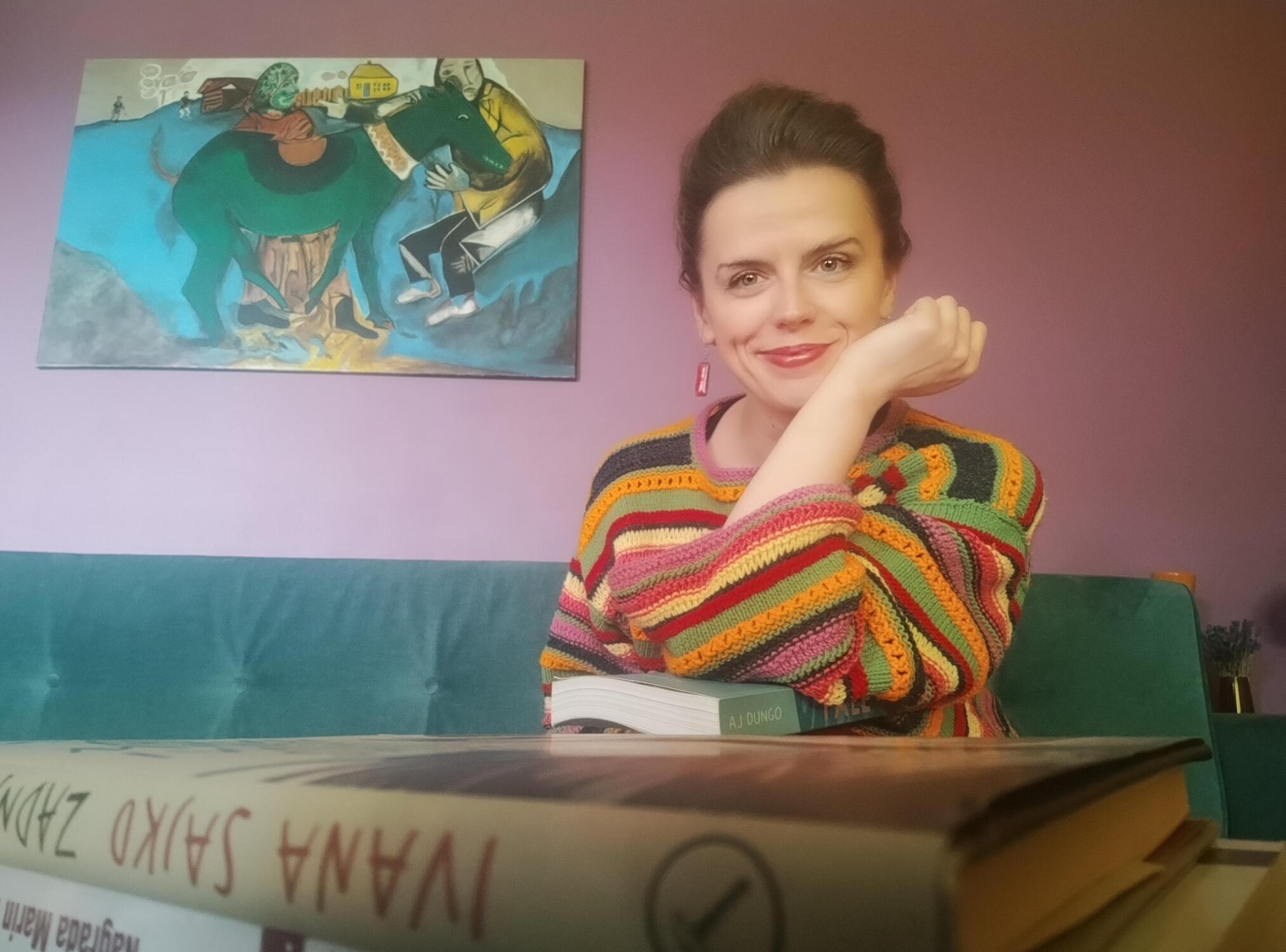
Photo credits: Gabriela Abrasowicz.
IAB: Your collaboration with organizations such as the Croatian ITI Centre and ADiT places you inside a living ecosystem of contemporary European dramaturgy. From your perspective, what distinguishes the ex-Yugoslav playwright from other European playwrights today? Is there a specific rhythm, cruelty, irony, or poetic instability that defines the region?
GA: The space of the former Yugoslavia functions as a complex multi-zone of contacts and represents a unique laboratory in which transfer under the influence of new impulses has acquired a powerful capacity for hybridization. These processes encompass not only the mixing of different materials, approaches, media, artistic practices, and technologies, but also the dynamics of interpersonal relations. It is precisely these intra-regional influences and turbulences, combined with specific experiences and rich traditions, that generate new qualities which, in my view, fill a certain gap within European dramatic writing. I, for example, observe in this network many shared points of reference and clear lines of development, and I believe that it is precisely these that define the strength of its dramatic and theatrical production. This engaged form of artistic creation serves as a space in which social, historical, and personal truths intersect. It is permeated by contemporary theoretical frameworks that describe the reality surrounding us (on a supra-local level) and represents an attempt to confront the cultural heritage of this region. Contemporary drama in the region emerges as a document of social transformation, a reflection of political attitudes and philosophical beliefs, while at the same time possessing an inherent capacity for intervention. Thanks to a radical qualitative renewal, ex-Yugoslav drama in the 21st century has become a form better suited to artistic expression linked to social engagement, one that does not confine itself to ready-made solutions for ordering the world, but instead compels readers and audiences to make an intellectual effort in order to more fully understand the issues presented.
IAB: When you choose an author to translate, what do you search for first: theatrical architecture, political courage, linguistic innovation, emotional danger, or something impossible to define rationally? Which qualities make you immediately trust a playwright?
GA: When I look back today at the texts I have chosen to translate, I am unable to identify a single common denominator. At times, the selection was impulsive. I read extensively; many playwrights send me their texts, and they also often recommend the work of their colleagues. Good sources include, for instance, the website drame.hr and the journals Kazalište and Scena. In my case, I have sometimes become interested in a text after seeing a particular performance at a showcase or festival.
IAB: You have written extensively about female dramaturgy, violence, and performative resistance in post-Yugoslav theatre, do you think women playwrights from the Balkans are still read in Western and Central Europe through exoticism and wounds instead of through artistic complexity?
GA: As a researcher, I have devoted a significant amount of time to analyzing women’s dramatic writing, in an effort to identify its most distinctive characteristics. It is not even primarily a question of themes (which are often related to corporeality), but rather of a specific way of interpreting reality and of particular methods of artistic articulation. At present, the gender of the playwright is not a decisive factor for me. I support women authors by translating their work, but I do not do so in a programmatic or deliberately strategic way. However, in my plans and imagination I often return to an old idea: preparing and publishing a regional anthology of plays written exclusively by women. I have not given up on it. Perhaps one day…
IAB: Theatre today competes with algorithms, distraction, and accelerated attention spans. Yet contemporary Balkan drama often remains intellectually dense, politically uncomfortable, and emotionally brutal. Do Polish theatres still have the courage for discomfort? And does the audience still have patience for ambiguity?
GA: The plays I particularly value those with unconventional structures, ambiguity, and those that address contemporary issues through reference and suggestion are not particularly commercial (as you will probably have guessed). This is highly demanding and often unsettling material, both for theatre practitioners and for audiences. In my view, theatre is meant to unsettle us and push us out of our comfort zone into a zone of learning. I am very curious to see how the forthcoming collection of post-dramatic and poetic dramatic texts by the Croatian writer Ivana Sajko, which I am currently translating, will be received in Poland. It is scheduled to be published at the end of the year so, fingers crossed!
IAB: Finally, after years of translating, researching, and mediating between cultures, what has contemporary ex-Yugoslav theatre taught you about Europe itself? Does theatre still possess the power to create genuine transnational intimacy, or are we merely translating each other’s loneliness and disorientation into new languages?
GA: Drama and theatre from the former Yugoslav region have taught me that the only constant value is change and mobility (in various dimensions both literal and symbolic). Such dynamic processes are a defining feature of our time. I view theatre projects and plays as attempts to confront different phenomena and challenges. It is difficult to predict the consequences of these artistic activities, not only in the region, but more broadly. Nevertheless, I hope to continue being pleasantly surprised and to remain fully engaged with work.
IAB: Thank you very much, dear Gabriela Abrasowicz.
Wroclaw/Zagreb/Skopje 2026
This post was written by the author in their personal capacity.The opinions expressed in this article are the author’s own and do not reflect the view of The Theatre Times, their staff or collaborators.
This post was written by Ivanka Apostolova Baskar.
The views expressed here belong to the author and do not necessarily reflect our views and opinions.