For the second time in two years, a flashy, big-budget Romeo and Juliet has opened in New York that’s so bent on pleasing one particular target audience with shallowly conceived staging gimmicks that its storytelling is hopelessly muddled.
Late 2024 brought us Sam Gold’s teen-centric, gender-fluid “Romeo + Juliet” at Circle in the Square, set in a high-energy music club accessorized with stuffed animals. The gimmicky premise there was that a bunch of angsty and disaffected young people had broken into a Broadway theater to “get something off their chests” by performing Shakespeare’s play (as Rachel Zegler, who played Juliet, explained to Jimmy Fallon). The reason these kids were so driven to enact this particular play was decidedly obscure—though banners in the lobby suggested voter turnout was central: “The youth are voting/Voters of tomorrow/Romeo + Juliet.”
Now we have Saheem Ali’s production at the Delacorte Theater in Central Park, performed in both English and Spanish (translated by Alfredo Michel Modenessi). This version is set in “Nueva Verona” where a realistic replica of the U.S.-Mexico border wall spans the stage with giant white statues of the Virgin Mary and a Day-of-the-Dead skeleton peering over it from behind (design by Maruti Evans). The Capulets are English-speaking xenophobes who employ a thuggish militia dressed like Italian fascists. And the Montagues are scrappy, bilingual, opposed to the wall, and allied to a curiously unassertive crew of anti-ICE activists.
The topicality of all this primes us to expect some cogent mapping of the play’s family feud and tale of forbidden love onto America’s toxic, present-day immigration politics. But that’s not what we get. The immigration crisis, it turns out, is just for vibes.
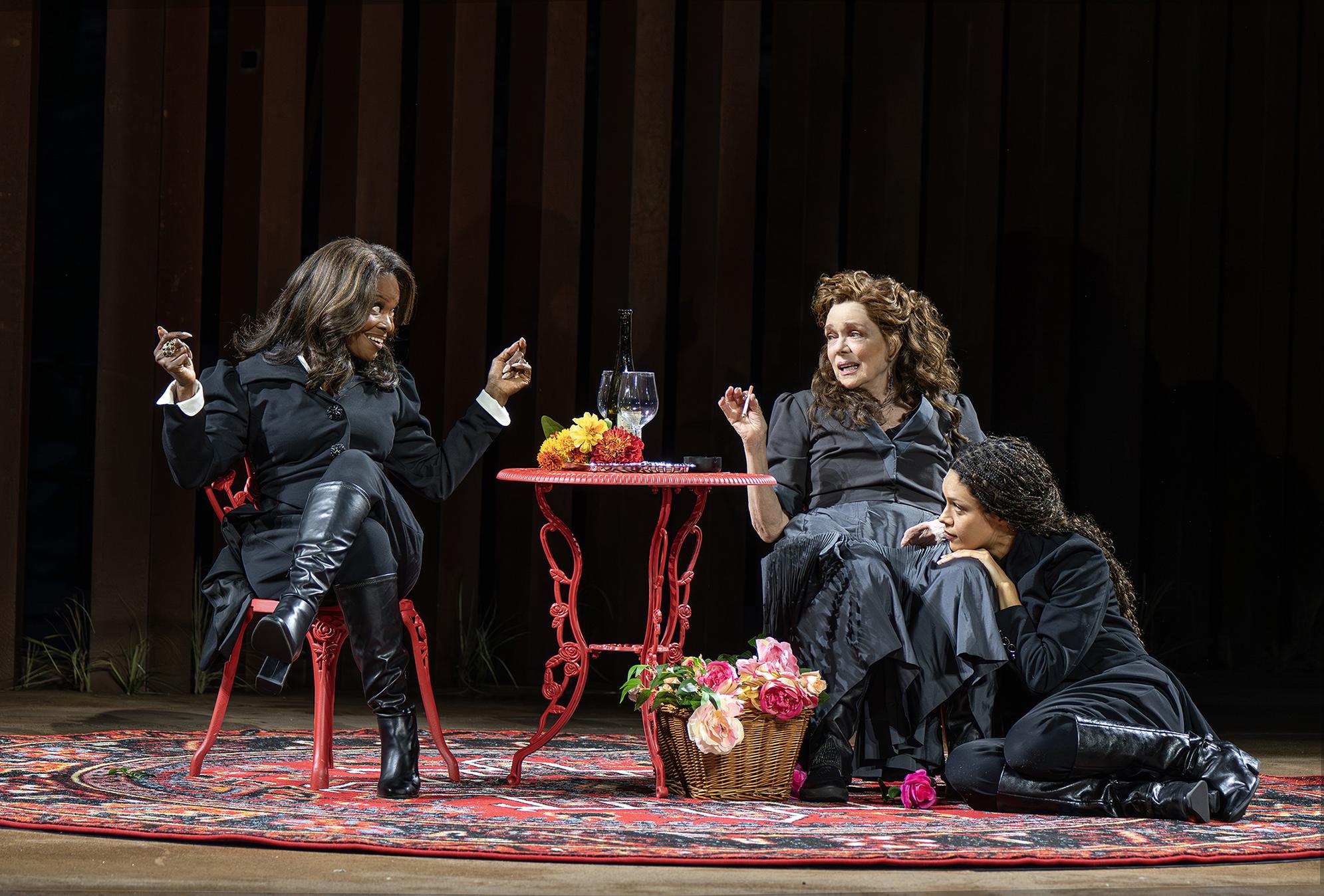
LaChanze (Lady Capulet), Deirdre O’Connell (Nurse), and Ra’Mya Latiah Aikens (Juliet). Photo: Joan Marcus.
No careful thought seems to have gone into aligning the story with the politicized setting. Nor do we ever learn why one family is cast as villainous and the other as virtuous—a judgment Shakespeare doesn’t make. Painting the story’s “ancient grudge” as a struggle of black against white (or red against blue) no doubt seemed like an easy way to magnify the stakes and heighten the lovers’ obstacles, but its main result is confusion.
It’s never clear, for instance, where Nueva Verona is supposed to be. Are we on the U.S.-Mexico border? And what are this city’s rules? Its leader, Prince Escalus, is a woman (played by Jessica Pimentel) with the power to order execution and banishment, but she evidently has no armed guards and, still more peculiar, seems oblivious to the Capulet’s black-clad fascisti, who patrol the wall like authorized border guards. Is this woman really in charge or not?
The play’s central plot complication is, famously, a gang “brawl” in which Juliet’s cousin Tybalt kills Romeo’s best friend Mercutio, and then Romeo impulsively kills Tybalt. Ali for some reason doesn’t stage this scene as a brawl, but rather as a pair of abrupt, cold-blooded shootings with handguns. A small band of ICE-protesters looks on and cowers while the very individual violence occurs. One consequence of the change is that the Prince has no reason to say “Where are the vile beginners of this fray” when she rushes on. Another is that Mercutio has no reason to say “A plague o’ both your houses” as he dies (the comment is usually seen as resentment that Romeo hesitated to fight).
Confusions and absurdities of this kind arise every few minutes. The balcony scene, for instance, takes place on a high platform that suddenly opens up in the border wall, presenting Romeo with a fascinating climbing challenge but leaving us baffled about living arrangements.
The Apothecary who sells Romeo poison in Mantua (played by Rachel Crowl) insists that she’s taking this illegal action, punishable by death, only because she’s poor. Why then is she dressed in an elegant coat? She’s also curiously sloppy about safety, readily accepting Romeo’s gold necklace as payment instead of the cash the script specifies. Wouldn’t such a shady character know that his jewelry will be easily traceable to her after his body is found?
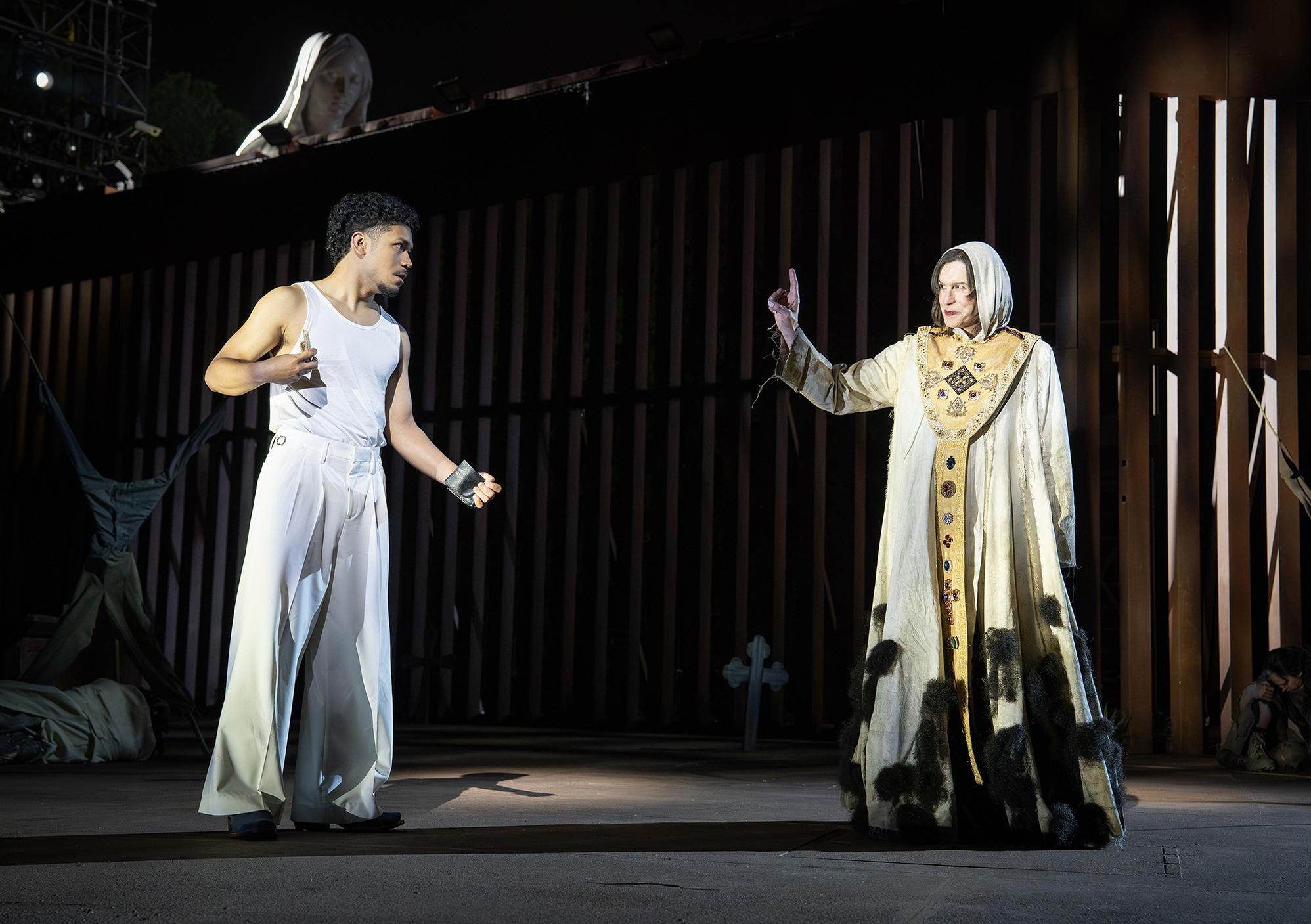
Daniel Bravo Hernández as Romeo and Rachel Crowl as the Apothecary. Photo: Joan Marcus.
There’s no need to go on, though it should be said that this production’s text is also part of its clarity problem. Hundreds of lines are exclusively in Spanish, including all the intimate scenes with Romeo and Juliet, so only those audience members who are thoroughly bilingual can understand everything and feel wholly included. (The production has supertitles but they aren’t translated.)
A kind word is due to the actors. Frances Jue brings poise and dignity to his earnestly avuncular Friar Lawrence. Caleb Joshua Eberhardt is charming as a goofballish Mercutio more interested in clowning than fighting. And Deirdre O’Connell’s wine-swilling, chain-smoking Nurse is a droll cameo. As for Romeo and Juliet, both Daniel Bravo Hernández and Ra’Mya Latiah Aikens are bright and charismatic youngsters who could no doubt shine in a production that made sense.
This one, alas, is an egregious misfire, and I have a hunch that Saheem Ali knows that because he goes to great trouble to add a distracting gimmick at the finale. Each night a real-life couple from the audience dashes onto the stage during the curtain call to re-affirm their vows with Friar Lawrence. Sweet. The Freudian in me can’t help seeing this as a rather transparent effort to take the audience’s minds off the 3-hour artistic fiasco they just sat through.
The point I would stress about Ali’s Romeo & Juliet is that it fits a troubling recent pattern in the Public Theater’s Free Shakespeare offerings. I’m fine with well-thought-out concepts, but numerous Delacorte productions over the past decade have sacrificed clarity for notoriety and highjinks, straining for broad appeal with facile topicality. There was Oskar Eustis’s 2017 Julius Caesar, for instance, whose Caesar and Calpurnia were made up to resemble Donald and Melania Trump. And Daniel Sullivan’s 2019 Coriolanus, which dressed its rampaging plebeian Roman mobs as Brooklyn hipsters.
Showing us how these 400-year-old dramas still have relevance is one thing, but condescending to us by low-rating our intelligence and interest in Shakespeare is another. The Public should have more respect for its public than that.
By William Shakespeare
Spanish translation by Alfredo Michel Modenessi
Directed by Saheem Ali
The Delacorte Theater in Central Park
This article appeared in TheaterMatters on June 26, 2026, and has been reposted with permission. To see the original article click here.
This post was written by the author in their personal capacity.The opinions expressed in this article are the author’s own and do not reflect the view of The Theatre Times, their staff or collaborators.
This post was written by Jonathan Kalb.
The views expressed here belong to the author and do not necessarily reflect our views and opinions.