Dedicated to the 40th anniversary of the world premiere
The idea for the musical Chess belongs to the British author, lyricist, and dramatist Tim Rice. The events of the Cuban Missile Crisis of 1962 served as the trigger for the project, whose artistic concept was to depict the confrontation between the USA and the USSR. While working on the script, Rice decided to present the competition between the two political systems through a chess match between Russian and American grandmasters for the world championship title. Tim Rice attended special meetings with Anatoly Karpov and Viktor Korchnoi, legends of the chess world who later formed the collective image of the Russian grandmaster Anatoly Sergievsky. The American participant was based on the image of Bobby Fischer.
Tim Rice made a special visit to the USSR in the early 1980s. He invited Benny Andersson and Björn Ulvaeus to collaborate on the music, and other members of the legendary music band ABBA participated in the recording of some songs as part of the first concept album. In the original cast album recording, the role of the Russian grandmaster was played by Tommy Körberg, his lover Florence by Elaine Paige, and the American by Murray Head. Listeners immediately fell in love with two singles – One Night in Bangkok, and I Know Him So Well – which quickly took their place among the top compositions of the British and American hit parades. Successful album sales, the London Symphony Orchestra’s “Chess in Concert” tours of European capitals, and a documentary film (Jacob Dahlin) created all the preconditions for a successful theatrical release.
In 1986, the musical premiered at the Prince Edward Theatre in London. Trevor Nunn directed the production and included the original cast. The musical enjoyed a successful run on the West End for nearly three years. In 1988, the Broadway premiere took place, for which the book [initially written by Richard Nelson] was significantly revised to appeal to American audiences. The musical score was also revised. However, the project didn’t last long.

Chess the Musical, Broadway, Original Production 1988/ (L)-Philip Casnoff as Freddie Trumper, (C)-Judy Kuhn as Florence Vassy, and (R)-David Caroll as Anatoly Sergievsky/ Photo Credit by Martha Swope
From the early 1990s to the present, there have been national tours in the UK and the US, as well as several international productions in Austria, New Zealand, Germany, Hungary, South Korea, and Japan. The most recent in this series was a Russian adaptation. Before the collapse of the USSR, the musical Chess was officially banned in the country and condemned in absentia by critics as “anti-Soviet.” It was only in 2020 that a licensed production of Chess in Russian premiered in Russia, running for over a year and receiving a warm reception from audiences and acclaim from journalists.
In the four decades since the world premiere of the musical Chess, many significant events have occurred: the USSR ceased to exist, the confrontation between the two political systems ended, and the Cold War seemed to be a thing of the past.
Tim Rice, creator of the musical Chess, discusses what future he envisions for the musical in this new world reality. [*The interview took place before the 2025 Broadway revival.]
Lisa Monde: In Russia, the success of the musical Chess surpassed that of the first Broadway production, in terms of the number of performances played, if you look at it. Do you think that Сhess would be relevant once again in Russia, or has its time passed?
Tim Rice: Сhess, the musical, was set during the Cold War, but the war was kind of in the background. It was a big hit in Russia until quite recently. When the Ukraine War broke out, we were still running. We hadn’t seen it. We went to Moscow to meet the cast, the director, and everybody involved, which was great. But that was in, I think, February 2020 or something. And then COVID-19 struck. So, the reason we couldn’t go and see the opening night was the pandemic that took over the world. And then we were thinking about when we might go and see it once COVID was over, but then the war broke out. Russians stopped caring about COVID, and the show ran anyway for about a year or longer. When the war started, we realized we couldn’t make money out of a commercial run in Russia. But the Russian cast and producers were very passionate about the show and convinced us to keep the show running there. So, we said: “If you want to continue or you want to stop it, it’s entirely up to you, but we won’t take any more money from it.” We would be getting quite good royalties from it, but we said we wanted all the royalties donated to the Ukrainian cause, which happened, and the show ran for another year. I never saw the production there in person, but I’ve seen lots of YouTube videos of bits of it, and it looked good.
When it comes to the relevance of the show currently. The relevance is neither here nor there, in a way, to what’s going on in the papers, as opposed to in real life.
LM: Will current events taking place in the world somehow influence the new productions of the musical Chess, in terms of new additions or changes to the script?
TR: When the musical was written, it was already “looking back”; I mean, it was set in 1975, even though it’s always been a bit vague when it was set. But now, 50 years have passed. It works much better now, I think, as a period piece. And if there is a message, it’s how politics will always try to muscle in on anything successful. This is what happened with the Fischer vs Spassky chess tournament. I mean, I’m not that interested in chess as a game. But the idea of it: it’s a wonderful story because Bobby Fischer was the shit, and yet he was our guy. And the Russian guy was really nice, Spassky. So not only did we have East versus West involved, we had nice guy versus nasty guy, but the West guy was the nasty guy. That’s wonderful. You couldn’t make it up. So, we used it in our story.
LM: Is the story told in the musical more about interpersonal relationships than politics?
TR: I think it’s all about human nature. That’s why Shakespeare still works today. It’s about human characteristics. And Chess, I’m not saying Chess is up there with Shakespeare… but it’s the way the characters react to the situation, and the fact that their love lives, their personal lives, their ambitions are often thwarted by events beyond their control. And human nature is in the way they treat each other, the way they react. That’s what Сhess is attempting to be about. And that’s not affected really by anything else. So, yes, I’m sure people will say: “Wow, we better do Сhess now because of the relevance” … or probably more likely: “ Oh, we better not do Сhess now because of what’s going on politically.” But it’s got nothing to do with that, really.
LM: How would you rate the Russian production?
TR: Well, it was apparently very good. I mean, I’ve got one or two Russian fans, you know, who’ve loyally written to me over the years. And what I heard from them was that it was going well. And when we went to the launch, which we did go to just before COVID, we met the cast, and they sang half a dozen or more of the songs to us, and they sang them really well. The audience, a very large one, went bananas.

Chess the Musical, Russia 2020-2021/ (L)-Alexander Sukhanov as Anatoly Sergievsky, (C)- Denis Demkiv as Arbiter, (R)- Alexander Bobrov as Freddie Trumper/ Photo Credit by Yuri Bogomaz, Lyubov Shemetova
LM: Was the Russian production closer to the original London production than the first Broadway one?
TR: Overall, yes.
LM: The Russian version eliminated a whole series of songs—five or six—and even “missed” one character, Walter. The story is told from the perspective of Anatoly Sergievsky, through the prism of his memories. How do you feel about these changes?
TR: It’s a great score no matter what. I mean, forget the words because I didn’t understand the words; they were in Russian. But I knew what the song was about, obviously. The melodies, God, they’re brilliant. I didn’t write them. I’m not playing my own trumpet here. It’s a great privilege to work with Benny and Björn [Benny Andersson and Björn Ulvaeus, composers]. I mean, listen to the Аnthem!
LM: Indeed. For the Russian production, obviously, the successful translation was done by Alexey Ivashenko. Do you know if there were any adjustments to the text to make it closer to Russian realia, allowing the audience to better understand certain things?
TR: I don’t know. I imagine that was the case. We had quite a few meetings with the director, and it seemed to me that since there’ve been so many versions of Chess, the musical has been mucked around with too much. I think the story, as per the original cast album, is the simplest. But the Russian team seemed to be very enthusiastic. They had great singers and a great orchestra. And to be honest, I didn’t think it was necessarily going to be a hit, but it was a big hit.
LM: I read an interview with the director of the Russian production, Evgeny Pisarev. I found it interesting that he said that the musical Chess “divides the audience in two and forces you to take sides. The audience is constantly making moves. Like in the chess game.” [** Novaya Gazeta, No. 116, October 21, 2020, author’s translation]. Would you agree with this statement?
TR: The trouble is, people don’t want too much politics in a show. I’m a bit worried about different versions, you know… When you start throwing in too much politics and ambiguous lines with heavy meaning…you lose the main idea, what this show is all about. This musical is about people and how they’re affected by what is happening in the world around them and the standards set by the world. The rest doesn’t really matter.
LM: The show’s run in Russia was truly a success, with over 600 performances! And this was despite the difficult times for the theatre industry during the COVID-19 pandemic years of 2020/2021. I think this is the biggest success for your favorite musical in the last decade. Do you think this can be attributed to the project’s authenticity for Russia?
TR: Аfter West End, it was the second-longest-running version. And it’s played in lots and lots of places. But the fatal thing is that people always think they can improve it. If you alter it once, then everybody thinks, “Oh, I can alter it as well, I can make it better. I can set it in, you know, Hawaii or something.” It’s been set in New York; it’s been set anywhere and everywhere.
LM: A Broadway revival is being prepared for the musical’s anniversary. What surprises await audiences, especially those familiar with the old version?
TR: Yes, there’s a plan for Chess to come back to Broadway in 2025. And the Shubert Organization is very keen to do it. I think it could work. I mean, it was a bit of a disaster the first time around, but the storyline was changed so much. And also, it gets updated all the time. It was set originally “in the present day”, which was bonkers. So, we get all the terrible news… the Berlin Wall’s about to come down, you know… because it made the story irrelevant.

Chess the Musical, West End, 1986/ (L-R)-Tommy Körberg as Anatoly Sergievsky, Siobhan McCarthy as Svetlana Sergievsky, Elaine Paige as Florence Vassy, Murray Head as Freddie Trumper/ Prince Edward Theatre, London/ Photo Credit by Donald Cooper/Alamy
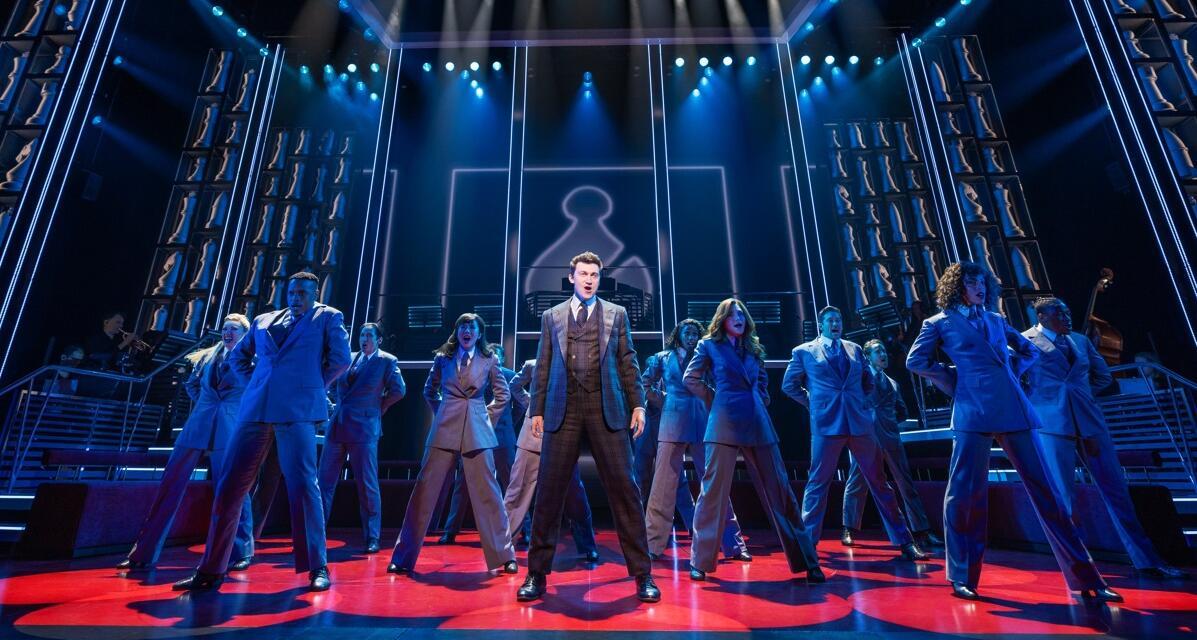
The revival of the musical at the Imperial Theatre on Broadway is preparing to close after a seven-month run. What worked and what didn’t?
The new book, written by Danny Strong, has received the most criticism, as has the minimalist approach to the production (Michael Mayer). This seems completely unfair. The original West End and Broadway productions, like the Russian version, had some differences in their plot lines. However, Tim Rice’s central idea is certainly recognizable. Representatives of two different worlds – grandmasters from Russia and the USA – are fighting for victory, but the price of the latter turns out to be greater than a place on the podium. Its components are duty, love, integrity, and kindness. Each character values these feelings and concepts individually. Viewers see beautifully developed characters, nuanced inner-world transformations of all the main characters, and the logic of their actions. It doesn’t matter where the directors relocate the international chess tournament, or when they do so. And, who played the role of the reigning World Champion? What techniques did the KGB agent and the American champion’s agent use to “work” their charges? As Tim Rice rightly said: “It’s all about human nature.” And the audience, leaving, thinks not about one character being “good” and another “bad” or the outcome of the battle between good and evil, but about the fact that all the characters in Chess are simply “pawns” in Someone Else’s Game. The key to a pawn in any situation is to make the right move. Otherwise, checkmate is inevitable… It’s only a matter of time.
The attempt to modernize the action on stage doesn’t distort history in any way. All the “relevant” jokes are very delicate and facilitate understanding and appreciation. Considering that the main action takes place during a chess competition, the set can’t be criticized for its minimalism. In any musical, even if it’s not initially programmed for spectacle, the most important thing is the story and the quality of its delivery. There are no complaints about the performers – Lea Michele (Florence Vassy), Aaron Tveit (Freddie Trumper), Nicholas Christopher (Anatoly Sergievsky), and Hannah Cruz (Svetlana Sergievsky): they coped with the task brilliantly.
Even though Nicholas Christopher’s appearance doesn’t exactly evoke a Cold War-era Russian, and Hannah Cruz is visibly not “from the USSR,” the emotions they convey on stage remove all doubts about the casting (Jim Carnahan, Janson Thinger). Bradley Dean, as KGB agent Alexander Molokov, played the “bad guy,” adding an inappropriately operetta-like quality to the show. The image of the intelligent, empathetic, and “committed” Soviet intelligence officer, as he originally appeared in the British version (John Turner), would obviously have fit just as well into the dramaturgy of the production. And Bryce Pinkham’s performance as the Arbiter successfully added color to the original character (Tom Jobe).
Many of the most famous musicals tackle sensitive political themes. Shows that use global upheavals—revolutions or wars—as their backdrop are rare: Les Misérables depicts the French Revolution of the late 18th century, Doctor Zhivago depicts the 1917 Russian Socialist Revolution, Cabaret – the rise of the Nazi power in Germany on the eve of World War II, Miss Saigon depicts the Vietnam War, and Chess depicts the Cold War. The further away in the past the events themselves are, the less contemporaries know about them. These shows are especially valuable and deserve renewed attention from contemporary directors and producers because their stories remain relevant. Clearly, today is not the best time for a gripping political thriller based on real events that took place over half a century ago. Back then, the military and political crisis between the US and the USSR brought the world within a hair’s breadth of nuclear apocalypse. Even today, those relations are hardly “cloudless.” Hopefully, as the musical celebrates its 50th anniversary, audiences at the latest revival of Chess will be unburdened by the current political negativity in US-Russian relations and will embrace the story as it was intended: about human nature, not politics. And one of the best arias, Anthem, will again feature lyrics that were written specifically for the 1988 Broadway production:
“…We are one united family, Black and White.
The game, our one true guiding light
Sweeping through the darkest corners to eхpress
Countries, classes, creeds as one in love of chess.”
***
P.S. Be sure to see the musical Chess—you won’t regret it! And if fate brings you to Stockholm, Sweden, and you decide to visit the ABBA Museum, stop by the room dedicated to the musical Chess: there’s so much to learn about the show and its creation!
This post was written by the author in their personal capacity.The opinions expressed in this article are the author’s own and do not reflect the view of The Theatre Times, their staff or collaborators.
This post was written by Lisa Monde.
The views expressed here belong to the author and do not necessarily reflect our views and opinions.