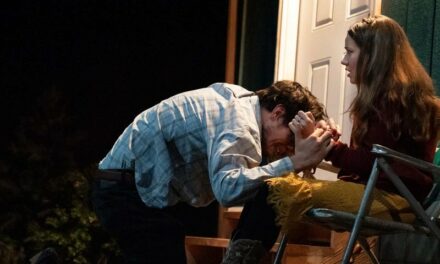
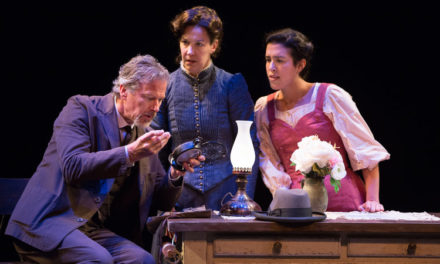
Seats have long been sold out for this production of Shakespeare’s The Tempest, which brings iconic actor Kenneth Branagh back to the RSC (Royal Shakespeare Company) after a thirty-year hiatus. Shakespeare buffs from all over the world have been keen to see the show, and the audience in the packed theatre on the evening I was there was a mix of overseas tourists and Brits from all over the UK. Branagh, along with an outstanding cast, did not disappoint.
Well known director Sir Richard Eyre, no newcomer to Shakespeare, is only now making his Stratford debut with what is probably the last complete solo play by Shakespeare. He has chosen to highlight the postcolonial aspects which in today’s world cannot be ignored; Caliban, Ariel, and the spirits are played by black actors. The magic and illusion of which Prospero, the magus, is master, are enhanced by Bob Crowley’s set, Akhila Krishnan’s video design, a musical score by Akintayo Akinbode and Stephen Warbeck’s music which carry us into a faraway world.
The Tempest, directed by Sir Richard Eyre. Royal Shakespeare Company. Photo credits: Johan Persson.
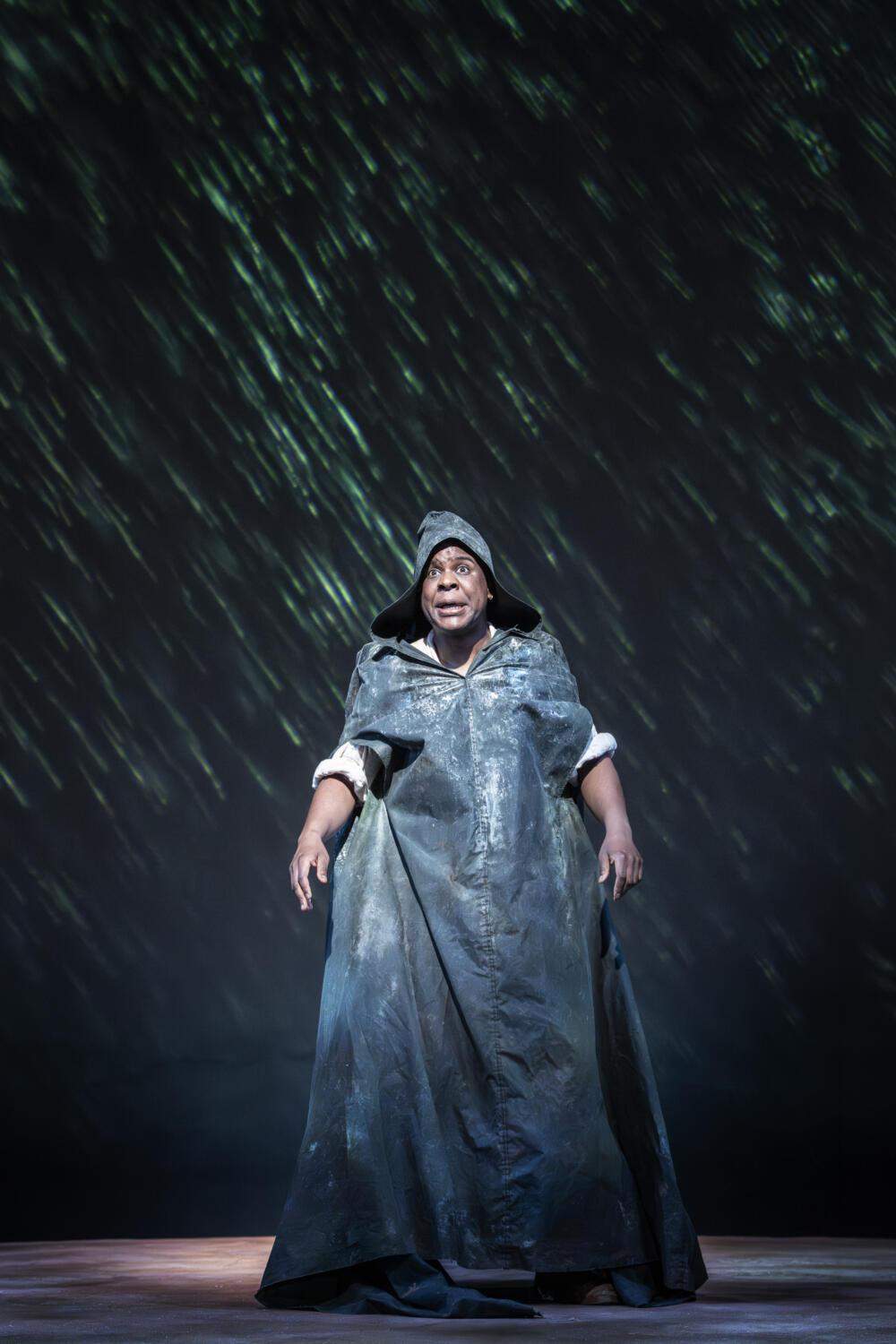
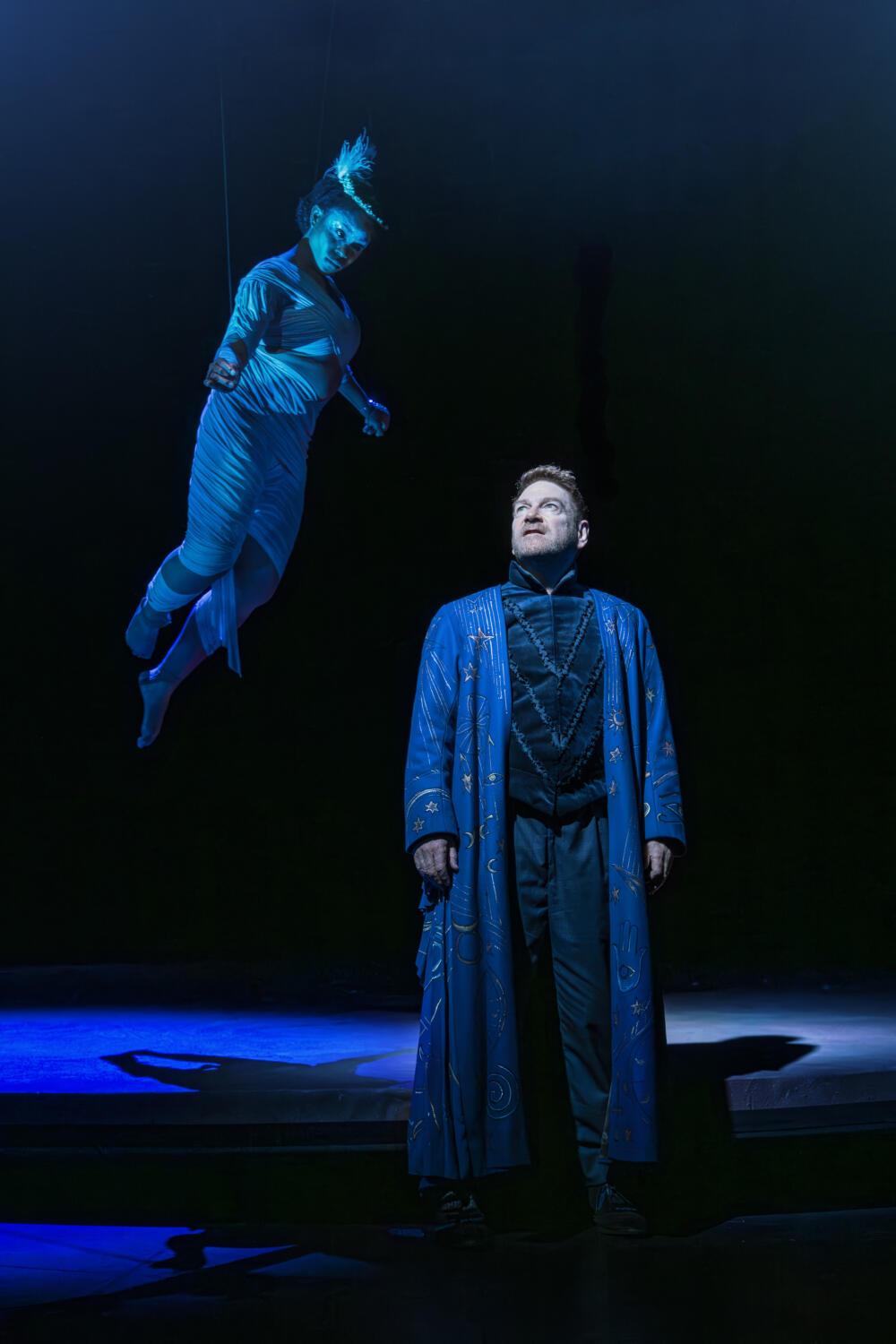
Kenneth Branagh enters a dark, empty stage, pulling on a blue gown, embroidered with magical symbols, and casually taking his position downstage in front of a music stand. An orchestra director-cum magician, he wields a baton – that might be a wand – to vehemently conjure a sea-storm. After twelve years spent on a remote island, the usurped Duke of Milan is about to get his own back on his roguish brother Antonio. And what a storm it is; thunder and lighting, loud music, and back-screen projections turn it into a truly perilous experience for the royals and the ordinary sailors who are hurled across a madly tilting stage.
Still, this dramatic, highly charged scene quickly gives way to a quiet exchange, between Prospero and his young daughter Miranda. Differently from other productions I have seen, the daughter-father relationship brims with playful banter. A feisty Miranda cajoles her father into telling her about their life before their arrival on the island. He complies, delivering the verse with speed and great clarity, as if this moment is what he has been craving since they left Milan all those years before. He delights in detail, painting a word picture of them being rushed at midnight through a city gate by Antonio’s men, and after shipped out to sea on a rotten carcass of a boat, so awful that even the rats quit it. The scene ends with Prospero silently casting a spell on Miranda, who instantly falls asleep, only to be magically and surprisingly levitated high above the stage.
The Tempest, directed by Sir Richard Eyre. Royal Shakespeare Company. Photo credits: Johan Persson
Richard Eyre’s interpretation of Ariel and Caliban, respectively, the spirit and native of the island, is likewise surprising. Shakespeare’s androgynous spirit Ariel, played by Amara Okereke, in this case is a very feminine presence, who sometimes comes on to Prospero. A trapeze artist, she floats and dances exuberantly above the stage until almost the end of the play, steering much of the action from her vantage point. Okereke’s magnificent voice, moreover, infuses the well-known songs in the play with new life. Towards the end, her take on “Where the bee suck there suck I” manages to charm the often-melancholic Prospero. Prompted by Ariel’s “on the bat’s back I do fly/ After summer merrily”, a dreamy look covers his face as if he is remembering the sensuality of an Italian summer’s day.
Caliban (Ashley Zhangazha), whom Prospero accuses of being a monster, and a ‘savage and deformed’ slave, in this production is good-looking, well-spoken (after all, he did learn his English from the royal couple), and clever. As he plots to kill his master, with the two Neapolitan servants, Stephano (Guy Henry) and Trinculo (Keir Charles), he spits out the wine that Stephano plies him with, so staying sober and in control of the situation. While Stephano and Trinculo’s antics recall a nineteenth-century music hall sketch, Caliban remains composed. In the closing moments of the play, once Caliban has asked Prospero for grace, the now reinstated Duke of Milan makes the surprising gesture of placing his blue mantle round the shoulders of his former slave, thereby acknowledging that the man is indeed king of the island.
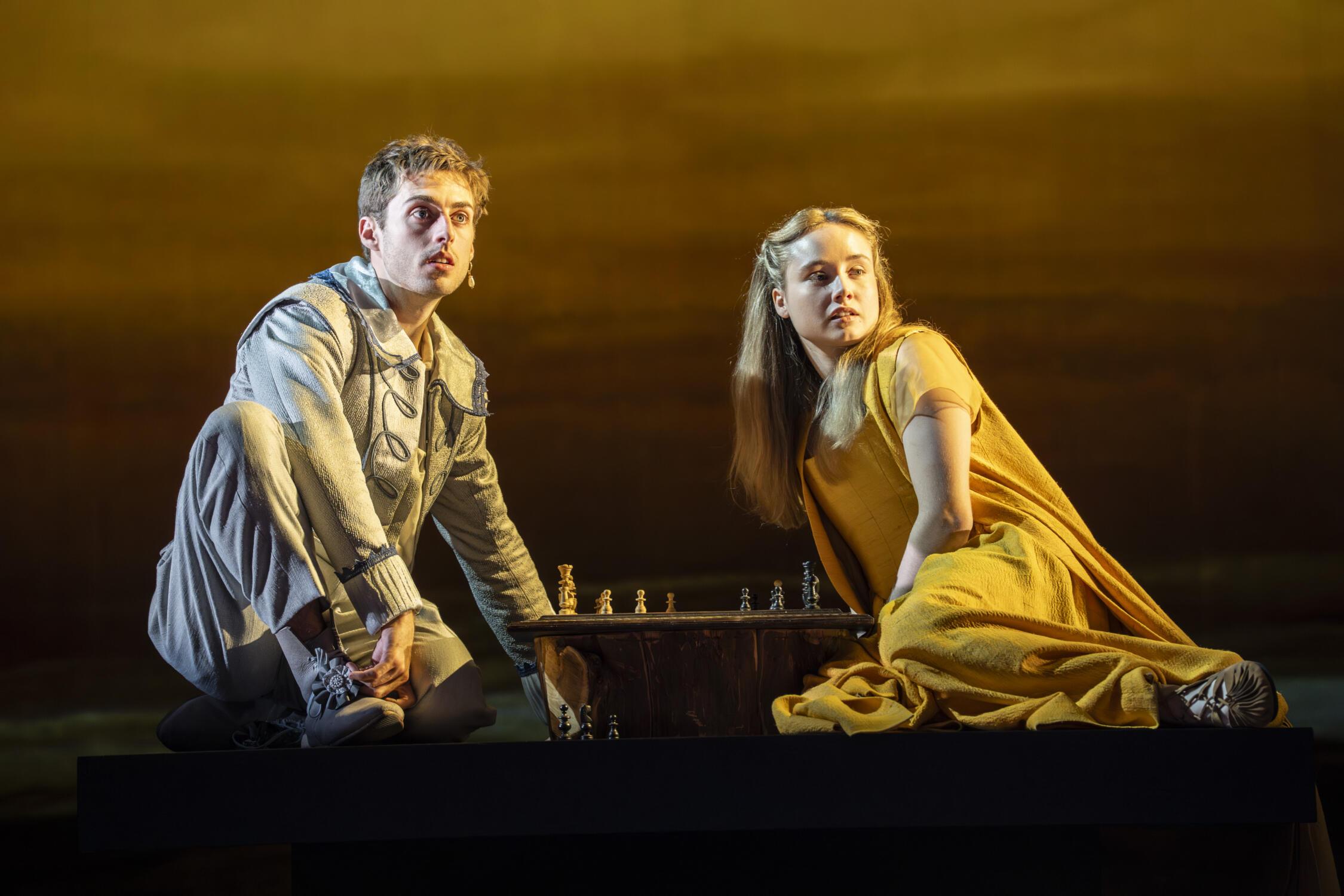
The Tempest, directed by Sir Richard Eyre. Royal Shakespeare Company. Photo credits: Johan Persson.
The first encounter between Miranda (Ruby Stokes) and young Ferdinand, Prince of Naples (Fred Woodley Evans) is full of humor rather than sweetly romantic. The minute Ferdinand sets eyes on Miranda he tries out ridiculous, over the top gestures to communicate with her, behavior which highlights his youthful naivety. She responds, by boldly rushing towards him and making no bones about her wish to marry him immediately. Dressed in beautiful Tudor inspired, white and silver costumes, the two are very soon married, instead of having to wait until their return to Naples as Shakespeare imagined. All this while, Prospero’s moody shadow never leaves the stage, observing the couple, and determinedly stopping them from consummating their marriage before it has been officiated in Naples.
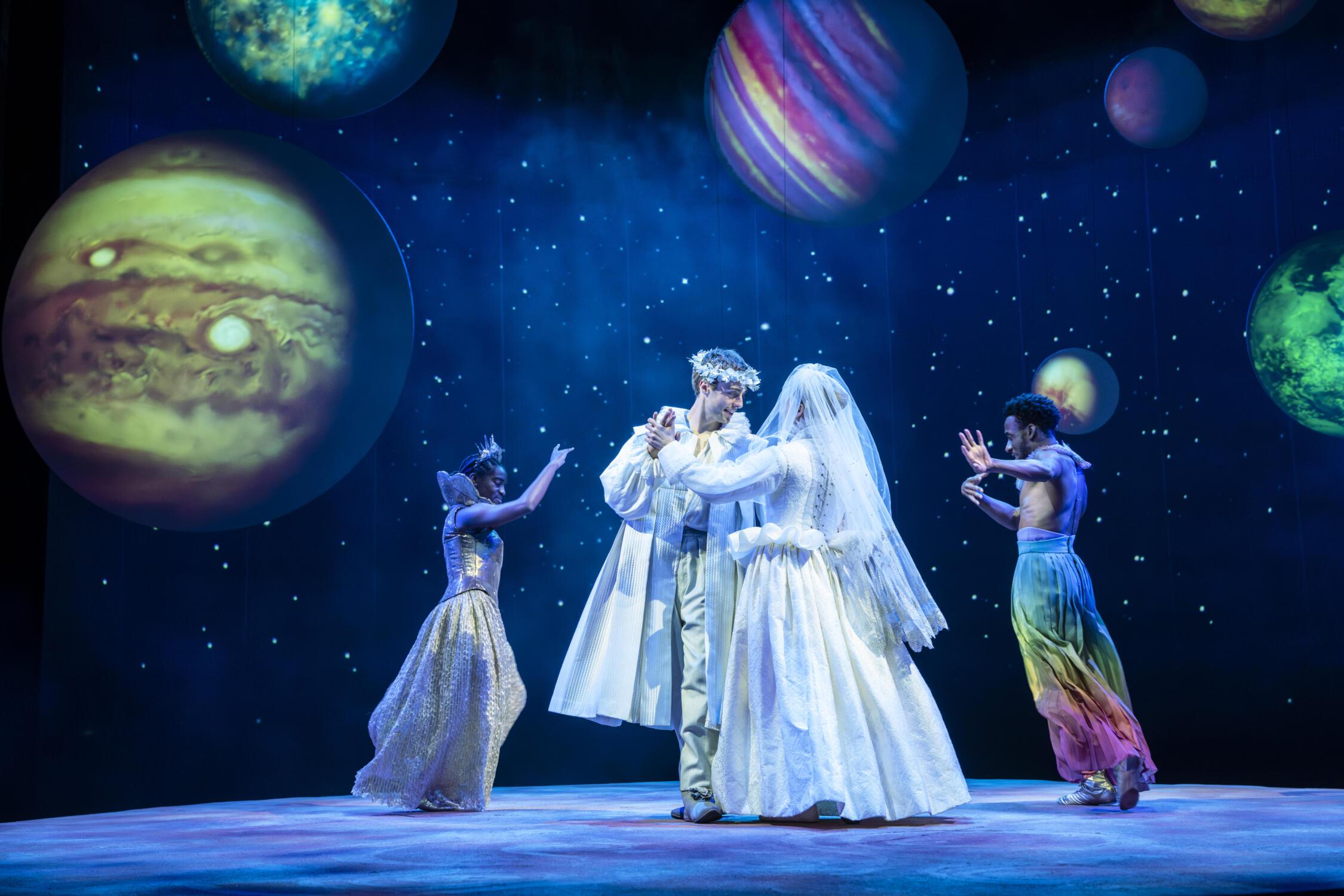
The Tempest, directed by Sir Richard Eyre. Royal Shakespeare Company. Photo credits: Johan Persson.
In the final part, when Prospero encounters face to face Alonso, King of Naples, Alonso’s brother Sebastian, and his own brother Ferdinand, all three of whom have plotted against him, Branagh’s Prospero conveys a range of emotions, but not anger. He leaves it to Ariel, morphed into a harpy and hovering menacingly above the royal contingent, to severely chide these ‘three men of sin.’ Instead, Prospero half whispers “Some of you are worse than devils.” He proceeds to warmly embrace the kind Neapolitan counsellor, Gonzalo, who saved his life, by making sure he had food, clothes and books for the trip to the island, after which he almost grudgingly forgives his enemies, before moving downstage and emotionally pronouncing the line at the heart of the play, “the rarer action is in virtue rather than revenge.”
The last stage picture shows Ariel descending onto the stage and Prospero carefully releasing her harness. After which he exits. Ariel has finally regained her freedom and can take a few hesitant steps, while Caliban watches on. The island again belongs to them.
This post was written by the author in their personal capacity.The opinions expressed in this article are the author’s own and do not reflect the view of The Theatre Times, their staff or collaborators.
This post was written by Margaret Rose.
The views expressed here belong to the author and do not necessarily reflect our views and opinions.