American women of a certain vintage can be sorted into haves and have-nots based on possession of a single commodity: an American Girl doll. Just whisper the name Samantha Parkington to an elder millennial and you’ll see her disassociate, withdrawing into happy childhood memories, returning to her earliest feelings of aggravated envy, or a destabilizing combination of both. This potent nostalgia exists within a complicated matrix of class, race, gender, and politics, and it’s exactly what Jackie Soro and Pax Ressler tap into in their invigorating new show Girl Dolls: The American Musical. Running at just over an hour, the show is an exploration-through-song of the history and symbolism of American Girl dolls, of childhood yearning and adult unlearning, of loneliness and connection. Grown-up audience members brought their dolls to the theater, and I cried through about 75% of the show.
American Girls were brought to the market in 1986 by the Pleasant Company, which was founded solely to produce these dolls. Each doll represented an epoch in American history, and was accompanied by chapter books that told her story, as well as outfit changes, furniture, and an astonishing variety of additional desiderata. The first three dolls were the aforementioned Samantha Parkington, a wealthy orphan who lived with her Grandmary in New York state at the turn of the nineteenth century, Swedish immigrant Kristen Larsen who came to Minnesota in the era of westward expansion, and Molly McIntire, a plucky young patriot whose father is serving in World War Two. All the doll characters are eight or nine years old, making them the same age as the girls to whom they were marketed, a significant departure from the rest of the doll market which was then dominated by babies and Barbies. And they were very expensive. In the mid-1990s, when I was the target demographic and also the era to which Soro and Ressler return us, the dolls themselves cost around $80. But what good was the doll herself without the books, the clothes, the accessories?
Soro and Ressler co-wrote the show, and they perform it with the intimate giddiness of two best friends sneaking out to go to a party. You may be wondering, do they play the dolls? Yes, they absolutely do. During the raucous number “Yankee Doodles,” they dress up as and embody the major historic dolls: Samantha, Kirsten, Molly, Felicity, Josefina, and Kaya. Addy, the line’s only Black doll, is conspicuously, indeed disruptively absent from this number; later in the show, we will turn our full attention to her. Addy is in fact the only doll that gets her own musical number: “Meet Addy” is performed first as a filthy and full-throttle rap-rock battle cry, immediately followed by a cleaned-up version, meant to be more palatable to a mainstream (read: white) audience.
Mainly, Soro and Ressler play different versions of themselves, as children, as historians, as agent-provocateurs. Soro’s vocal range goes from the deeply throaty to sweet and crystalline, and makes for beautiful tight harmonies with Ressler. Ressler, who brings to mind a young John Cameron Mitchell, brought the house down on “Doll Hospital,” a joyous singalong that imagines the Pleasant Company’s famed repair shop as a model for socialized and trans-inclusive healthcare. (Ressler and Soro are backed by a powerful and playful band–Mel Hsu on bass, Corinne Kite-Dean on guitar, and percussionist Mel Regn.) And they bared their tender soul with “Tea Party,” a song about understanding, and aching to take part in, the rituals of girlhood.
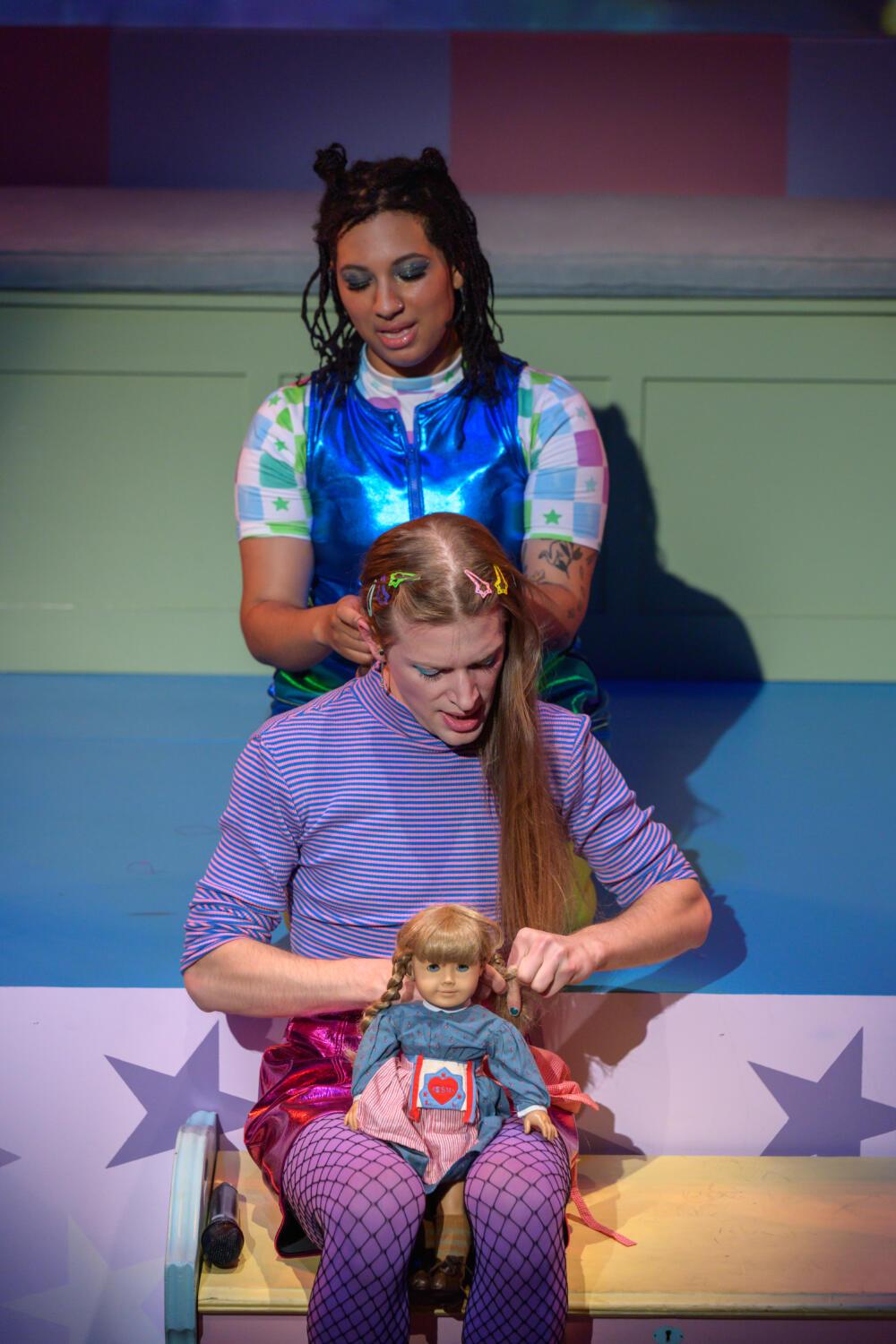
Jackie Soro and Pax Ressler with Kirsten. Photo credits: Johanna Austin.
I admit I am grappling with the Addy storyline. On the one hand, if there is a main character of this show, Addy may be it, and her story is told with care and emotion, outrage and humor. The first Addy book was a graphic depiction of childhood slavery, and for many children, this was their first encounter with such details. This amounts to a traumatizing reading experience and was presented to Black girls as meaningful representation. In contrast, little Swedish-American girls, who make up less than 0.5% of the country’s population, got Kirsten’s observance of Saint Lucia’s Day. On the other hand, the story felt unresolved and the narrative came in stops and starts. Told out of sequence, this plot was robbed of its own momentum. And the story is complicated, but I found myself wishing for the artists to land somewhere other than “It’s complicated.” But maybe this reaction makes me no different than the white Pleasant Company board members satirized in the show, recognizing the need (/incentive) for a Black doll but resisting the friction it would bring.
The play is at its best when it is earnest and fully committed. “Pleasant Rowland,” a mock-spiritual paean to the founder of the Pleasant Company, features otherworldly headgear and quotes an academic article in its lyrics. While the interstitial dialogue sometimes falls flat, the show is more of a musical revue than a narrative (the production is a collaboration between FringeArts and the Bearded Ladies Cabaret). In its current iteration, the play essentially has two endings. There is a climactic and cathartic song “We Did It!” that had the audience on its feet, ready to move right into an ovation. If Girl Dolls is expanded into a two-act, this song has the DNA of an eleven o’clock number. The return of the Addy storyline, unfurled and resisting resolution, brings an additional climax that is as emotional as it is intellectual, delivering us at last to a softer finale about the sanctity and sanctuary of friendship.
The first generation of American Girl owners (and enviers) are now in their prime. We are writers, filmmakers, and encyclopedists. (This is not even my first time writing about American Girls.) What is so special about Girl Dolls is Soro and Ressler’s ability to hold the good, the bad, and the ugly simultaneously. They connect playing with American Girl dolls with witnessing the great American female athletes of the 1990s, like Mia Hamm, Kristi Yamaguchi, and the Magnificent Seven, and the deep feelings of confidence and pride this, ahem, engendered. They invite us to return to the innocence of a past era, not with ahistorical blinders on, but with the sparkly heart-shaped rose-tinted glasses of youth. They remind us that, every once in a while, as a treat, we can put those glasses back on and just play.
This post was written by the author in their personal capacity.The opinions expressed in this article are the author’s own and do not reflect the view of The Theatre Times, their staff or collaborators.
This post was written by Abigail Weil.
The views expressed here belong to the author and do not necessarily reflect our views and opinions.