In late January and early February, Filippo Timi’s Hamlet² played to full houses at the 500-seater auditorium of Milan’s Franco Parenti theatre. One of the finest actors in contemporary Italy, Timi boasts a highly successful career in theatre, cinema and television. He is a cult figure, who draws audience members, from different backgrounds and age groups. The Shakespeare buffs, who like their Shakespeare reimagined, turned out for this innovative retelling of Shakespeare’s tragedy, as did people who might not care if it’s Shakespeare or not, but simply want to see their favourite actor and enjoy a good night out.
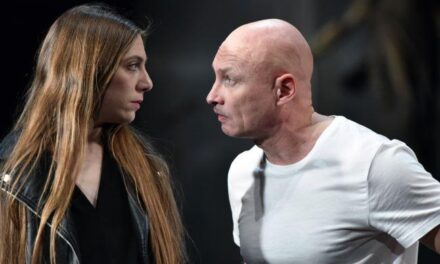
Hamlet² is very much Filippo Timi’s own creation, marking his long attachment to Hamlet, the first play he ever directed in 2009. Haven’t the people got bread? Well, give them some croissant, a retelling of Hamlet by Timi and Stefania De Santis, enjoyed a sold-out run for two consecutive seasons. In the present revisitation of the Shakespearian tragedy, he has penned the script and directed, as well as casting himself, once again, in the lead role. Two, sometimes overlapping, storylines are developed. The first, features Marilyn Monroe, superbly brought to the stage by Marina Rocco. The anxiety and fragility of this Hollywood star are highlighted, including an aborted attempt to commit suicide by injuring herself with the famous Golden Globe statuette. The second, focuses on Hamlet’s madness, or feigned madness, and particularly his relationships with Ophelia and his mother, Queen Gertrude.
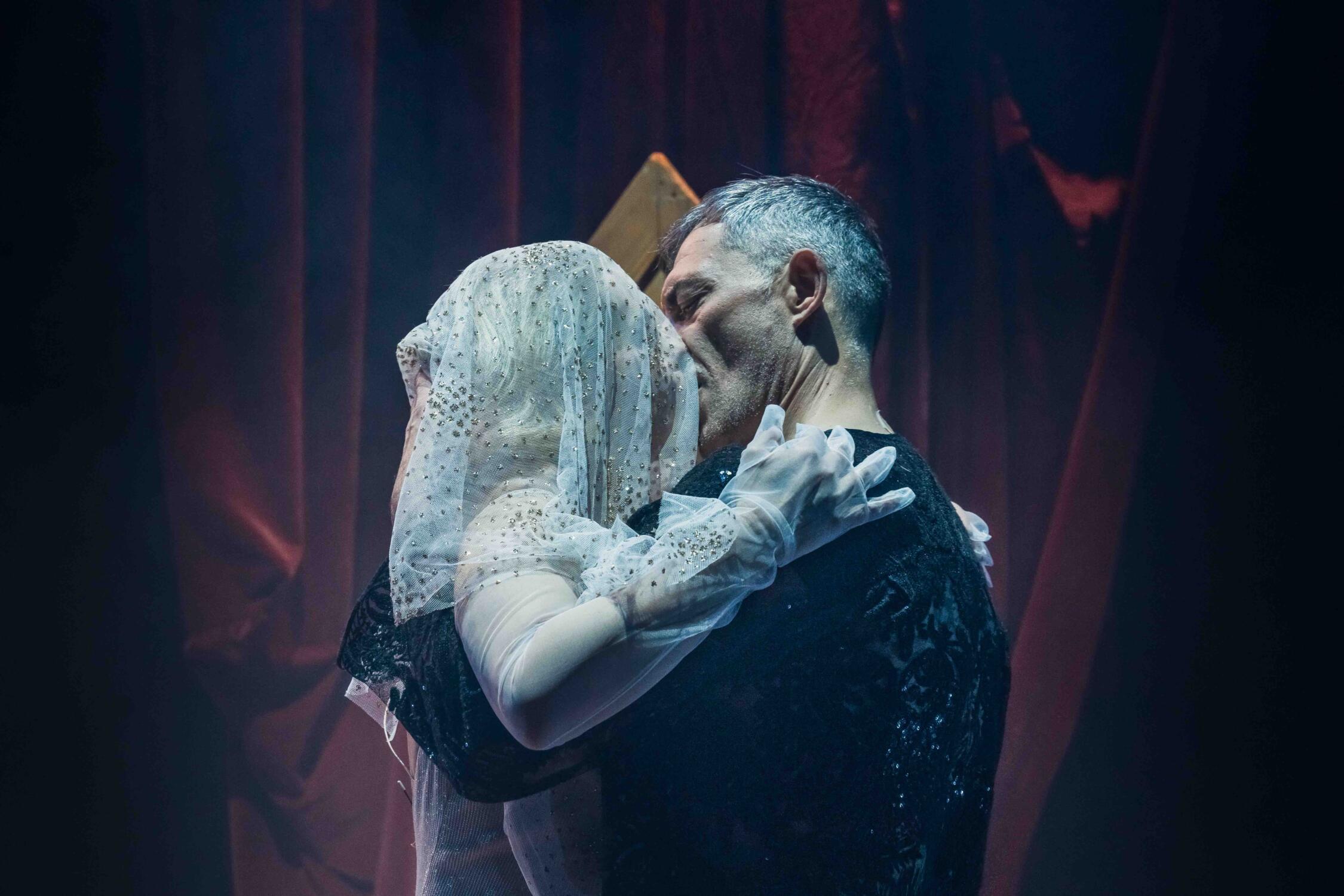
Filippo Timi and Marina Rocco in Hamlet² (Amleto²). Photo by Annapaola Martin.
Hamlet² opens with a glamorous Marilyn Monroe, delivering a long monologue in front of a closed curtain. Clutching an old-fashioned mic, this modern-day Hamlet pours out her doubts and troubles, a beginning which made me wonder whether the Prince of Denmark was ever going to appear. However, once the curtain opens, a wooden throne stands centre stage, with Timi in the role of Hamlet, surrounded by shadowy figures in penumbra, red velvet draping, black and white balloons. Downstage, straw is strewn and metal bars turn the stage into a kind of animal cage, through which the actors occasionally speak directly to the audience, making the latter aware they are watching a performance.
In what at one level might appear to be a crazy romp, accompanied by images from popular culture, such as a giant Papa Smurf and a medley of contemporary and classical music and songs, ranging from Beethoven, Edith Piaf to Jimmy Scott’s Nothing Compares 2 U, there is ‘method in this madness’. Treating the original Shakespeare script very freely, Timi has chosen a few iconic moments and boldly reworks them into an ironic, entertaining cabaret interspersed with an occasional story from contemporary Italian culture and his own life.
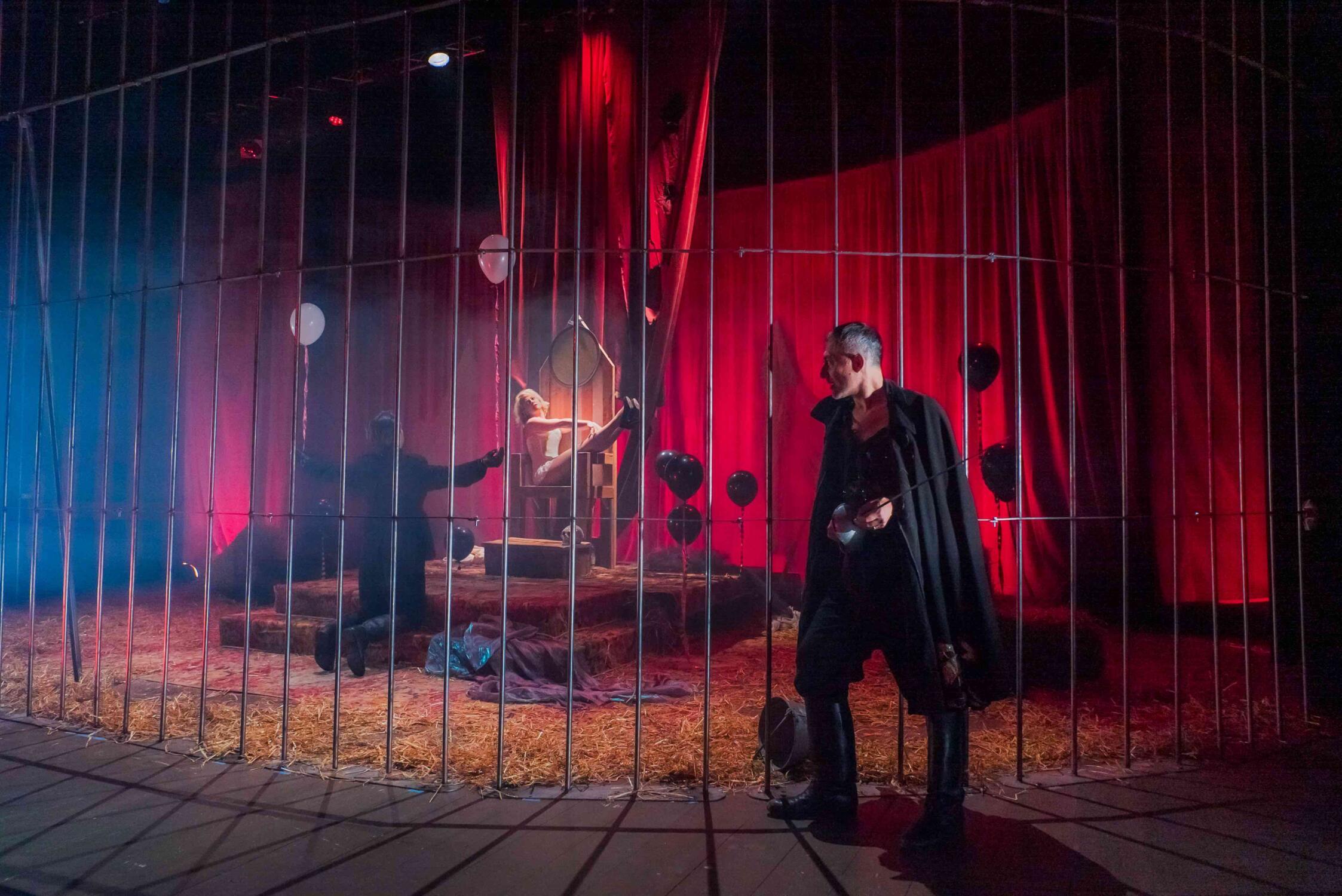
Filippo Timi in Hamlet² (Amleto²). Photo by Annapaola Martin.
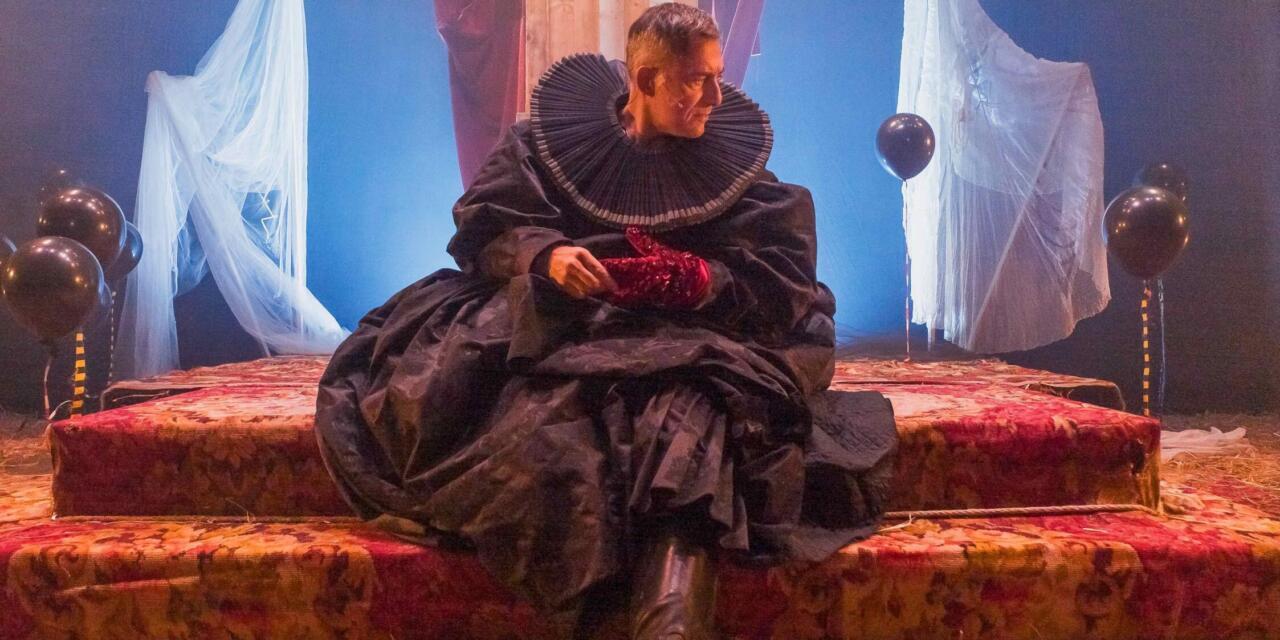
Dressed in a beautiful satin costume, complete with Elizabethan ruff, Timi, as Prince Hamlet, lolls on the throne, looking bored, sardonic and amused by turns, his gaze darting around to observe the ongoing action. The scene in which Old King Hamlet’s ghost returns, to inform his son about his murder and call for revenge, comes as a surprise. The ghost is no other than the Marilyn Monroe figure, played by Marina Rocco, who speaking in colloquial Italian, engages with her son. Hamlet’s ‘To be or not to be’ is likewise transformed. The monologue is cut short after the first lines, the actor revealing he has had quite enough of repeating the same old words for more than four hundred years. The usually fraught encounter between Hamlet and Ophelia, when Hamlet orders Ophelia to go to a nunnery, also takes a different turn; the couple embrace in a long kiss accompanied by romantic music, leaving no doubt as to the passion fuelling their relationship. In rare moments, the production grows dark. As Ophelia performs her ‘And I, of ladies most deject and wretched’ speech, we get a sense of this young woman’s utter despair. Still, as is typical of this retelling, this deeply tragic moment, during which we are invited to savour Shakespeare’s haunting imagery, is quickly undercut by comedy. Hamlet turns into a crowing cock, coming downstage and peering at the audience through the bars. Ophelia, though, meets her tragic destiny. Her final appearance is excruciatingly sad and moving, as her limp body, head down, swings high above the stage. Elena Lietti’s Ophelia haunts the imagination, staying in the mind’s eye.
Filippo Timi’s exploration of Hamlet’s madness highlights the chaos, confusion but also the dark comedy that the Prince’s distraught state of mind brings to the Danish court and particularly to the people closest to him. The long applause at the end signalled the audience’s enthusiasm for this bold reworking of Hamlet.
This post was written by the author in their personal capacity.The opinions expressed in this article are the author’s own and do not reflect the view of The Theatre Times, their staff or collaborators.
This post was written by Margaret Rose.
The views expressed here belong to the author and do not necessarily reflect our views and opinions.