Taiwanese playwright Chien-Cheng Chen is set to release A Chronicle of Consciousness, his second play collection, this August. However, the plays in this collection bear little resemblance to the realist dramas that launched his career. While his early works show a strong Chekhovian influence, his latest plays are built through collage, experimenting with different forms of language and narratives. For Chen, breaking with realist conventions does not mean rejecting the craft of playwriting. Instead, it is an attempt to capture more truths that cannot be fully contained within a linear narrative.
Chen believes that a play is not written on a blank page but on an empty stage, where playtexts are completed by performers and audiences. His works engage deeply with both Taiwan’s history and its present, inviting audiences to consider how the stories we believe shape who we are, even as other versions remain. Before the collection comes out, Chen sat down with Kuan-Ting Lin, Literary Manager at the Prologue Center for New Plays, to talk about his movement from realist conventions towards postdramatic forms, how directors and actors interpret his playtexts, and how teaching has changed his understanding of playwriting.

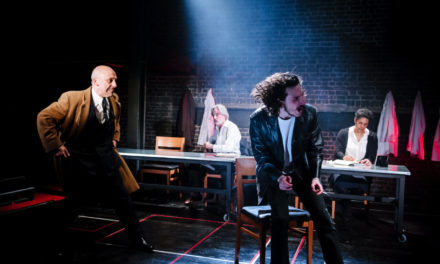
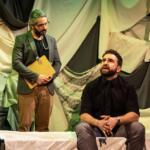
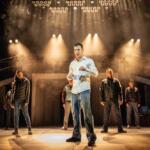
Chien-Cheng Chen’s Normality. Photo by Tsai Hsin Yi. Courtesy of Genesis Ensemble.
Lin: Your early works, such as Normality (日常之歌) and Millennium (在世紀末不可能發生的事), are grounded in the realist tradition, with characters navigating life within linear narratives. What drew you to realism as your starting point?
Chen: I began learning playwriting through classical texts, and Chekhov resonated with me the most. I found myself reading his plays over and over again. So much is happening beneath their everyday surface. Chekhov’s characters are often mistaken for being all talk and no action, but take Lopakhin in The Cherry Orchard as an example—he keeps urging the Ranevsky family to deal with the estate. Chekhov’s characters do not lack action; they are just good at concealing it within dialogue. His writing taught me how to shape a character’s desires with subtlety.
Chekhov is also a master of economy. Every line, prop, and stage direction serves a purpose. There is nothing extraneous. That sense of economy has become an anchor in revising my own plays. The first thing I do is cut unnecessary lines, and sometimes I take out entire pages. Cruel to myself, but kinder to the work. In that sense, Chekhov has really been an influence on my writing.
Lin: The plays in your upcoming collection, A Chronicle of Consciousness (意識編年), The Intertwined Labyrinth (心是交織的迷宮), and Paradise Remix (樂園混音), are more experimental and fragmented, moving among different language and theatrical forms. What drove you to make this stylistic turn?
Chen: Actually, Undo (解), a play in my previous collection that explores the psychology behind random killing, already showed my interest in non-linear narratives. I found that language played a significant role in how the killers justify their actions, so I incorporated forms of language beyond monologues and dialogues. I wrote the play in 2013 without being fully aware that I was experimenting with language.
After Undo, I went on to read more works by Sarah Kane and Martin Crimp. Their plays may appear to lack a rigid structure, but form and content are actually in alignment. They reminded me not to write against realist conventions simply for the sake of it. There must be a good reason behind each artistic choice.
The three plays in my second collection are all built through collage. A Chronicle of Consciousness uses multiple narrative frameworks, ranging from monologues and dialogues to a book launch, a play within a play, and the recitation of letters written in prison. These forms reflect an epistemological approach to history. The Intertwined Labyrinth attempts to capture different personalities or inner voices. Given that they coexist within the same body at the same time, a linear narrative may not be the best form. Paradise Remix is a meditation on the recent emphasis on personal growth. Ideas of the self, love, and happiness generate a great deal of uncertainty today, and people respond in different ways. Some do yoga, some practice mindfulness, and I have read that some people in Japan have even married themselves in response to that uncertainty. I juxtapose these responses to create a remixed soundscape of contemporary pursuits of paradise.
Lin: How is playwriting different from other forms of writing? How does that difference shape your understanding of theatre as an art form?
Chen: A play is written on an empty stage rather than a blank page. I have to imagine how other theatrical elements—spectacle, acoustics, performers, and, most importantly, the audience—will interact with the playtext. Think of a play as architecture. It already has its columns and beams, but someone else still has to design the interior. There have been times when actors told me that the playtext could stand alone and that they did not know how to embody it. Still, I write every play expecting it to be performed onstage before an audience.
What remains precious about theatre today is its ability to gather people. When an audience chooses to spend time with me in a theatre, it creates an opportunity for us to share something through the work. I usually imagine my audience as people living in Taiwan today. This imagined audience helps me decide whether the time is right to write about a particular subject. What matters is whether I can see a connection between that subject and the lives we are living now.

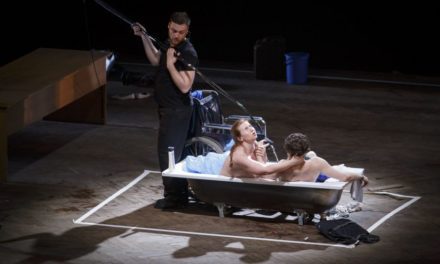
Chien-Cheng Chen’s Millennium. Photo by Jordak Yang. Courtesy of Genesis Ensemble.
Lin: Let’s stay with how performers respond to your playtexts. Given that acting training in Taiwan is deeply rooted in realism, how do you bridge the gap between performers’ instincts and your own expectations?
Chen: That is something I am still figuring out. Whether I am writing a realist play or a more stylized piece, I often imagine the delivery as neutral. In Undo and Millennium, there are even stage directions asking actors to deliver the lines in a flat tone. However, neutrality can seem at odds with acting. Most realist training asks actors to dramatize events and express emotions, so it is not surprising that they may feel at a loss when working on a play that does not operate within that system.
My approach varies from production to production. Take The Intertwined Labyrinth as an example for now. The four voices in the play sometimes speak in harmony like a chorus; at times, their voices become noise, carrying conflicting thoughts and emotions. There are endless ways to interpret the playtext, so rather than intervene and insist on my reading, I let the director and actors decide. That is both the pleasure and the challenge of collaborating on a work outside realist conventions.
Lin: Many of your plays draw inspiration from a social event, historical period, or a political atmosphere, yet none of them functions as overt propaganda or calls the audience to action. What do you think is the relationship between theatre and politics?
Chen: Interestingly, some theatre critics have criticized me for not being political enough. They were right in a sense, because I do not intend to make a political statement or mobilize the audience through my plays. What interests me most is how politics, history, and society generate stories, and how people draw on these stories to form their identities. If being fascinated by how storytelling works means being political, then yes, my work is political.
If I were to trace back my political awakening, I would place it around 2014, with the Sunflower Movement playing a major role. It was not that I had been apathetic to politics before then. I had already written plays about events in Taiwan, and I had cared about the marginal place of Taiwanese plays and theatre history in drama schools. But after the movement, the dots connected and many things came into focus. I felt I needed to be more conscious of how each play entered into conversation with Taiwan.
I often think about what it means to be socially aware as a playwright. Theatre cannot exist without a space, the performers, and an audience, and that gathering already creates a small social world. Even if a performance begins with a personal experience and has no intention of being political, the act of presenting it before an audience inevitably places it in a social context. In that sense, even the most private work enters into a relationship with the public.
Lin: You are now both a playwright and a teacher of playwriting. How has working with student playwrights changed your understanding of playwriting?
Chen: Teaching made me look more closely at the writing process. Watching my students work, I found that each of them had their own understanding of when a play was finished, and that significantly changed the structure of my class.
My students used to present their plays in public staged readings at the end of each semester, but this often led them to equate finishing the first draft with finishing the play. I do not think that is a healthy idea to carry into professional practice. At that stage, a play is still an early draft, nowhere near its final version. Rather than immediate presentation, what an early draft needs most is discussion and revision. So, I eliminated the mandatory public staged readings. I would rather have students bring their drafts to me for discussion and revision.
Revision is the hardest part of playwriting to teach. It is a phase in which playwrights have to be honest and objective about their own work. Sometimes, they even have to battle the devil within. Some playwrights find themselves rewriting instead of revising, jumping between different versions but never moving forward, while others cannot bring themselves to delete a single line. As I said earlier, I revise by cutting. Perhaps I should offer a seminar on revision, teaching students how to cut and edit.
Lin: That sounds like a good idea. Thank you for spending time with me today, and good luck with your new book!
(Kuan-Ting Lin is a playwright, translator, and dramaturg from Taiwan. Currently, he serves as the literary manager at the Prologue Center for New Plays.)

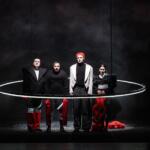
Chien-Cheng Chen’s Dissociation. Photo by Tsai Yin Hao. Courtesy of Genesis Ensemble.
This post was written by the author in their personal capacity.The opinions expressed in this article are the author’s own and do not reflect the view of The Theatre Times, their staff or collaborators.
This post was written by Kuan-Ting Lin.
The views expressed here belong to the author and do not necessarily reflect our views and opinions.