

Jonathan Spector’s new play Birthright—just opened at MCC Theater in a sharp, superbly acted production directed by Teddy Bergman—is way more absorbing than you might expect from an incessantly talky and disputatious, 3 ½-hour drama about American Jewish identity.
This astute and remarkably moving work follows 6 Jewish young people from the DC area who meet in their early 20s on a Birthright trip to Israel and maintain a friendship circle into their 40s. We meet them in 2006, three weeks after their trip, pick up with them in October 2016 (just before Trump’s election), and pick up again in June 2024 (8 months after the Oct. 7 attacks). This 18-year view proves to be a clever means of holding their very various personal choices and changes up against the major public events that occur in that time without ever pushing those events into the center.
The play is refreshingly unpolemical, despite keeping hot-button political issues before us the whole time. Spector’s real interest is his characters, whose complex, open-ended, and messy stories of self-discovery he teases out with tremendous care. That’s why the play is so long; it needs its length to do full justice to all the stories.
That’s also why Birthright feels deeper and more consequential than Eureka Day, Spector’s Broadway hit from last year. Eureka Day was a satire of Berkeley liberals coping with vaccine politics, and I laughed lustily at it (sometimes–Trump’s re-election dampened the fun). I also found it too homiletic and tidily wrapped for its own good. Birthright is topical without taking sides among its points of view, and that uncertainty makes it gripping.
The characters, it should be said, aren’t really demographically diverse. They’re all wealthy, college-educated Washingtonians with a liberal bent—drolly calling their group-chat “BirthLeft,” for instance—and all but one are from religiously observant homes. No right-wingers intrude on the group spirit, or religious equivocators, determined assimilationists, tribalists, paupers, or schnorrers. Still, there’s wide diversity (if I can put it that way) in their personalities and souls.
Chaya (Zoë Winters)—whose comfortable suburban home with a hot tub is the setting—is a feisty, take-charge organizer who joins the Obama campaign and then becomes head of a centrist “social justice non-profit based in Jewish values.” Noah (Eli Gelb), who nurses a crush on Chaya the whole play, is a pioneer blogger who becomes a nationally recognized pundit after being discovered by the New York Times. Izzy (Molly Bernard) is a lesbian and Chaya’s oldest friend who equivocates about law school and becomes a strident social justice warrior working for J Street. She and Chaya argue fiercely in Act 3 over whether Israel is “a brutal Settler Colonialist Project.”
Alona (Molly Ranson), a Ph.D. student in Sociology at Yale, is the most attached to Israel of all; she marries an Israeli man and starts a family there, then reluctantly flees with her children back to the U.S. after October 7. Lev (Hale Appleman) is a charismatic seeker who drops out of the Birthright trip to wander around the Middle East. He returns with a calling to rabbinical school but drops those plans after marrying (and then divorcing) a gentile woman. He is the play’s spiritual touchstone, a sort of de facto rabbi despite his confusions and detours, until (in a surprise twist) he’s effectively usurped near the end by Emerson (Nate Mann), introduced as a confused, substance-abusing, indie-rock musician from a secular family.
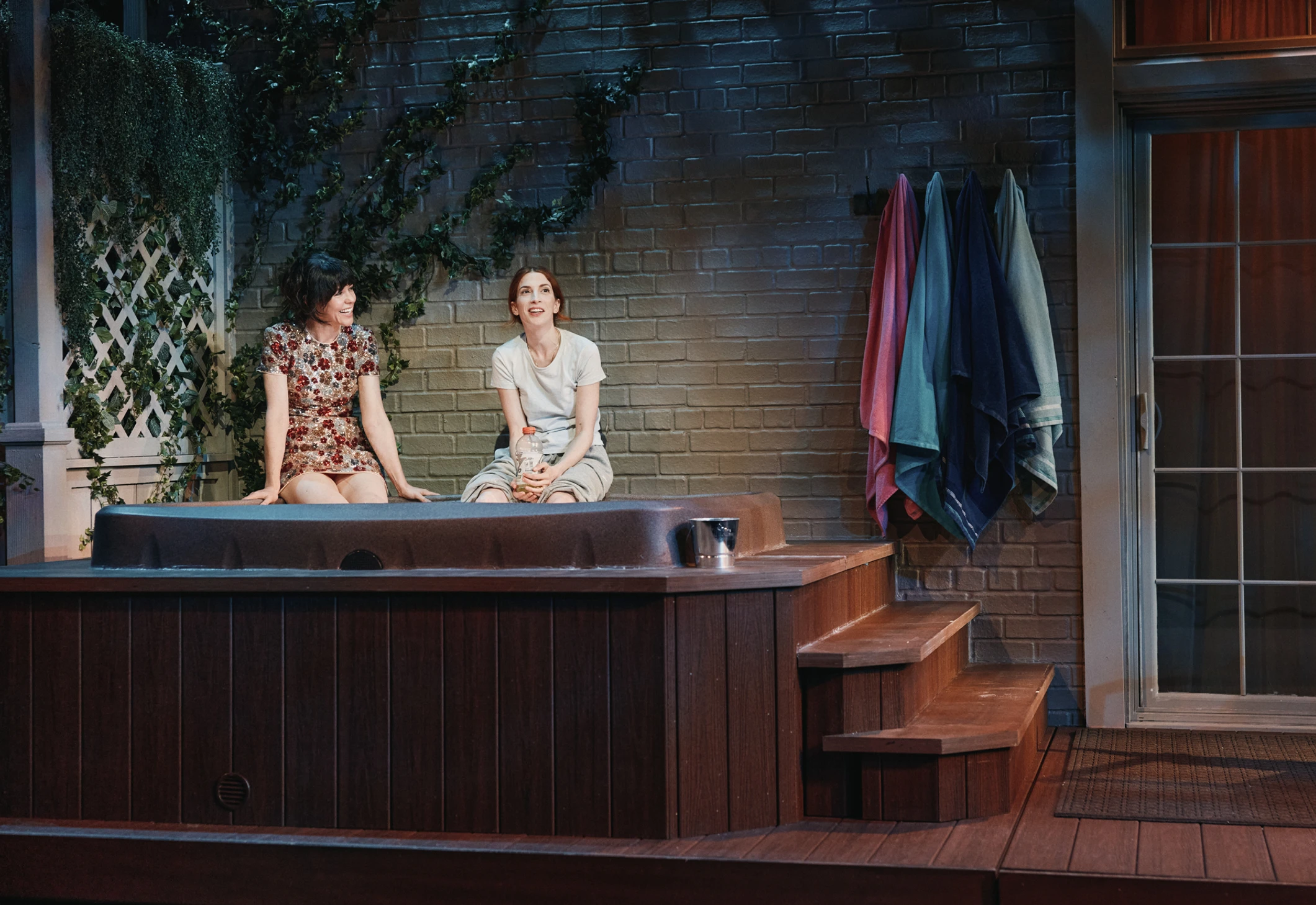
Zoë Winters (Chaya) and Molly Bernard (Izzy). Photo: Emilio Madrid.
There is much more to these tales, about hookups and breakups, children and parenting, job coups and debacles, illness and death—the whole farmishte megillah of real human lives honestly observed over decades. You must get the details from Spector’s sparkling dialogue, vibrantly delivered by the excellent MCC cast. Story gaps between the acts are cleverly and efficiently filled in with flurries of projected emails and social media posts.
As for the play’s overarching point, I think it has to do with accepting contradiction and complexity as the essence of Jewish identity, at least in the liberal diaspora. Early on, Lev describes his revelatory feelings after reading Yosef Yerushalmi’s influential book on Jewish history and memory, Zakhor, whose title means “remember.” Lev has just remembered both IDF soldiers mistreating Palestinians in the West Bank and his Holocaust-survivor grandma flourishing on a postwar kibbutz, visions that pull in opposite directions in his search for belonging. The Yerushalmi idea that strikes him is that Jewish history has “never been a straight line,” has “never meant only one fixed thing/ it’s more a thing you interpret/ that you find meaning in.”
That may not be a new or world-changing idea. But its emphasis on heterodox flexibility, on the essential importance of drawing the widest possible circle around types of American Jewishness, lands like a fortifying breeze right now. All of us are watching in horror these days as Israeli forces reduce nearby places they can’t control to ash, and the stifling ancient poison of anti-Semitism spreads anew like a toxic cloud, reducing Jews everywhere yet again to cartoon cutouts and singular venal traits. Go see this loving, touching, broad-minded play about young people trusting not to any barbarous governments but to a group bond they alone have forged to help them live upright and meaningful lives. It’ll make you feel a smidgen better.
By Jonathan Spector
Directed by Teddy Bergman
MCC Theater
This article appeared in TheaterMatters on July 17, 2026, and has been reposted with permission. To see the original article click here.
This post was written by the author in their personal capacity.The opinions expressed in this article are the author’s own and do not reflect the view of The Theatre Times, their staff or collaborators.
This post was written by Jonathan Kalb.
The views expressed here belong to the author and do not necessarily reflect our views and opinions.