
A towering figure in Chicago theatre, Charles Newell—former Marilyn F. Vitale Artistic Director of Court Theatre and 2024 Joseph Jefferson Special Award recipient—discusses the five-year process of directing Berlin, illuminating how invention, team-building, and intuitive risk-taking shaped the production and offering heartfelt advice to aspiring directors.
Susanna: It was your vision to adapt the graphic novel for the stage at Chicago’s Court Theatre. What initially drew you to Berlin, and how do you reflect on that choice now, after five years of living with the project?
Charlie: That’s a great question. It really began when Court Theatre’s executive director walked into my office one day and asked if I’d ever read this graphic novel. I hadn’t. I read it and immediately thought, this is impossible—and I really want to do it. How do you take a 500-page graphic novel with dozens of characters and wrestle it into a piece of theatre, rather than a literal adaptation? We knew it would take years, and by the time we got there—about six years later—it felt unexpectedly urgent. None of us anticipated how closely it would resonate with the American political moment, even though we were aware of the historical parallels. Still, we weren’t interested in drawing obvious comparisons or forcing the point. We didn’t want to do something like putting Julius Caesar in a blonde wig. Instead, we focused on telling the story as honestly and rigorously as we could.
I don’t think of myself as a particularly political theatre artist. What draws me are the human and emotional stakes—what it feels like to live through history. So we concentrated on the people in the story and trusted the audience to make their own connections. One of the things I love about theatre is that it doesn’t have to tell everyone what to think. If you tell the story well, audiences bring their own lives, memories, and emotions to it. Figuring out how to create that space was a central part of developing the project.
Susanna: I’m really interested in the adaptation process from a graphic novel, especially because— as the dramaturg David Levin mentioned—there isn’t a single, fixed play text. The script keeps changing in rehearsal, which I find fascinating.
Charlie: What was most interesting was that the production script you saw was essentially draft number seven. The earlier drafts went through all kinds of permutations. One of the earliest was a five-hour draft, basically trying to tell as much as possible of what Lutes was doing in the graphic novel. When Mickle read it, and then we all read it, we realized this was not going to work. So the question became: how do we distill it? As the playwright Mickle distilled it down to twelve principal characters, it still felt—very generously speaking—like he had captured all of Lutes’ work, but not yet his own point of view. The commission framework you mentioned, with people speaking from the present while reflecting on the past, isn’t in Lutes’ work at all. That was Mickle’s contribution, and it gave the piece a foundational grounding that was invaluable. From there, we kept distilling—not just story, but the emotional journey we wanted the production to take.
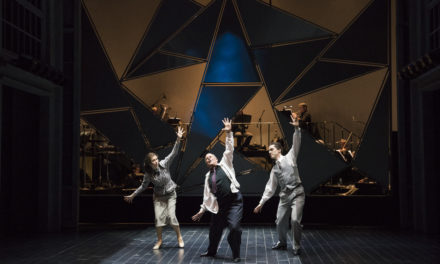
Mickle initially proposed a version where everyone sat in chairs with microphones. I said, that’s fine, but it’s not really theatrical—it’s not using what theatre does best, which is distillation that allows for many meanings. A lot of what followed came from the brilliance of our scenic designer, John Calderberg. We kept asking: what are the absolute essentials? Everything else has to go away. That’s how it became twelve chairs and six big black tables, which defined most of our storytelling vocabulary.
When you commit to that kind of essentializing and hold to very rigid rules, it becomes powerful—because then you can break them. Most of the sound was generated live by the actors: music, raindrops, rioting, all of it, like radio theatre or foley work. But when Hitler appears at the top of the ladder, we broke every rule. We turned the volume up as loud as possible and used the ugliest, most beautiful sound cue we could find. That rupture only works because everything before it is so restrained.
Susanna: So what is the principle you’re distilling here? Is it about defining characters through objects? If you were to really essentialize it, how would you articulate that guiding principle?
Charlie: Yeah, it’s something that’s taken many decades for me to move away from trying to represent liberalism and instead get to a place where—just to use the tables as an example—we ask: what else can this object do? We knew we had to have the tables so that we could always, in some form, return to the commission. But what if, over the course of the production, we keep using them not just as tables, but in different configurations and for different reasons than you’d expect? So when you see the flipping of the tables during the racist attack on a couple of the characters, that’s the equivalent of someone punching somebody. We used the flipping table as a vocabulary for violence.
Another moment I think about is the scene from the graphic novel where David and Sylvia are trying to connect. We decide to have the table tipped on its side and suddenly it becomes the wall between them, the bedroom they’re in together, the bed he wants to lie on top of her, the edge of the window she jumps out of. It just becomes all these other things. There’s so much trauma and terror and ugliness and darkness in the production. We thought that if we could use the tables, the chairs, the microphones—whatever—in ways that are kind of delightful, moments where the audience goes, oh, what’s this? Oh, I see, that would add an important quality so the piece isn’t entirely bleak. So the challenge became: here’s an object—how many different ways can we use it in a non-literal way? That became something we found delightful as theatre artists, and we hoped the audience would too.
Susanna: I think part of why I respond so strongly to this piece is that it actually resonates with the aesthetics of traditional Chinese theatre. “One table and two chairs “are often the minimal props onstage, and everything else is carried by the actor’s body. At the same time, those same tables and chairs are powerful. They can signify violence—as in battle scenes—and the meaning shifts through use. Different meanings are created simply through the actor’s movement and the motion the body generates.
Charlie: Another challenge the graphic novel presents us is that even with twelve people and a two-and-a-half-hour running time, if we had to stop and change scenery and costumes every time something shifted, it would be endlessly boring. So we decided to tap into the metaphor of the river—you hear so much about the river flowing through Berlin, about the trains coming and going. This was a period of incredible movement and evolution in aesthetics, culture, and identity—we want the piece to feel non-stop. It doesn’t just land somewhere and then move on.
At the same time, how do you create an art form like that without it becoming one thing for two and a half hours? So we tried to start slowly, then begin using things slightly differently, then more complex, and more complex, until by the very end everything is happening all at once and all the rules are broken. We were trying to create a kind of energy—something we can only imagine through our own experience right now—where things feel crazy, anxious, fearful, joyous, lustful, where emotions are at their extremes and switch very quickly. For the actors, whose work is so rooted in emotional context, I said: imagine your psyche layering in all kinds of directions. The faster you switch, the greater the cost to you—and that cost becomes devastating for an audience to watch.
We were fortunate to have actors willing to take that kind of risk. Our goal is never perfection, and certainly not being finished by opening night. So every night became an opportunity to discover something new, because there wasn’t enough rehearsal time to find everything. So it didn’t lock into one thing—they kept finding the next iteration. As I said in the closing-night toast, I would go into any theatrical nightmare of a process with this group of actors. They were fearless and ambitious, always leaning forward, always finding something new.
Susanna: That’s really fascinating. As the director, what’s your approach to working with the actors?
Charlie: Given the development team had over five years to think about what story this text is telling, I was very aware that it would be completely overwhelming if the actors showed up on the first day seeing the script for the first time and trying to figure out all the meta layers—I’m playing this role, but now I’m playing another role as the first role would have played it. It’s very complicated. So I did something I’d never done before: I created arcs. Usually plays have scenes or acts, but in this script it’s hard to tell where something begins and ends. Creating an arc for each actor was tremendously relieving. If you have an arc, you know where the scene takes place, who you are in it, what your objective is. It meant they weren’t trying to do everything all at once, which would just blow their minds. That gave structure.
But even more important was that two or three months before rehearsal, we held a one-day workshop. Ostensibly, the goal was practical—does drumming your fingers on a table sound like rain, does sliding suitcases feel like a train in a Berlin cityscape? We tested those things, and that was great. But what mattered more was that the actors saw we weren’t coming in saying, this is exactly how you do it. We played. We saw who was physically adept, who was excited by what, and we began building from what they were doing rather than telling them what to do. That sense of empowerment is incredibly valuable for actors.
Another thing I learned a long time ago is that it’s not a good idea to stand in front of the company and give individual notes where everyone can hear. I once watched a seasoned director I assisted pull Morgan Freeman aside during a complicated rehearsal and talk with him privately for twenty minutes. I thought, this is terrible, it’s wasting everyone’s time. But then Morgan came back into the scene completely transformed, and none of us knew what had been said. I later heard a Chicago actor say to me, most actors are more anxious about being judged by their fellow actors than by a director or a critic. That really stayed with me. So I try to avoid conventional table work and protect that confidential space between director and actor.
Susanna: It’s like personal coaching.
Charlie: Exactly, exactly.
Susanna: You teach a leadership course here at UChicago’s Graham Business School, and you’ve described directing as an act of trust, intuition, and risk rather than control. How do you understand leadership as a practice of presence and trust—both in the rehearsal room and beyond the theatre?
Charlie: Business leadership and directing theatre actually share something essential: helping bring forward a person’s most authentic, powerful self in moments of transition. We use a lot of theatre language—let’s rehearse, let’s try that again, here’s the obstacle, here’s the challenge, here’s something that’s not your go-to. It’s really about exploring what you’re less comfortable with. The truth is, the only way I know any of this is because I’ve been doing it for a very long time. And what I would say is: trust your gut, trust your intuition. It took me too long to learn that. I invest a huge amount of time over decades preparing, but once I’m in the room, I trust my instinct. I don’t try to be right. In fact, I sometimes intentionally model being wrong or taking a risk—so people can see, oh, he took a risk and it didn’t work out. That makes it safer for others to take risks. But you have to lead first.
People will ask, where did that idea come from, what book did you read? And I say: I intentionally forget my preparation and try to be fully present with the other artists, operating out of instinct and encouraging them to do the same. It gets confusing and messy—and really fun.
Someone once said to me, Charlie, trust that nobody has your imagination, your life experience, what you bring. Don’t worry about being right or wrong. Worry about what’s true for you, because only you have your imagination—so why not use it? That took me many, too many years to learn. And it’s the advice I pass on to aspiring directors: do your homework, then trust that what you have is absolutely unique, and find a way to put it into the world.
Susanna: Thank you so much for sharing!
This post was written by the author in their personal capacity.The opinions expressed in this article are the author’s own and do not reflect the view of The Theatre Times, their staff or collaborators.
This post was written by Susanna Sun.
The views expressed here belong to the author and do not necessarily reflect our views and opinions.