
How do we learn to forgive, especially in the aftermath of a massacre that has no rational explanation? This is the subject of Diego Garrido Sanz’s Violencia (Violence), his adaptation of Fran Kranz’s 2021 film Mass, which presents two couples brought together in an Episcopalian church by a horrific tragedy. Garrido Sanz follows the single location intensity of the film, opting also for a setting — a community centre — which feels more neutral than a church.
The premise may be simple, but it is never simplistic. Six years after their son, Iván was murdered in a school shooting by another pupil, Jaime, his parents Beatriz and Martín have come to a neutral location, an arts-community venue run by a young man called Diego (played by director Diego Garrido Sanz), to have a face-to-face encounter with the assassin’s parents, Ricardo and Amelia. The couples have corresponded, but it is their first in person meeting.
Cecilia Freire’s Beatriz looks disturbed on entering the room – she is no longer sure she can go through with the meeting. The entry of Ricardo (Jorge Kent) and Amelia (Esther Ortega) leads to awkward greetings and stunted pleasantries. Diego is on hand to facilitate but the couples don’t think his presence is needed; he leaves the room and 90 minutes of intense conversations begin.
At first all four parents aren’t sure of what to say – it is as if they are skirting around what they want to ask and the awkward physical distance makes this clear. Martín (Ignacio Mateos) and Beatriz want to try and find answers as to why Jaime went on a shooting rampage that resulted in the loss of their son. But Ricardo and Amelia have no answers to this question. Rather, as they share memories and mementoes, a space begins to open up for understanding. Beatriz has photos of Iván: one is of their last Christmas as a family and another of their son as a five-year-old boy. Amelia shares an artwork made by Jaime of paper snails, to demonstrate his sensitivities and love of nature. She struggles to reconcile her beautiful son with the murderer who carried out the school shooting.
Martín wants to believe that the signs of violence were there when Jaime was a child, but Ricardo and Amelia can’t corroborate his view. They describe a thoughtful, artistic boy who loved nature and animals. It is only with adolescence that the obsession with video games comes, with a growing insularity taking hold of their son. He doesn’t want to leave his room and becomes more anti-social. But nothing leads the family to suspect that the obsessive online activity in his bedroom was one manifestation of a mental distress that would quickly spiral out of control.
Ricardo and Amelia are also mourning the loss of a son. Jaime killed himself at the site of his crime. Both parents reference the ostracism that followed Jaime’s actions and the challenges faced by his sibling, Esteban. Beatriz and Martín also mention Iván’s sister, Sofía, who has struggled to come to terms with her brother’s death. The impact of Jaime’s actions spread out to characters referred to but never seen on stage. Grief and guilt go hand in hand in Violencia.
Martín (in Mateos’s edgy performance) has acquired a forensic knowledge of how events unfolded in the fatal few minutes between Jaime opening fire and the death of his son. He probes Ricardo and Amelia, but they have no explanation; they cannot make sense of what has happened. Their faces betray confusion as Martín quickens his questioning. A glance from Beatriz and he pulls back.
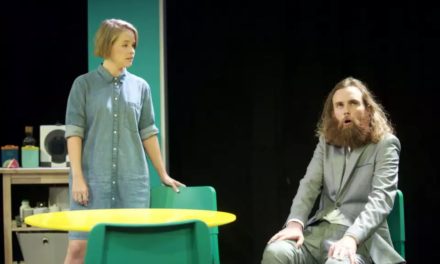
The table that dominates the set — no credit is provided for the stage design — provides a powerful way for the couples to face each other. The two mothers share a moment of proximity around the table as they look at photographs. In another instance, the men move away from the table: as if they cannot manage any kind of physical closeness. Ricardo is dressed in a suit and tie with a formality to his attire. Beatriz and Martín are more casual in their clothing — jeans and a jumper for the former, chinos and rain jacket for the latter. Ricardo looks down a lot as if he can’t face the parents of the child his own child killed, while Martín faces up to Ricardo repeatedly. At times none of the quartet know where to look.

Ricardo (Jorge Kent) stands, his wife Amelia (Esther Ortega) and Martín (Ignacio Mateos) and Beatriz (Cecilia Freire) sit around the table trying to make sense of the events of the past. Photo: Bárbara Sánchez Palomero
At a time when suicide is the largest cause of death for under 30s men in Spain, this is a piece that invites an audience to listen with compassion. In a culture where antagonism increasingly prevails, Violencia provides a space for encounters that feel open and empathetic. At the play’s end, there is no forgiveness as such, but a space where hate is sidelined in favour of consideration and care. Beatriz wants to move on as her daughter has begun to do, but is eaten up by the gnawing pain of grief. Martín may not get the answers he wanted, but he begins to understand that Ricardo and Amelia also lost a child. Dialogue provides a way forward so that at the piece’s end, the two couples feel that something has been achieved, even if they can’t quite articulate what it is. Their bodies feel less tense, the shoulders a little more relaxed.
This is a piece that rests on the convincing performances of the two couples. These feel intimate and real. Ortega’s Amelia talks as a way of managing the discomfort of the situation. The directness of Mateos’s characterisation of Martín betrays an impatience born of grief and frustration. Freire’s Beatriz displays an exhaustion that is palpable from her body language: her moves suggest a woman who has to make an effort to get out of bed each day. Kent’s Ricardo – a giant bear of a man — struggles to know where to put himself. At times he mutters, and references made to late nights at work suggest he blames himself for not being around to notice his son’s descent into acute mental distress. At one point Amelia returns to share a painful memory, wishing she could turn back the clock, but none of them can.
The child that enters the stage dancing in the play’s final section may be a configuration of Iván and Jaime or perhaps neither. Perhaps they are a figment of Beatriz’s imagination, perhaps a physical manifestation of a memory. This a play that provides no answers but its questions provide a space where dialogue opens up the space of possibility. Restorative justice here, as in James Graham’s Punch, challenges the language of punitive rhetoric and defiant judgements. Something feels different at this quiet play’s end, as Beatriz sits down to listen to a child practicing the piano in a room that feels somewhat at peace. The characters may talk in Violencia but it is ultimately through listening that real change is seen to happen.
Violencia (Violence) plays at the Sala Princesa of the Teatro María Guerrero, Centro Dramático Nacional Madrid, from 28 November to 28 December 2025.
This post was written by the author in their personal capacity.The opinions expressed in this article are the author’s own and do not reflect the view of The Theatre Times, their staff or collaborators.
This post was written by Maria Delgado.
The views expressed here belong to the author and do not necessarily reflect our views and opinions.