
By a fortuitous coincidence, a new theatre-work The Chair and The Cello – which features an armchair manufactured by a Swedish homewares corporation – premiered two days before that same corporation opened its long-awaited first store in Aotearoa New Zealand. This timing added extra resonance to the politics of a show which draws attention to the impact of corporate consumerism on the human psyche. The performance begins with actor Hannah Banks alone onstage with her sole piece of furniture – the armchair – together with a pile of household detritus and a silent cellist (Briony Luttrell).
A trans-Tasman collaboration by artist/academics, The Chair and The Cello was performed as a special opening event for the 2025 Australasian Association for Theatre, Drama and Performance Studies Conference (ADSA), held in Te Whanganui-a-Tara (Wellington) in December. This production is a devised work in progress, part of an academic project examining creative safety in devising theatre from autobiographical material, and empathetic partnerships between devisors from different creative disciplines.
The Chair and the Cello is an autobiographical work inspired by Hannah Banks’ experiences of living alone in a new country during the 2020 Covid-19 pandemic. Before she re-located to Australia to teach at the University of the Sunshine Coast, Banks was a theatre-maker, actor and teacher based in Te Whanganui-a-Tara. She co-founded and directed the innovative company My Accomplice in 2012 and completed her PhD on women’s devised theatre in Aotearoa in 2018. Her performance in The Chair and the Cello veers from the playful to the deeply emotional, displaying the versatility which won her the Outstanding Performance award for her role in My Accomplice’s WATCH at the 2014 Wellington Theatre Awards. In The Chair and the Cello, Banks’ considerable acting skills are tested by a role which requires her to hold the stage for nearly one hour and to play a wide range of emotions, from keeping up a brave face with her students while teaching on Zoom during the pandemic, to experiencing a devastating phone call.

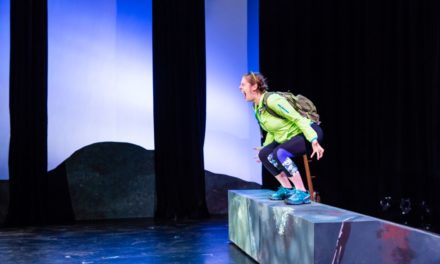
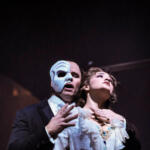
Hannah Banks (left) and Briony Luttrell in The Chair and The Cello. Studio 77, Wellington. Photographer Lucas Neal
The interdisciplinary collaboration between the theatre-makers and the musician (Briony Luttrell) gives the work much of its impact, creating a performative dialogue between Banks’ monologue and Luttrell’s music. While the words chair and cello are linked by their alliterative qualities they are at first presented as opposites – the chair as a utilitarian object, the cello as an extra-ordinary, exclusive, aesthetic instrument. Yet the comparison is not as stark as it seems. Both are beautifully designed objects. Banks narrates interweaving histories of chairs and cellos while Luttrell punctuates this with a variety of sounds and tunes. The script highlights the creative and political functions of chairs. Like cellos, chairs figure in iconic artworks, representing both presence and absence, and this sense of loss resonates with the isolation of the protagonist. Banks plays with all the performative possibilities of the chair, physically engaging with it as she narrates its genealogy. The chair’s aesthetic qualities are especially evident when in its skeletal form, without the upholstery, which Banks uses variously as a yoga mat, a comforter, a shield, a shelter, a weapon, and, most poignantly, in a slow dance with a lost lover.
The script is distinguished by delightful humour and witty wordplay, which was much appreciated by the capacity conference audience. Banks drily observes, “You take your old chair to the dump. You take your old cello to the insurer”. The script parodies the language of home decor catalogues and “easy-clean DIY dystopian capitalism”. The audience responds with empathetic laughter as Banks relates the infuriatingly complex process of assembling the chair from a flatpack. The audience loves the humour of the speeches about the sensual qualities of the cello, and its exploitation in the soundtrack of a remarkably popular Netflix regency romance.
The clean lines of the perfectly-designed chair contrast with the higgledy-piggledy pile of stuff in the corner (which the protagonist calls her “doom pile”) representing the myriad of things she hasn’t organised or dealt with. This juxtaposition neatly suggests the tensions between the social pressure to maintain a clean, minimalist lifestyle and the messy reality of existence. Under the enforced lockdown conditions, the protagonist’s’ home becomes a prison rather than a refuge or retreat. At one point prison bells ring out suggesting an escape break. But how does it feel when one can escape intellectually, but not physically?
Nicola Hyland’s direction sparkles with invention and striking stage imagery. She keeps the rhythms changing from sharply paced poetic monologue to high-energy movement sequences, to loaded moments of stillness and reflection. Just when I thought every performative possibility for the chair had been exhausted, the base of the chair becomes a projection screen for a moving shadow play. A delightful coup de theatre towards the end of the show – which I won’t reveal here – propels it into a more expressionist mode.
Reflecting the protagonist’s changing moods, the lighting design by Carl Walling captures the psychological shifts in the protagonist’s journey, often isolating Banks and the chair while Luttrell plays in a warm glow upstage, barely visible. Simple scenographic elements such as a long red ribbon are used to great effect. The lighting has a painterly quality, especially in the expressionistic scenes towards the climax as the character’s emotional crisis deepens, transforming the mostly bare stage into environments such as a forest and a stormy sea.

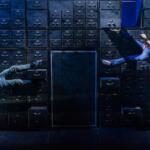
Hannah Banks (left) and Briony Luttrell in The Chair and The Cello. Studio 77, Wellington. Photographer Lucas Neal
Luttrell and her cello are the emotional core of the work. The cello provides stylised sound effects, such as a phone ringing, and its gentle vibrations resonate with the themes of the play, supporting the psychological shifts of the protagonist. The script plays with the gender politics of cello-playing, noting the Victorians’ insistence that women play the instrument side-saddle, and charting the increase in female players since the 1970s. The soft strains of the cello are both a comforting presence and a surrealist disruption to the lockdown setting, with the protagonist breathlessly demanding to know why there’s a cellist in the corner of her room, sitting “like Whistler’s fucking mother”.
The lockdown scenario in The Chair and the Cello is a catalyst for a much wider excavation of the human soul. It foregrounds the roles objects play in defining our most intimate, private spaces. The piece brims with ironic metaphors and juxtapositions, highlighting the disposability of consumer items, and the shift to mass production of objects once made by hand, suggesting links between corporate expansion and fascism. The notion of home as a safe, nurturing space conflicts with commercial practices of home design and furnishing. The script plays with the seductive nature of consumerist desire, suggesting that this perpetuates fantasies of “white spatial control”. The piece is both intellectually challenging and accessible, ultimately balancing despair with a sense of hope.
There are plans to expand The Chair and the Cello for a season in Australia, and I am excited to see how the work evolves. I was particularly intrigued by the potential of the dialogue between performer and musical instrument, and as the show is developed would like to see the cellist taking a larger role.
The themes of The Chair and the Cello intersected nicely with the ADSA conference theme, the Māori concept of manaakitanga, interpreted as “performing welcome, care and respect”. Banks’ autobiographical narrative resonates with the project’s overall mission to explore creative safety and empathetic partnership. One of the research questions for this project was “how can the practitioner keep themselves and the audience safe?” For me, this was achieved through humour, as well as text that stimulated intellectual as well as emotional engagement. The Chair and the Cello is a moving, relatable personal story, a “private nightmare” that expands to a multi-layered meditation on the need for human connection in a turbulent world increasingly governed and controlled by corporate culture.
Disclosure statement: David O’Donnell was one of Hannah Banks’ PhD supervisors and a colleague of Nicola Hyland at Te Herenga Waka – Victoria University of Wellington
Review of The Chair and the Cello devised by Hannah Banks, Briony Luttrell and Nicola Hyland, with Carl Walling and Lucy Orkild. Music composed and performed by Briony Luttrell. Directed by Nicola Hyland
Opening event: Manaakitanga: Performing Welcome, Care and Respect Australasian Association for Theatre, Drama and Performance Studies Conference (ADSA) 2025
Performed at: Studio 77, Victoria University of Wellington – Te Herenga Waka, Wellington, Aotearoa New Zealand, 2 December 2025.
This post was written by the author in their personal capacity.The opinions expressed in this article are the author’s own and do not reflect the view of The Theatre Times, their staff or collaborators.
This post was written by David O'Donnell.
The views expressed here belong to the author and do not necessarily reflect our views and opinions.