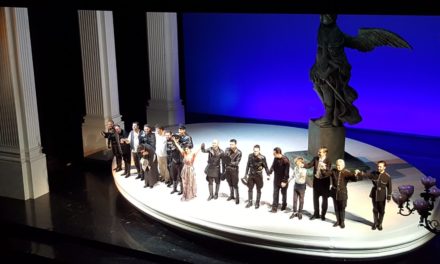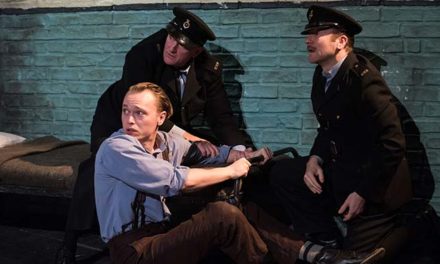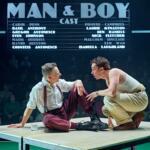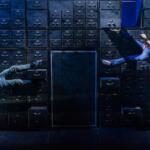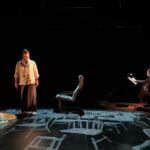

Berlin at Chicago’s Court Theatre (April–May 2025) was nothing short of a theatrical triumph. Directed by the seasoned Charles Newell, who has helmed the Court Theatre for three decades, the production brought together a remarkable group of artists whose collective vision and craftsmanship elevated this play to an exceptional level. Featuring a stellar creative team—playwright Mickle Maher, scenic designer John Culbert, dramaturg David J. Levin, and movement director Julia Rhoads—Berlin also has a powerful cast that included Raven Whitley as the resilient Marthe Müller, Tim Decker as the enigmatic Kurt Severing, and Elizabeth Laidlaw, whose dual performance as Gudrun Braun and Adolf Hitler left a lasting impression.
Set in the turbulent years of the Weimar Republic during the WWII, at the cusp of fascism’s rise in 1928, Berlin paints a vivid mosaic of individual stories that illuminate the varying ways people grappled with a world spiraling toward chaos. What makes the production so compelling is not only its historical context, but the way it weaves personal trauma and collective strife into a narrative that feels both timely and timeless.
The play is a culmination of over five years of rigorous development, a testament to the dedication of its creative team. The extended rehearsal period allowed the work to evolve organically, reflecting a process of constant refinement that paid off onstage. A particularly unique aspect of the production’s development was its integration into a course offered at the Theatre and Performance Studies Department at the University of Chicago, where the play was workshopped in an experimental seminar workshop in the winter quarter of 2024-2025. This interactive approach brought fresh insights into the piece, contributing to its depth and resonant impact.
One of the most striking features of Berlin was its tactile, “organic” approach to performance. The creative team opted to rely heavily on the actors’ physicality—using the human body not only for emotive expression but also for creating soundscapes and motion. The actors’ footfalls on the floor, the clinking of objects, and their synchronized movements evoked the chaos of war without relying on digital effects. In a particularly poignant moment, the actors themselves created the sound of a moving train—an elegant, almost primal way of capturing the mechanics of a violent, disorienting time. Julia Rhoads’ role as movement director cannot be overstated: the physicality of the actors imbued the production with a visceral quality that made the emotional weight of the story palpable. The human body in this context is not just a vessel for character, but a symbol of the trauma war inflicts, and the fragile connections that remain despite it. This emphasis on corporeality—this focus on what the body can express in the face of violence and instability—was one of the most powerful elements of the production.
The early stages of Berlin‘s production, around 2020/2021, coincided with the upheaval of the Covid pandemic, as well as significant global and domestic political turbulence. Fast forward to its premiere in May 2025, and the play’s themes of instability and anxiety took on an unsettling resonance, echoing the disintegration of democratic institutions in the Weimar Republic. In this sense, Berlin not only speaks to a historical moment but also offers a chilling reflection on the cyclical nature of history, where the shadows of past crises seem to reemerge, echoing the very fears and tensions the play explores. This repetition, this “uncanniness,” is at the heart of the production’s urgency: it invites the audience to confront the uncomfortable reality that the lessons of history are often forgotten—or ignored—until we are forced to face them again.
Indeed, at its core, Berlin is a meditation on the very idea of historical “progress.” As the characters navigate the encroaching darkness of fascism, the play asks whether humanity learns from its mistakes or is doomed to relive them. The questions raised are not just academic; they speak directly to the way we engage with history today. How do we reconcile the atrocities of the past with our current understanding of progress? Are we fated to forget the pain of history as it becomes commodified in textbooks, reduced to facts rather than lived experience? And if history is a cycle of recurrence, does that disillusion us to the very idea of human advancement? As the production’s program notes, Berlin “speaks to our current moment, and our future, with undeniable urgency.”
In short, Berlin is a tour de force. It is not merely a production that stands out in a season of theater, it will last.
This post was written by the author in their personal capacity.The opinions expressed in this article are the author’s own and do not reflect the view of The Theatre Times, their staff or collaborators.
This post was written by Susanna Sun.
The views expressed here belong to the author and do not necessarily reflect our views and opinions.