On German TV, each channel has its set of regular crime drama. For example, there is the long-running series Tatort, broadcast by the main channel ARD, launched in 1970, with so far 1336 90-minute episodes, focusing on currently 21 local teams. The SOKO series (abbreviation for Sonderkommission, EN: special commission) for main channel ZDF was launched in 1978, with some 3800 45–50-minute episodes across eleven teams/locations. While these deal with serious crime, usually without elements of comedy or comic relief, some TV crime series are explicitly meant as comedy, such as Rosenheim Cops (ZDF, 601 50-minute episodes since 2002). In addition, there are new one-off 90-minute crime films or miniseries, as well as frequent repeats of German crime films originally made for release in the cinema. Between 1959 and 1972, Rialto Films and CCC Films created 32 and 6 films, respectively, on the basis of novels by British novelist Edgar Wallace (1875-1932). These are available on streaming platforms and are broadcast on freeview channels literally hundreds of times a year. In addition to fictional crime, whether serious or as comedy, there are regular and popular true crime documentary series across channels, self-made or imported from abroad and dubbed into German (but with the original soundtrack still audible to increase the documentary “feel”). It is fair to say that Germany likes crime on TV.
Theatre makes use of this predilection of German TV audiences for crime. Crime-related plays feature in the seasons of regular federal state, municipal and state theatres, as well as the unsubsidized “free” scene. Some companies are solely dedicated to this genre. In a series of contributions, I want to shed more light on this phenomenon. I start with different kinds of crime comedy.
The 38 German films based on the 170+ crime novels by Edgar Wallace were incredibly popular already in the cinema. Many actors, well-known from other film appearances in high class, award-winning literary films, and some with eminent careers in serious theatre, were cast in those Wallace films and what they delivered there was “hamming it up” on the grand scale, taken seriously at the time, but with hindsight, involuntarily (from the perspective of the filmmakers, I am sure) hilariously funny. There were many moments of heavy and meaningful sighing, speaking with a trembling voice or mysteriously whispering, and much screaming in horror. Many characters were stereotypically mad, with frantically staring or rolling eyes. Murderous shadows emerged from the darkness, preferably in the “London fog.” In later decades, the genre invited parody on film and TV. In 1929, Wallace’s novel The India-Rubber Men was published. In 1930, the German version was published by Goldmann under the title Das Gasthaus an der Themse (EN: The Guesthouse on the River Thames), translated by Arthur Schönhausen. New German translations were published in 1971 (Goldmann) and 1982 (a different publisher, Scherz). In 2024, a theatre version of the novel, written by Florian Battermann and Jan Bodinus, was premiered at Komödie am Altstadtmarkt in Braunschweig, directed by Bodinus. The production was revived, under the direction of Christian H. Voss, at Neues Theater Hannover in August 2025, returning there for a further 22 performances, due to audience demand, in August 2026.
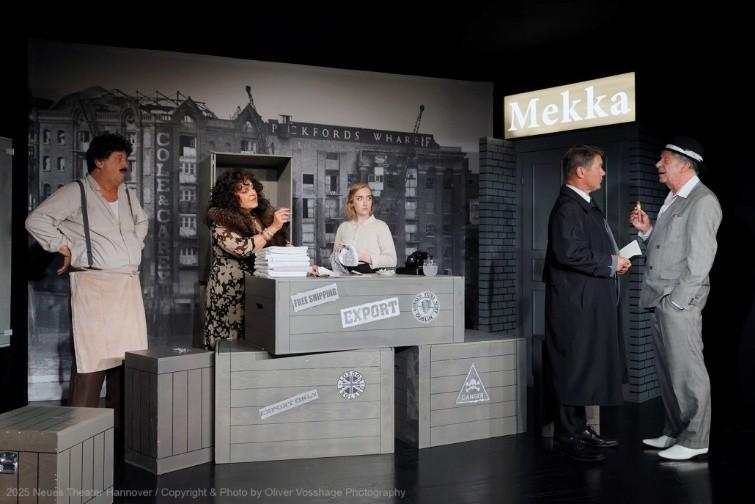
Das Gasthaus an der Themse, by Florian Battermann and Jan Bodinus, Neues Theater Hannover. (L. to R.) Thomas Henniger von Wallersbrunn, Sabine Schmidt-Kirchner, Fiona Sonnemann, Jens Knospe, Bernd E. Jäger van Boxen. Photo credits: Oliver Vosshage Photography.
The production could expect the audience to be familiar with the genre of the Edgar Wallace film, and the adaptation and production played with the hallmark characteristics of the genre. This started with the pre-show announcement asking spectators to turn off their mobile phones (or else…), and not to worry about the fog, because it was meant to be harmless, all spectators who attended the show last night were still alive … or at least most. The lights dimmed and the high reverb words and tune that started each of the films, “Hier spricht Edgar Wallace” (EN: “This is Edgar Wallace speaking”), sounded in the darkness. The set used a lot of fog machine effects and made use of flexible set elements to enable swift scene changes. The characters were easily identifiable set types, also known from the films. Jens Knospe’s inspector was particularly smooth, suave and elegant, and appropriately insecure when talking to his love interest, Lila. Fiona Sonnemann gave Lila just the right mix of sweet naivety and clever sophistication, emerging gradually from the cocoon of the young woman who appears much shallower than she is. Sabine Schmidt-Kirchner was hilarious as the feisty innkeeper, Nelly Oaks, with a voice roughened from decades of smoking and drinking whiskey. Her gravelly voice and black wig probably intentionally reminded audiences additionally of a character from current TV crime series (the public prosecutor in the Münster Tatort), and actress Katy Karrenbauer (from a number of popular TV series, including crime series). When Schmidt-Kirchner played her “other character”, Anna Fuller, a simple old woman, not only did she change costume and wig, but she also equipped Anna Fuller with a much higher-pitched, fragile voice befitting that character’s old age and fragile state of mind.
Bernd E. Jäger van Boxen was mysterious as the enigmatic Mr. Romanov, and as Dr Smith, the police force’s medical officer, innocently efficient, providing no clue as to his identity, revealed at the play’s climax as the master criminal known as “The Shark” because he appeared in diver gear on the Thames and killed his victims with arrows of a harpoon. Thomas Henniger von Wallersbrunn played Nelly Oakes’s dim-witted assistant Wilson (Woody) as a sad, shy little creature, while as Captain Brown he was all nasty, aggressive and transgressive scheming criminal. Karl Szaknys differentiated well between his three stereotypes, seaman Fred McMullen, gambler William Golly, and small-time crook Nathan Lane, regulars at Nelly Oakes’s inn, characters not in the original film or novel, but added by Battermann and Bodinus to add local color in the dingy pub by the riverside.
The production’s director, Christian H. Voss ensured fast and efficient scene changes. In the smooth flow of the plot, he foregrounded the many instances of gently exaggerated, stereotypical characterization, as well as sound and light effects (the moment the arrow is released from the harpoon, and the London fog in particular), making for excellent summer entertainment.
The crime comedy Bis das der Tod was premiered at Komödie Frankfurt in February 2025, followed by independent productions at Kammertheater Karlsruhe (September 2025) and Komödie Winterhuder Fährhaus (July 2026). Komödie Winterhuder Fährhaus was founded in 1988 as a sister company to the Theater am Kurfürstendamm / Komödie Berlin (founded in 1921 and 1924, respectively, and led by the Woelffer family since 1934, now in its third generation by Martin Woelffer). It is one of the leading boulevard comedy theatres in Germany. For many years, Woelffer has been successful in attracting leading actors from more conventional theatre, and from film and television, to perform on his stages. The attraction for those actors is usually associated with the renown of the dramatists. Katja Riemann played in Ayckbourn’s Intimate Exchanges in 2001. For Bis das der Tod, the attraction was Austrian dramatist Stefan Vögel (b. 1969), who has written some 55 plays to date, most of which were very successful indeed. The cast included Hans-Werner Meyer and Katharina Abt, both widely known from German TV. Meyer played Pascal, a solicitor, and lover of very rich businesswoman Helena, who is married to good-for-nothing Gregor. Pascal plots with Helena to have Gregor killed, and plots with Gregor to have Helena killed – Pascal will hire and pay the murderer with Helena’s money, and he will inherit all of Helena’s fortune after their deaths will have been discovered. The hired murderer, Arno, (only a minor criminal, usually working as a burglar) turns out to be rather incompetent. He is also revealed as a former schoolmate of Helena, with a big crush on her. With many hilarious plot twists, in the end four of the five characters are dead, and the sole survivor is Yvette, Helena’s over-the-top friend who has turned up on many occasions over the course of the play at the very worst moments possible, triggering gales of laughter from the audience with the chaos and confusion she has been causing all along.
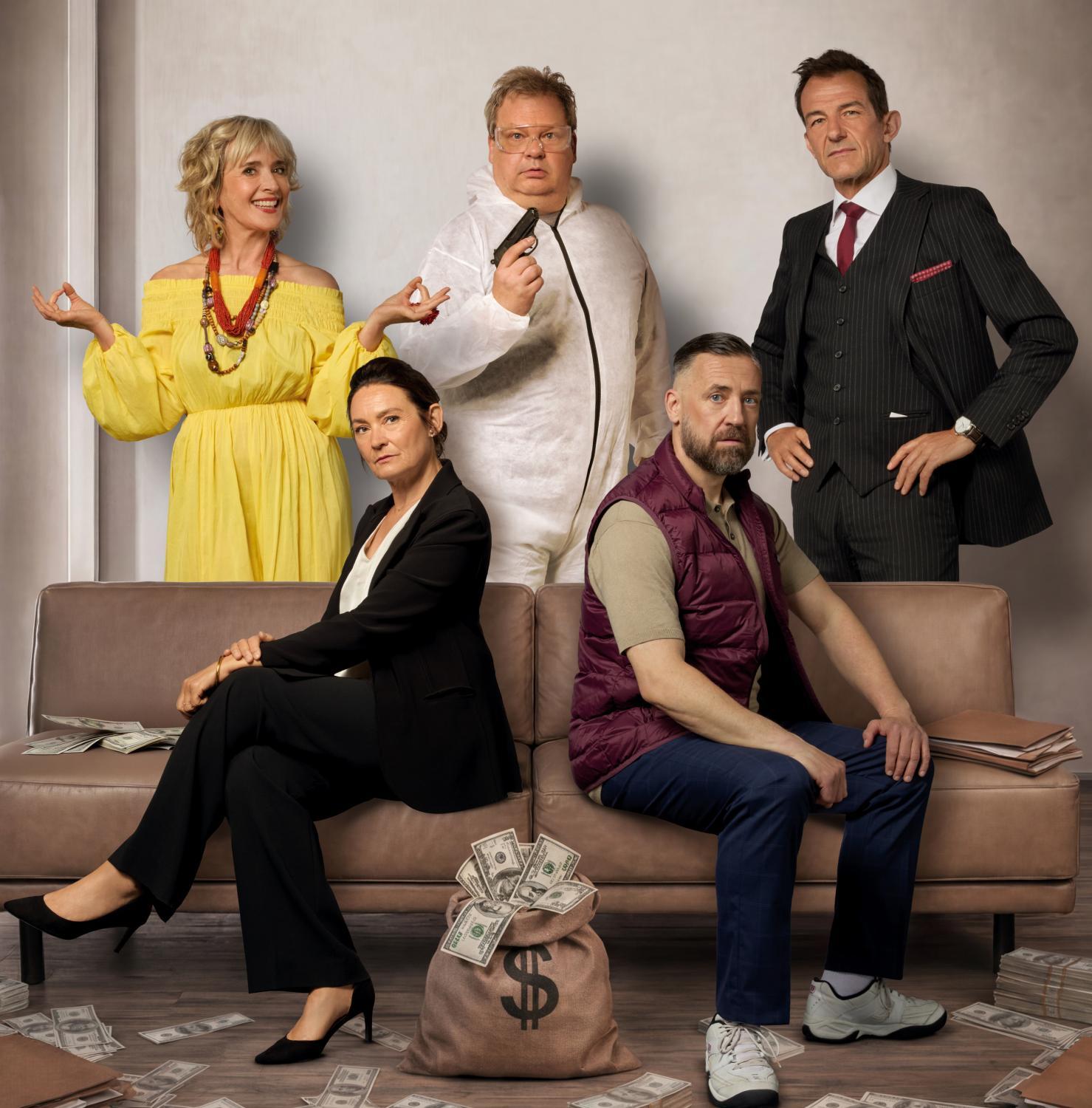
Bis das der Tod, by Stefan Vögel, Komödie Winterhuder Fährhaus, Hamburg. (L. to R.) Standing: Katharina Abt, Ulrich Bähnk, Hans-Werner Meyer. Sitting: Jacqueline Macaulay, Bürger Lars Dietrich. Photo credits: Michael Petersohn.
Meyer was suitably suave as the solicitor, even if Pascal was perhaps not as clever as he thought himself to be (otherwise he would not have chosen inept Arno as the hitman); Meyer also excelled at the more sinister moments when Pascal suddenly turned on an innocent victim. Meyer’s real-life wife, Jacqueline Macaulay, was convincing as the rich businesswoman, Helena, who was used to getting her ways because money buys everything. It was striking how quickly her Helena kept moving on from unexpected developments, not wasting any time lingering on in the past. Bürger Lars Dietrich played Helena’s husband, Gregor, who has made an easy life for himself at the expense of his wife’s money – he probably never loved her and certainly does not love her any more now. He risked losing all her money, though, if she proceeded with her plans for a divorce, and was thus an easy target for Pascal’s intrigue. Because Ulrich Bähnk, known from funny roles on German TV, was ill, the production’s director, Sebastian Goder, stood in at short notice as the hitman, Arno. He was funny enough as the bumbling fool who managed to kill two of the four characters who ended up dead in the play. Katharina Abt, also known widely from TV (including some 20 episodes as a detective inspector in the popular crime comedy series Die Rosenheim Cops) played Helena’s outrageous friend, Yvette.
Mordpläne mit Himbeerdame (EN: Plans of murder with raspberry cake) is a recent play (2024) by relative newcomers Theresa Sperling and Stefan Voglhuber. This crime comedy takes a strange situation as its starting point: zookeeper Anton, single, mid-forties, enters his garden shed, as he does every morning, to change into his work clothes (he can’t do this in his flat, because he shares the flat with his grandmother who is suffering from an allergy against animal hairs). He is startled when he suddenly sees his neighbor, Claudia, in the shed. She is the wife of the local baker and owns the village bakery. She is upset because her husband has returned, yet again, apparently from drinking in the pub, only in the early morning and has not done the day’s baking. She needed some peace and quiet, which she hoped to find in Anton’s shed. The opening moments set the tone for the rest of the comedy. Claudia is seen on stage first, grim-faced, munching some cookie. She is startled when Anton enters, singing to the music he listens to from his headset, and she needs to resort to a litter picker to poke him into attention. In the course of the play, it emerges that Anton is at the constant beck and call of his grandmother. It turns out that the grandmother, suffering from Munchhausen-syndrome, is pretending all of her illnesses, and that Claudia’s husband is unfaithful to his wife. In a state of advanced drunkenness they plot murder, before Anton collapses. The next morning, Anton is still on the floor, fast asleep, while Claudia enters with two pieces of a newly baked Himbeerdame, a special kind of raspberry cake. It turns out that she put the poison they talked about the night before into the cake and left a piece each with her husband and Anton’s grandmother. However, the husband did not eat the cake in the first place and the dose of poison Claudia mixed into the cake only led to the grandmother falling asleep rather than dying. Both are relieved at this outcome. A few months later, Claudia is divorcing her husband and realizing her dream of opening a café, while Anton’s grandmother is reigning supreme in an old people’s residence. Despite some advances from Claudia, right from the start, which Anton consistently evades, at the end of the play Claudia and Anton do not enter a relationship.

Andreas Brendel and Vania Brendel in Mordpläne mit Himbeerdame by Theresa Sperling and Stefan Voglhuber. piccolo teatro Haventheater, 2026. Photo credits: piccolo teatro Haventheater.
The play, with only two characters, is a good choice for smaller venues, such as the 60-seat piccolo teatro Haventheater in Bremerhaven, where Vania and Andreas Brendel played the roles of Claudia and Anton, while also co-directing the production, designing and building the set, choosing the costumes and arranging the lighting and sound cues. They secured sponsorship in the form of an elaborate raspberry cake for each performance from one of the local bakeries, the rests of which were sometimes shared with appreciative audiences after the final curtain call. The result was a fast-paced production making for great entertainment.
This post was written by the author in their personal capacity.The opinions expressed in this article are the author’s own and do not reflect the view of The Theatre Times, their staff or collaborators.