
This year’s theatre Biennale (7 to 21 June), with Willem Dafoe at the helm, has the intriguing title, Alter Native. In fact, in the program, the director and his advisory team have included practitioners from Italy and many parts of the world, including Africa, Japan, New Zealand, Indonesia, Greece, and India, who are bent on exploring native rituals and traditions while developing them in often startlingly innovative ways. Dafoe described his intent as follows: “I have sought to invite work from theatre contexts, very different from the commercial and institutional ones in the West. It’s the absence of familiarity that allows us to discover the origins of theatre and re-awaken the essential contact between theatre makers and spectators. For me, the strength and uniqueness of theatre, a total art form, lies in its immediacy, in its ritualistic nature and meeting of human beings.”
Mario Banushi’s work has travelled far and wide to great acclaim since lockdown, when he wrote and staged Ragada, the first part of Romance familiare, a semi-autobiographical account of his family. This actor, writer and director was born in Greece from an Albanian family, after which he lived in Albania as a child before returning permanently to Athens. In the trilogy he takes inspiration from the culture and rituals of his migrant family. As he revealed in a talk organized during the Biennale, he visits Albania every year, to see relatives, and especially his grandmother, all of whom have had a huge impact on his creativity and work. His familiarity with the culture and rituals of Albania is what feeds his imagination, giving rise to what is a very intimate theatrical form, where words are non-existent or minimal, and visuals, music, sound, and smells predominate.
Ragada refers to the word for ‘stretch marks’ in Greek, scars that form as a person is growing. They can also be caused in labor, when a woman gives birth. They fade with time, but never disappear. Themes of suffering and pain, especially of women, permeate the play.
Mario Banushi’s Romance familiare (Chapter I – Ragada), at Venice Theatre Biennale 2026. Photo credits: Andrea Avezzù. Courtesy La Biennale di Venezia.
Due to restrictions during the pandemic, Banushi was forced to set Ragada in a private house in Athens, a setting which is still used today whenever possible. Along with another 20 audience members, I saw the play in a beautiful Venetian house by a canal. As the performance was about to start, we were ushered from the street through an anonymous front door into a dark living room, where we were seated on chairs and cushions, in close proximity to the actors.
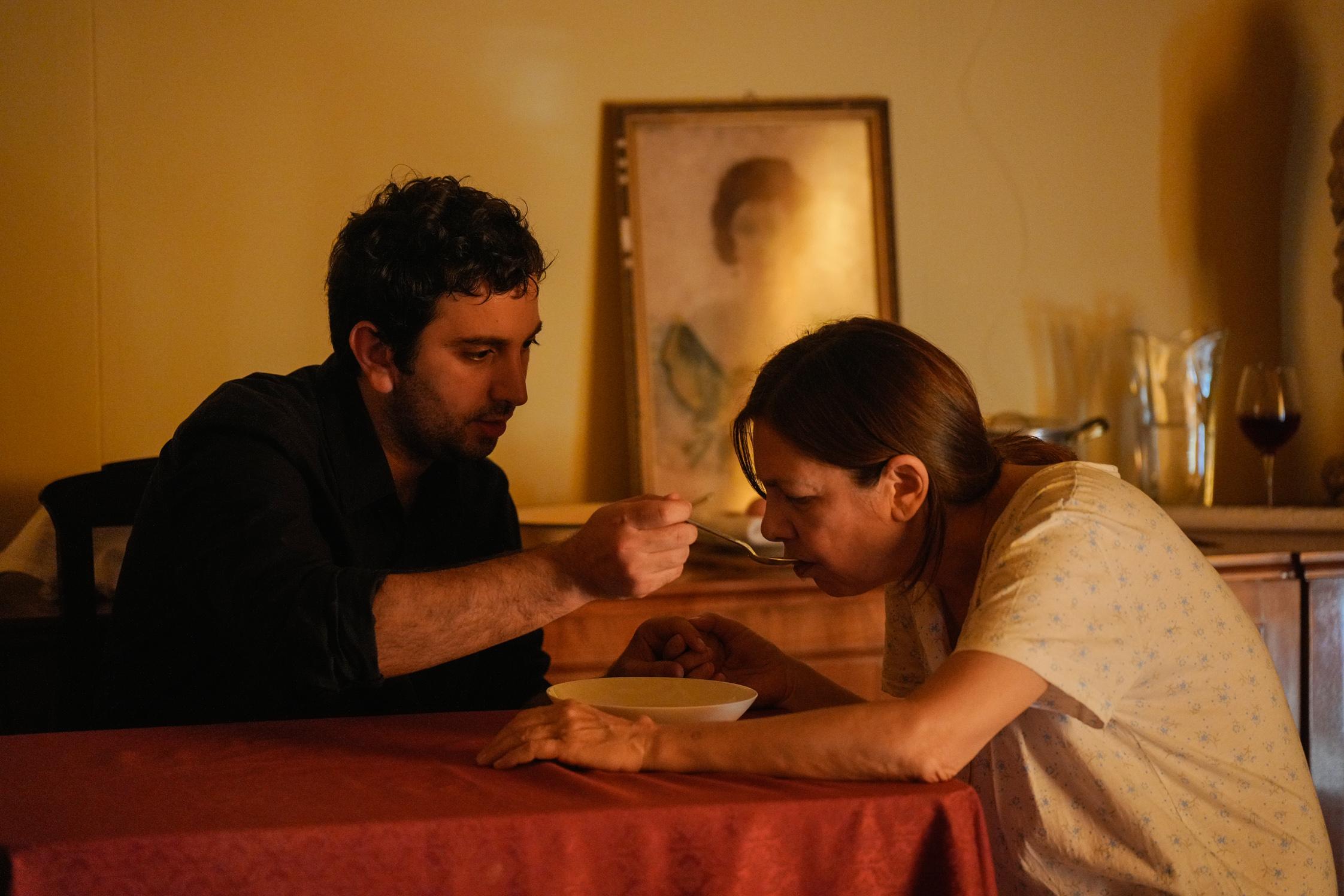
Stage right, a young man (Mario Banushi) sits at a table spoon-feeding an elderly woman, looking weary by his side (hereafter I call them Mother and Son). This slow, repetitive action, accompanied by the sound of a radio, is suddenly broken by the Mother taking off her clothes and lying naked on the table. The Son sets about covering her body with dust (a procedure in Albanian burial rites), when another woman enters, lightening the atmosphere by singing In the Mood for Love.
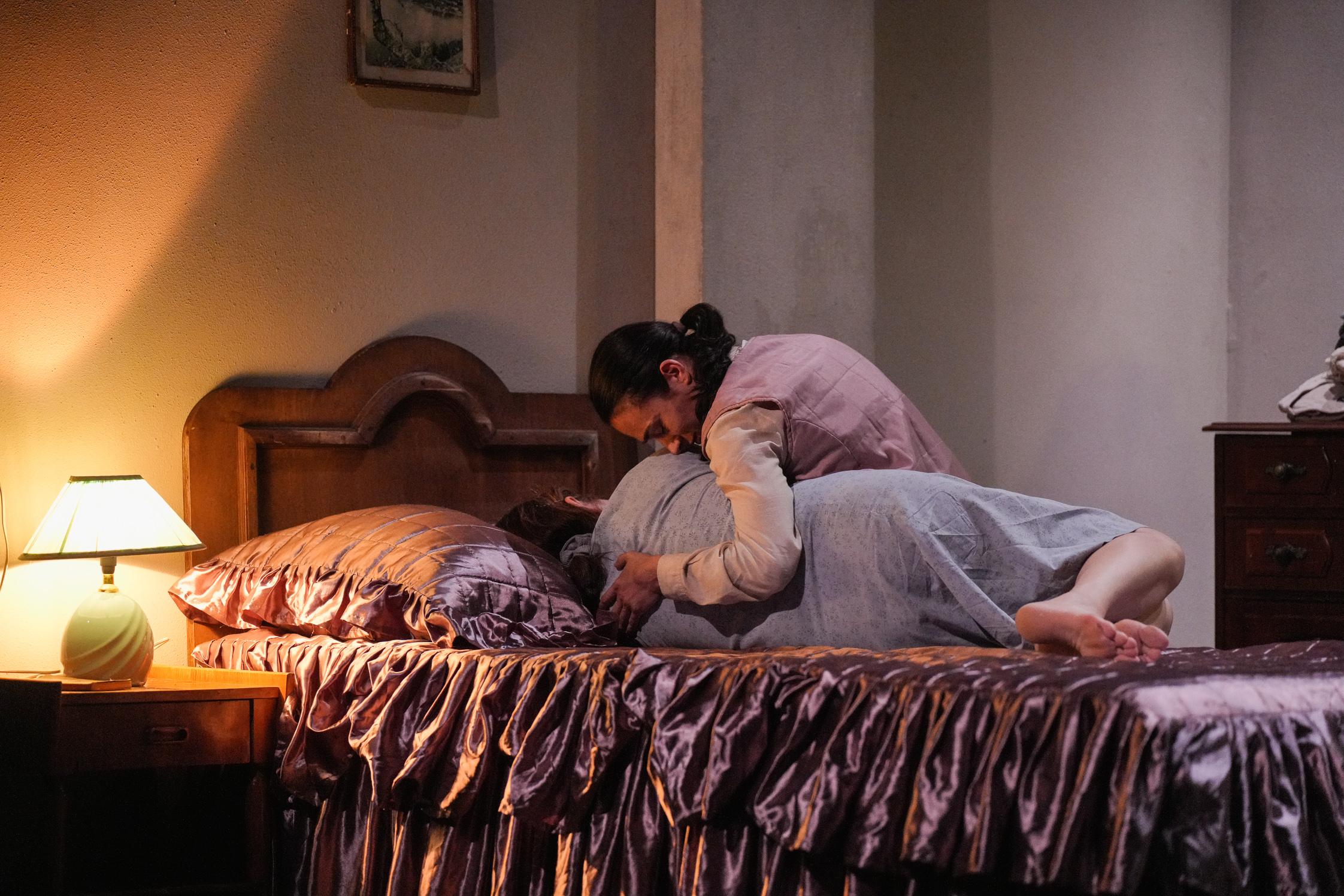
Mario Banushi’s Romance familiare (Chapter II – Goodbye, Lindita), at Venice Theatre Biennale 2026. Photo credits: Andrea Avezzù. Courtesy La Biennale di Venezia.
In what turned out to be a dreamlike sequence of events, a central door opens and a beautiful, dark-haired young woman emerges – a younger version of the Mother perhaps? Dressed in a stunning white satin, Albanian wedding gown, she stares out at the audience, looking sulky, frightened, uncomfortable by turn. Her ever-changing expressions seem to point to her fraught state of mind prior to her wedding. When the Son’s mobile rings, we hear a conversation in Albanian, surtitled in English – the only time words are spoken. In response to his request for a story, his Mother describes her unhappy experience of giving birth to his sister, Anastasia. When her waters broke, she found herself alone and treated badly by the hospital staff. In another short episode, the Son can be seen rhythmically kneading dough. Once again, though, what had seemed an everyday domestic task grows strange as he starts to tenderly cover the woman’s face with the dough, creating a kind of living mask. A very close bond between Mother and Son comes to light, foregrounding her suffering, and what might be seen as the Son’s desperate attempt to keep her alive, even in death.
The second part of the trilogy, Goodbye, Lindita, opened in Athens in 2023. In the play, Mario Banushi puts a family group onstage, made up of three men and five women, among whom are the Mother and Son from Ragada. In this case, death, mourning and the funeral rites of Albania stand central. At the outset, on a dimly lit stage, the family can be seen rushing around, intent on performing the everyday tasks of hoovering and providing fresh bedlinen and clothes for a figure who is sick in bed. Then one of the women throws some sheets to the floor, suggesting they are no longer useful since the person has died. A sideboard is brought center stage and opens up to reveal a woman’s body inside, prompting the women to carry out the ritual of preparing the body for burial, by stripping, powdering, and dressing it. A mattress is quickly rolled up and disposed of, turning the bed into a bath (which will be used later). In this dreamlike world, inanimate objects quickly change shape and use, creating situations of uncertainty and wonder.
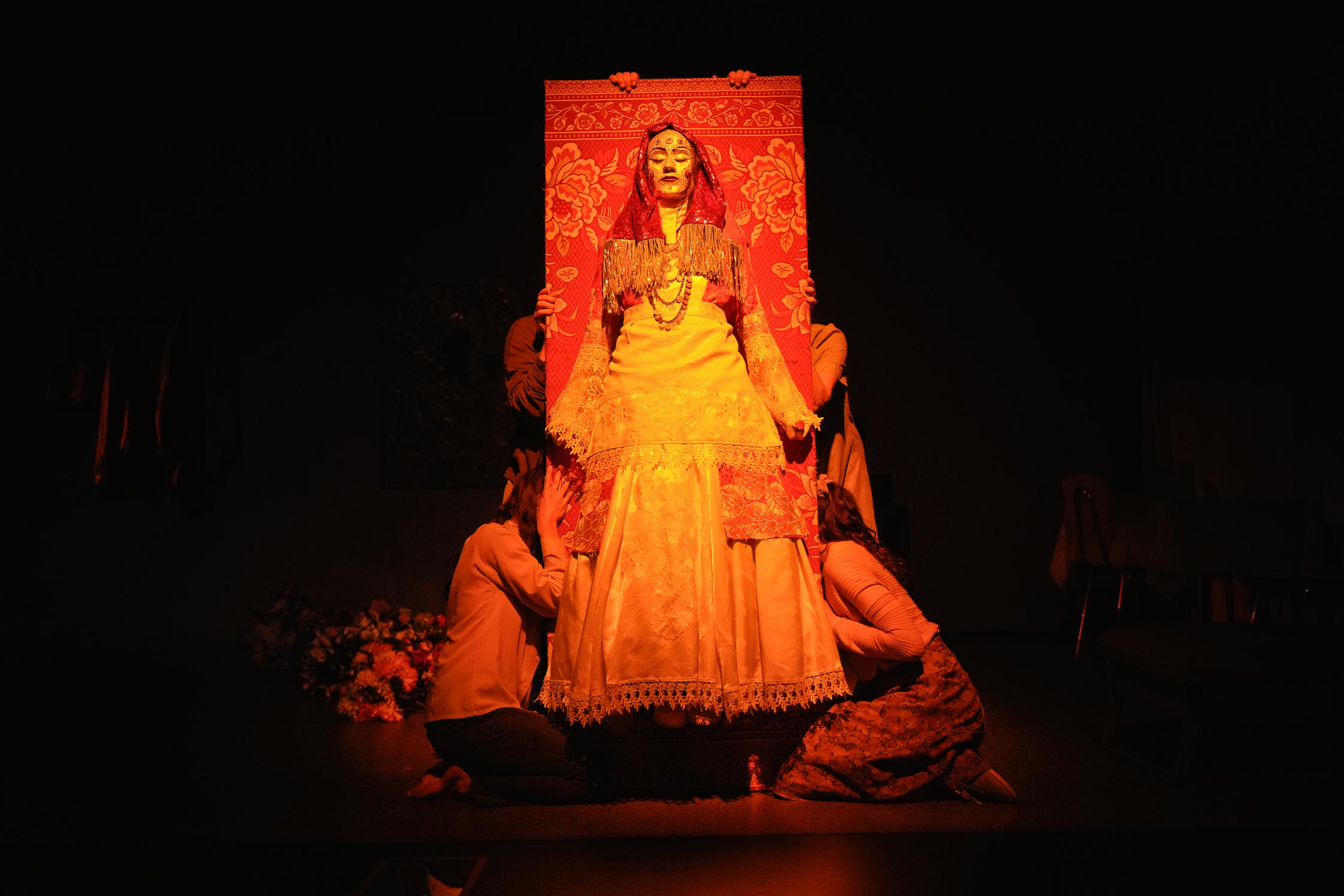
Mario Banushi’s Romance familiare (Chapter II – Goodbye, Lindita), at Venice Theatre Biennale 2026. Photo credits: Andrea Avezzù. Courtesy La Biennale di Venezia.
In the penultimate scene of a wake, the lighting turns to chiaroscuro, reminiscent of a Caravaggio painting. The family sit in silence around the body, while, in sharp contrast, at the foot of the bed, an old-fashioned television blares out. Another quick shift in mood, and play finishes in total chaos. Firing and gunshots fill the air, smoke and dust are everywhere. The family madly seek to escape, leaving the destruction behind them. The lack of explanation, regarding this deeply tragic ending left me uncertain as to this author’s intentions.
Still, despite this lack of clarity, Mario Banushi offers a haunting picture of a family grieving for a loved one, revealing this author-director’s deep sensitivity to human emotions and suffering. His vision is splendidly brought to the stage, moreover, with the support of a talented creative team, including dramaturg Sophia Eftychiadou, set and costume designer Sotiris Melanos, music by Emmanouil Rovithis, lighting designer Tasos Palaioroutas.
This post was written by the author in their personal capacity.The opinions expressed in this article are the author’s own and do not reflect the view of The Theatre Times, their staff or collaborators.
This post was written by Margaret Rose.
The views expressed here belong to the author and do not necessarily reflect our views and opinions.