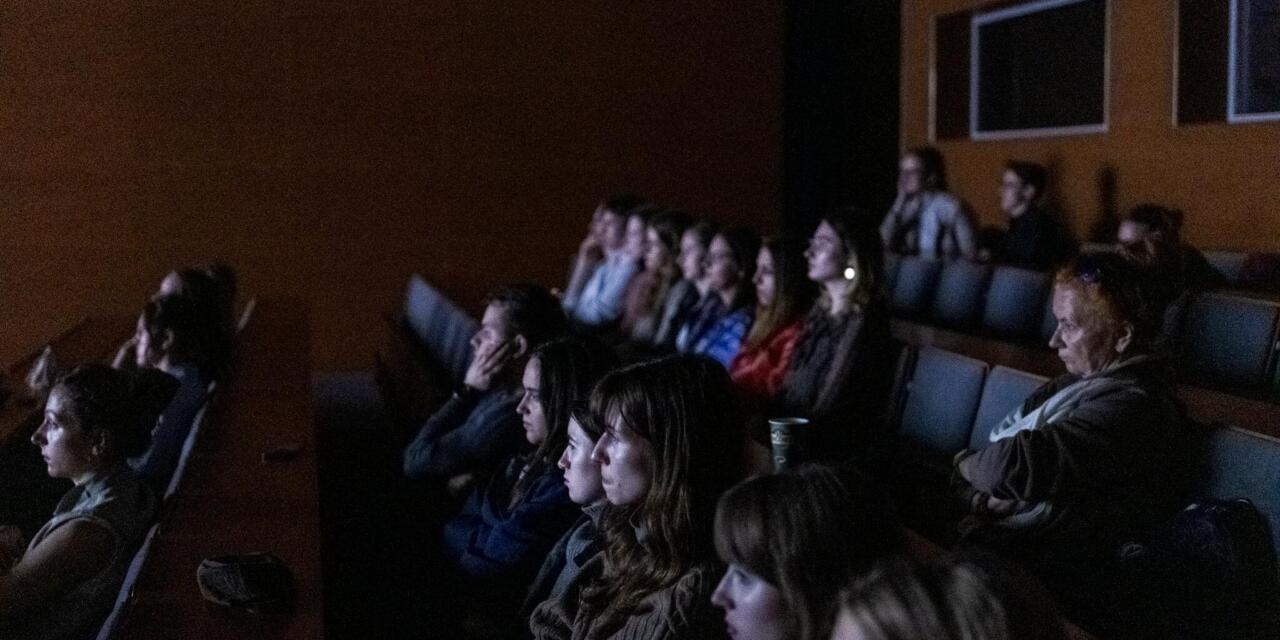
The “Screen / Stage” program was created as a space for shared viewing, discussion, and reflection on digital forms of contemporary theatre. Positioned at the intersection of live performance and digital mediation, the initiative invited participants to engage with recorded stage productions not as passive spectators, but as active commentators and critics. By combining collective viewing with moderated discussion, “Screen / Stage” explored how theatre functions across formats, cultures, and traditions, and how meaning is shaped through performance, adaptation, and craft.
Drawing on productions available via Digital Theatre+, “Screen / Stage” addressed a broad audience: students from various disciplines, Erasmus program participants, teachers, researchers, and theatre enthusiasts interested in English-language theatre and contemporary performance, as well as those who hadn’t engaged much with the performing arts before. Rather than focusing solely on interpretation or evaluation, the participants were encouraged to discuss how theatre works—how stories are told, how conventions operate, how cultural contexts shape meaning, and how the medium itself influences reception.
Pre-Festival “Screen / Stage” meetings
In the months leading up to the Between.Pomiędzy Festival 2025, “Screen / Stage” functioned as a preparatory program designed to establish a common ground for discussion. The three introductory meetings created a space where participants could develop shared analytical tools and become comfortable engaging critically with theatre in a group setting.
The first meeting focused on The Container, a site-specific play by Clare Bayley, staged inside a shipping container and experienced by small audiences. The discussion addressed the framing and promotion of the production, particularly the role of media representation in shaping audience expectations. Participants examined how non-Western narratives are presented within Western institutional frameworks, and how issues of power, space, and visibility operate within the performance. The portrayal of women, social divisions, and authority structures naturally led to broader reflections on ethics, spectatorship, and responsibility. The conversation also opened up questions about digital theatre more generally: what is gained, and what is lost, when performance is experienced through a screen?
The second meeting centered on Titanic: The Musical, first staged on Broadway in 1997. Here, attention shifted to the historical context and collective memory. Participants discussed the social atmosphere surrounding the Titanic’s maiden voyage and the ways in which class divisions, gender roles, and aspirations for a better future are woven into the musical’s structure. The form itself became a key point of discussion: how does the musical, as a genre, shape emotional response and audience identification differently from spoken drama? What kinds of stories does it make possible, and what kinds does it simplify?
The third meeting focused on Death and the King’s Horseman, written by Wole Soyinka. Moderators introduced the historical and cultural background of the play, including the real events that inspired it, Yoruba traditions, and the colonial context of the 1940s Nigeria. Particular attention was paid to language and translation: the decision not to translate songs and chants, the literal rendering of certain idioms, and the implications of these choices for understanding and interpretation. Participants also discussed costume, color symbolism, and cultural authenticity, as well as the play’s treatment of duty, honor, gender roles, and colonial power. The conversation repeatedly returned to the question of perspective: how does being a European viewer shape one’s understanding of the play?
Together, these introductory meetings established “Screen / Stage” as a space where disagreement, uncertainty, and multiple interpretations were welcomed. Rather than providing definitive readings, the sessions encouraged participants to listen closely to one another and to reflect on their perspectives as viewers.
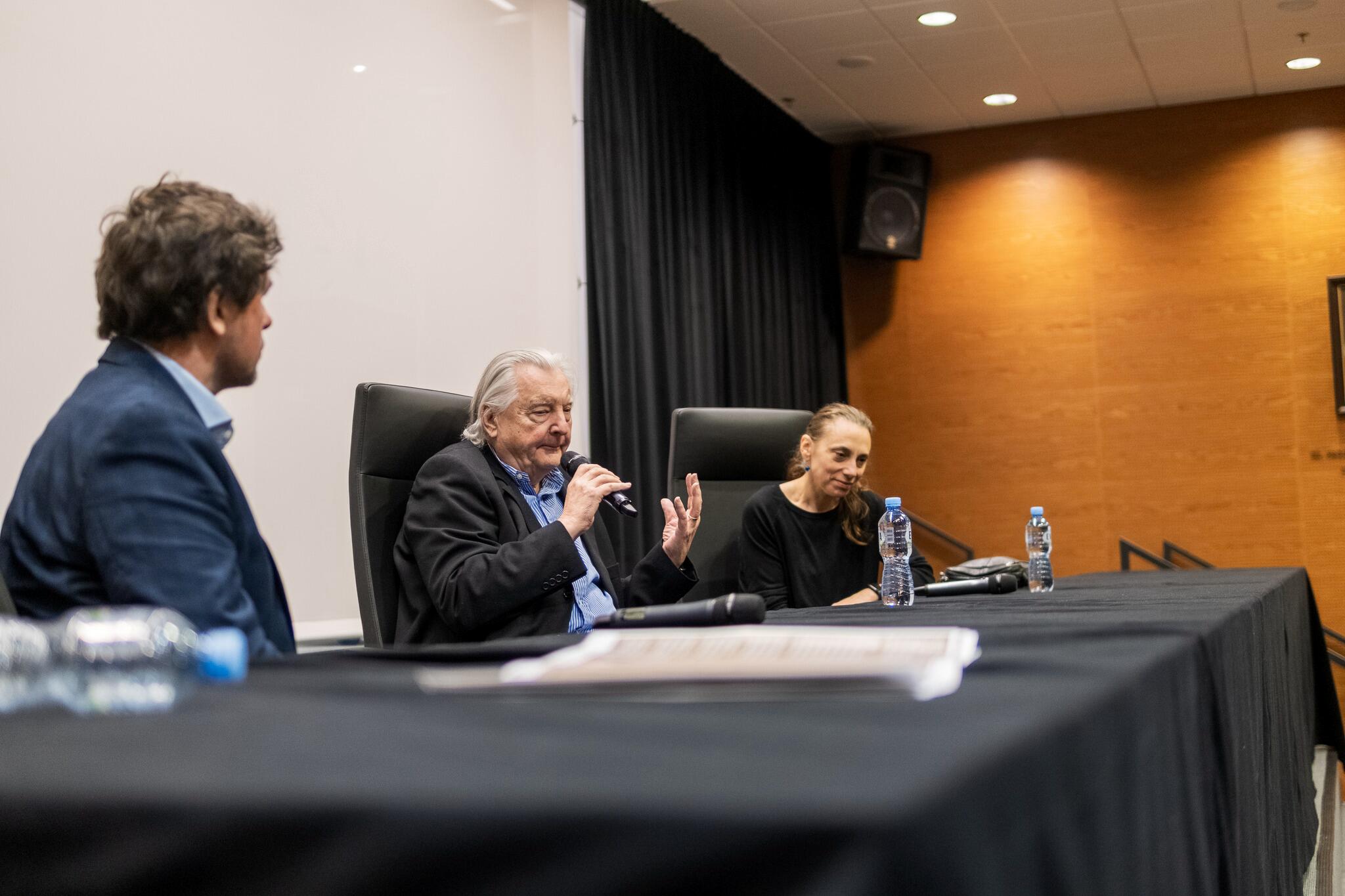
Tomasz Wiśniewski, S.E. Gontarski, and Klaudia Łączyńska opening the post-screening discussion. Photo credit: Dominika Milewczyk.
“Screen / Stage” during the Between.Pomiędzy Festival 2025
During the Between.Pomiędzy Festival 2025, “Screen / Stage” became an essential component of the festival’s intellectual and reflective dimension. While the festival itself foregrounded live performance, artistic experimentation, and international exchange, “Screen / Stage” offered a complementary element: slower, discussion-oriented, and focused on close attention to theatrical detail, now within a much wider audience.
Across three festival days, participants gathered to watch and discuss recorded productions that resonated with the festival’s central concern with theatre as a craft.
Day One: Drive Your Plow Over the Bones of the Dead
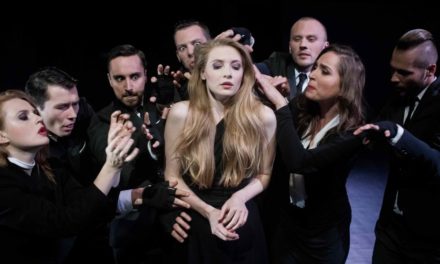
The first festival “Screen / Stage” meeting focused on Complicité’s adaptation of Drive Your Plow Over the Bones of the Dead. From the outset, the discussion turned toward theatrical conventions and the relationship between performers and the audience.
One of the central topics was the breaking of the fourth wall. Participants reflected on how direct address can both draw audiences in and disrupt immersion, depending on how and when it is used. This led to a broader discussion about the unspoken agreement between performers and spectators, which is the shared willingness to suspend disbelief and to accept the rules of the theatrical world.
The final moments of the performance, particularly the curtain call, became another focal point. Participants debated how the curtain call reframes the emotional and ethical weight of a play’s ending, sometimes softening its message, sometimes reinforcing it. The discussion also highlighted the importance of entering a performance without prior knowledge of the plot. Many participants felt that discovering the story as it unfolded intensified their engagement and allowed for a more visceral response.
Throughout the meeting, attention repeatedly returned to the precision of Complicité’s theatrical language and the way form and content were are tightly interwoven. The meeting set the tone for the festival “Screen / Stage” program by emphasizing attentiveness, curiosity, and openness to complexity.
Day Two: Into the Woods
The second day of the festival concluded with a “Screen / Stage” meeting devoted to Into the Woods, presented in an open-air production. The setting itself became a significant point of discussion. Participants described the experience of watching theatre outdoors as refreshing and unusually immersive, with the environment becoming part of the performance.
The stage design attracted particular attention. Rather than relying on elaborate sets, the production used a single, flexible structure made of scaffolding and performers’ bodies. This choice was widely seen as both inventive and thematically resonant, allowing the stage space to shift fluidly between locations and emotional states.
Discussion of the character development revealed striking observations about gender. Participants noted that the male characters tended to remain relatively static, while the female characters underwent significant transformation. This imbalance prompted reflections on agency, responsibility, and narrative focus.
Family relationships emerged as another central theme. The dynamics between parents and children, along with the long-term consequences of parental choices, were discussed in relation to the characters’ struggles and moral dilemmas. Gradually, the conversation moved toward more abstract notions, with “the woods” interpreted as a metaphor for adulthood itself: a space of uncertainty, compromise, and moral ambiguity.
Participants agreed that the production resisted simple moral binaries. There were no perfect heroes or villains, only flawed individuals navigating difficult choices. This openness to interpretation encouraged a rich exchange of perspectives and reinforced the idea that theatre does not offer answers, but creates space for questioning.
Day Three: Jane Eyre
The final “Screen / Stage” meeting of the festival focused on Blackeyed Theatre’s adaptation of Jane Eyre. The discussion was notably more critical, yet no less engaged.
Many participants were surprised by the production’s light tone, which contrasted sharply with the complexity of Brontë’s novel. A major point of critique was the adaptation’s heavy reliance on narration rather than dramatic action. This choice often made the performance feel closer to a dramatized audiobook than a fully theatrical experience.
The modernized elements provoked mixed reactions. While updating language and references can make classic texts more accessible, in this case several participants felt that the changes inched too close to parody, undermining the emotional depth of the story. The minimalist stage design also divided opinions: for some, it suggested conceptual spareness, but for many it appeared unfinished rather than intentionally restrained.
The camerawork also became a topic of discussion. Techniques such as lingering shots of non-speaking actors were compared to sitcom conventions, creating an unintended sense of irony that clashed with the narrative’s seriousness.
Despite these critical opinions, the meeting was widely regarded as valuable. The discussion returned repeatedly to questions of craft: adaptation choices, narrative balance, and the responsibility of theatre-makers toward both source material and audience. In this sense, the conversation echoed one of the central themes of the Between.Pomiędzy Festival 2025, being the importance of care, precision, and thoughtfulness in theatrical practice.
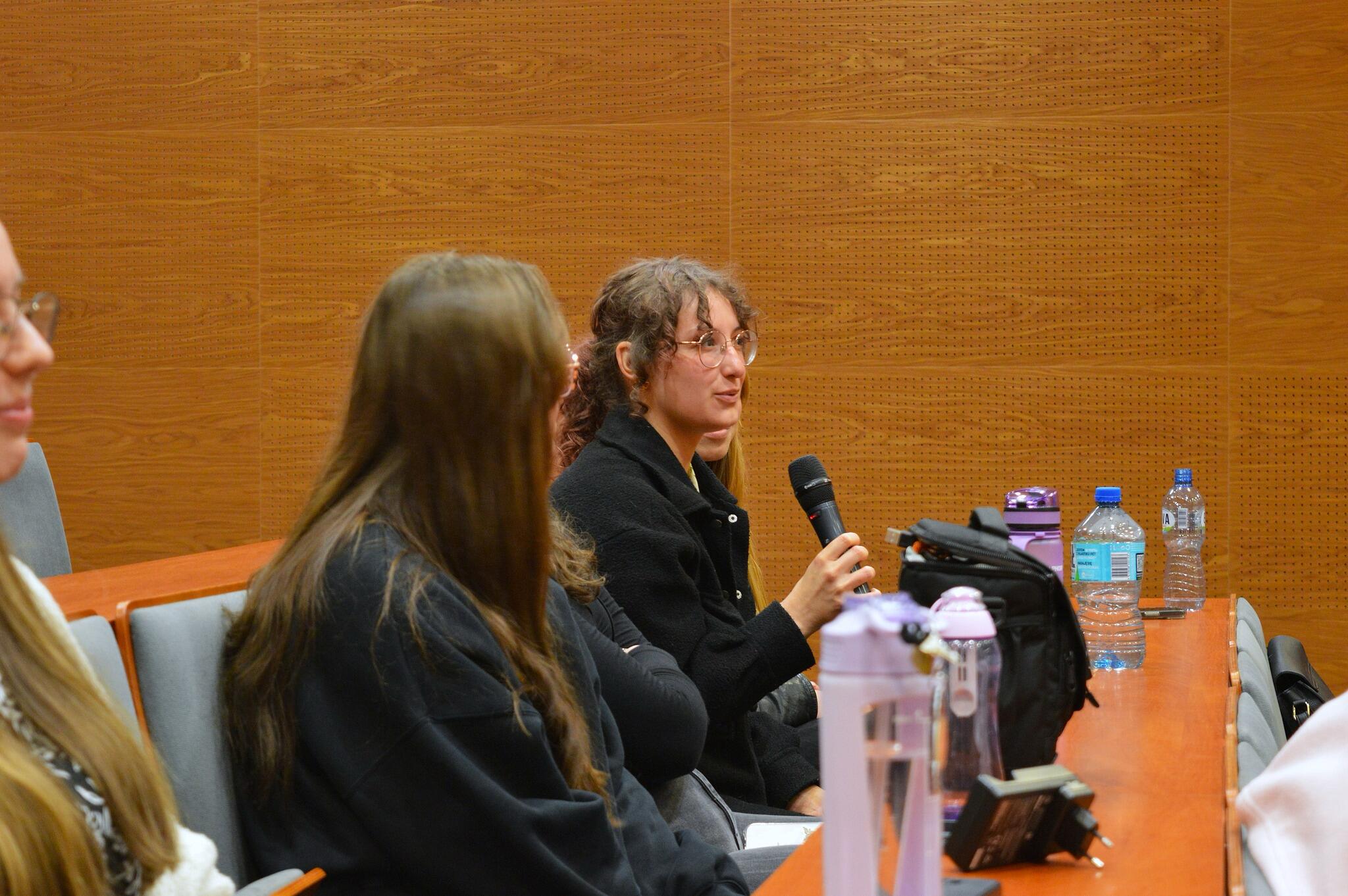
Photo credit: Patrycja Zielke.
“Screen / Stage” as a Space for Dialogue
Across both its preparatory phase and its festival presence, “Screen / Stage” functioned as more than a series of discussions. It became a shared space for thinking together about theatre—its possibilities, its limitations, and its changing forms.
By working with recorded performances, the program challenged assumptions about liveness and presence, while also highlighting what remains uniquely theatrical even when mediated through a screen. The emphasis on collective viewing and conversation transformed solitary watching into a communal experience, rooted in listening as much as speaking.
As part of the Between.Pomiędzy Festival 2025, “Screen / Stage” offered a slower, reflective counterpoint to the intensity of live events. It invited participants to pause, reconsider, and articulate their responses, reinforcing the
Across both its preparatory phase and its festival presence, “Screen / Stage” functioned as more than a series of discussions. It became a shared space for thinking together about theatre—its possibilities, its limitations, and its changing forms.
By working with recorded performances, the program challenged assumptions about liveness and presence, while also highlighting what remains uniquely theatrical even when mediated through a screen. The emphasis on collective viewing and conversation transformed solitary watching into a communal experience, rooted in listening as much as speaking.
As part of the Between.Pomiędzy Festival 2025, “Screen / Stage” offered a slower, reflective counterpoint to the intensity of live events. It invited participants to pause, reconsider, and articulate their responses, reinforcing the idea that theatre does not end when the performance does, but continues in discussion, disagreement, and shared reflection.
This article is part of the report on Between.Pomiędzy Festival 2025, available on TheTheatreTimes.com.
This post was written by the author in their personal capacity.The opinions expressed in this article are the author’s own and do not reflect the view of The Theatre Times, their staff or collaborators.
This post was written by Paulina Peret.
The views expressed here belong to the author and do not necessarily reflect our views and opinions.