It’s very hard to define Chiao-Jung Chen as one kind of artist, for she is someone who works fluidly across genres. She has worked as a playwright, a librettist, and a lyricist on various productions for the past ten years, with her plays and musicals being staged in both Macau and Taiwan. Outside the theatre, she is a comics writer whose work Sea You There and Us has garnered a worldwide fanbase. Her versatility makes any attempt to confine her to a single title seem blasphemous of her devotion to storytelling.
However, she has just received one of the most prestigious awards in Taiwan as a playwright. She was named the winner of the 2025 Taiwan Literature Award for Playwriting for The Thousand-Year Itch in July, and the play met its Taiwanese audience for the first time through a staged reading at the Prologue New Play Festival in November. Prior to the show, Kuan-Ting Lin, the literary manager at the Prologue Center for New Plays, sat down with Chen to look back on her major works and share insights into life as a playwright moving across Taiwan and Macau.
Lin: How did you become a playwright?
Chen: It was an accident. Originally, I was going to form a theatre group with friends when we were graduating from university. One of them took the director’s chair, and the other was more focused on acting, leaving me as the only person without an official position. Seeing that I didn’t show much resistance to writing, they encouraged me to enroll in a playwriting program, and that decision marked a turning point in my life.
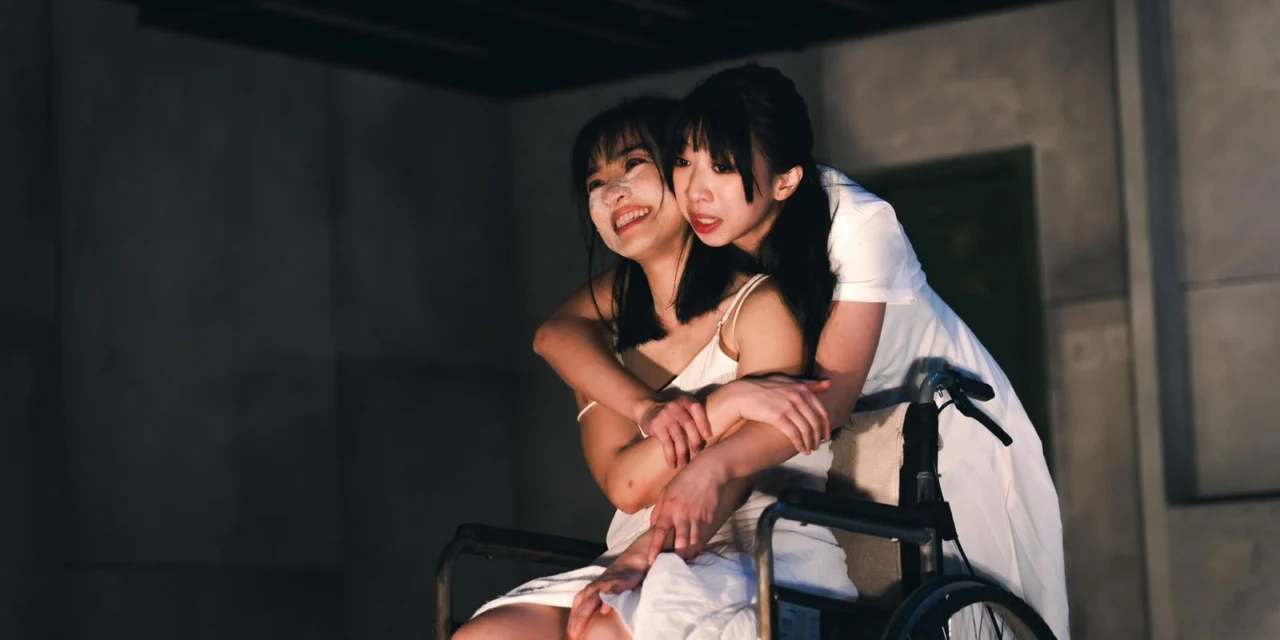
Lin: It did, since Let No One Sleep is both your thesis and the debut that introduced you to the Taiwanese theatre scene. It is not only about the family life of a disabled woman, but touches on the sexual needs of disabled people, the working conditions of social workers and immigrant caretakers, and how Taiwan addressed long-term care amid an aging population at that time. How did you select these writing topics and conduct field research?
Chen: Let No One Sleep didn’t require a lot of field research from me. I grew up in a three-generation household, and the hunched figures of my grandparents have always stuck in my head. At the time of writing, the Taiwanese media had also been covering two kinds of stories: one was the long-term caretakers killing their loved ones due to chronic stress, and the other was sex volunteers from an NGO called Hand Angels providing intimate services for disabled people. I thought it might be great to bring together my personal experience and the media trends.
Sex plays a significant role in the play, but this dramaturgical approach stirred controversy in the Macau production. Some audience members claimed that it was unnerving to see a disabled woman with sexual needs. However, their discomfort is precisely why such representation onstage is important. Disabled people, especially women, do not lack desire but are often desexualized. As a result, I portrayed the two sisters as libido-driven, using sex as a release valve for the mounting pressure within the family.
Lin: Compared with other works in your repertoire, Let No One Sleep is a rather realist play. Could you tell us how you made this artistic choice?
Chen: My writing style had been quite ungrounded before Let No One Sleep, and readers would complain about not understanding my work. So, my advisor suggested writing a realist play as my thesis, at least telling a story in a coherent and effective way once before leaving school.
Realist drama is arguably the genre that demands the most refined craft and meticulous imagination from playwrights. So, to be honest, writing the play was really wringing all the learned techniques from me. My advisor knew me well enough to make such a suggestion. Still, I have to admit that writing experience laid the groundwork for my later work.

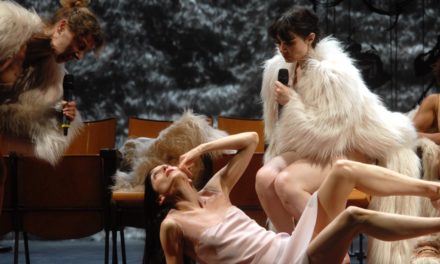
Chiao Jung Chen’s Sunset at the Shipyards. Courtesy of Dream Theater Association.
Lin: Your 2017 play Sunset at the Shipyards reflects the history of Macau through the declining shipbuilding industry. What prompted you to start writing about Macau?
Chen: My husband is from Macau, and that’s why part of my writing career is rooted there. Dream Theater Association, a theatre company in Macau, launched a three-year project in 2017 to revitalize the Lai Chi Vun shipyards and preserve the shipbuilding culture through theatre productions. They came to me, and that was the starting point of my writing career in Macau.
Lin: The workforce in shipbuilding was composed mainly of male laborers. Is that why there are few female characters in Sunset at the Shipyards? Also, what was it like to write about a masculine field as a female writer?
Chen: You’re right. Some shipbuilders told me that because of the labor-intensive nature of the shipbuilding industry, traditionally there were more male workers than female ones. That is why most characters are men. Yet, I also wanted a character to look back on the rise and fall of Macau’s shipbuilding industry from a feminine perspective, and this responsibility fell to the mother character in the end.
This writing experience also encouraged me to write herstory alongside history. I kept writing about shipbuilding and fishing in Macau following Sunset at the Shipyards, but historical accuracy gradually stopped being my main pursuit. In my short play The Flying Fisherwoman, I invented a fictional female captain who was active during the golden age of Macau’s fishing industry.
Lin: Was Sunset at the Shipyards written and performed in Cantonese? How did relocating to Macau and learning and writing in a new language transform you as a writer?
Chen: I used to write in Mandarin for the first few years in Macau, with my actors providing Cantonese translations during rehearsals. Nevertheless, Sunset at the Shipyards is a play that spans three generations, so the characters should speak Cantonese differently, reflecting how the language had evolved over time. So, I thought it would be best to write directly in Cantonese.
As I gained a stronger command of the language, I found that Cantonese words and phrases have so many nuances that would be lost in translation. My actors might have misread the moods and tones of the play if we’d kept the original writing and translation process. Although, more often than not, I still struggle with Cantonese, I became more sensitive to how language works in a play.

Chiao-Jung Chen’s The Thousand-Year Itch. Staged reading at the 2025 Prologue New Play Festival. Photo by Aaron Liau.
Lin: Your sensitivity came through in The Thousand-Year Itch, the multilingual play which won the 2025 Taiwan Literature Award for Playwriting. What inspired you to write a play that looks at the human world from an itch mite’s perspective?
Chen: I got scabies from my grandmother before she passed away during the pandemic. After returning from her funeral in Taiwan to Macau, I was quarantined in a hotel, finding myself not only grief-stricken but tortured by the itchiness from the scabies. The emotional and physical pain blurred together, giving me a delusion that my grandmother was still alive, transformed into invisible mites. This absurd idea led me to think more about time and space, the microcosm and the macrocosm, and eventually, life.
Soon after, I wrote a scene from a microscopic perspective, where the grand ancestor of the mite family is lying on his deathbed, surrounded by other members, and another scene where the microcosm and the macrocosm collapse, bringing the parasite-mite and the host-human into a magical space. The two scenes later became the opening and ending of the play.
Lin: The Thousand-Year Itch is a multilingual play, but it doesn’t include Taiwanese and Hakka, the two most predominant non-Mandarin languages spoken in Taiwan. Was it a deliberate choice or a coincidental consequence?
Chen: It was an intuitive choice at first, but I recognized and preserved it through the final draft. Mandarin functions as a symbol of Chinese culture in the play, since Chinese culture in Taiwan is my subject matter. Any time the play shifts into another language, whether it is Bahasa Indonesia, Bahasa Melayu, Korean, or English, it is a counterforce to push back against Chinese culture. I did consider including Taiwanese and Hakka, but they are too often used to construct a sense of Taiwaneseness, which is not my intention here.
Imagine a black hole: stars revolve around it, but not so closely that they are devoured. This, from my perspective, is the relationship between Mandarin and other languages, and between Chinese and other cultures. A distance between the center and its periphery must always be maintained, yet the very distance also suggests that the language is doomed to fail in fully conveying meaning, because Mandarin speakers are somehow afraid of communicating their thoughts and emotions directly. This is also why there is a deep sense of sorrow in The Thousand-Year Itch, but it is never addressed.
Lin: What do you generally think about using multiple languages in a play? Do you think it is possible to translate a multilingual play?
Chen: Before entering the playwriting program, I had already been using multiple languages in my writing. Taiwan has an obsession with languages, too. The reason behind my writing habit and this cultural phenomenon may be Taiwan’s history of colonialism. Having once been deprived of identity under Japanese colonial rule, many of us are subconsciously anxious about losing subjectivity or being misunderstood, and we feel the need to prove ourselves through multiple languages.
I am as doubtful as you when it comes to translating multilingual plays. That said, The Thousand-Year Itch will receive a Korean staged reading in 2026, and a Cantonese production is also in negotiation, so we will see how the play adapts in different cultural contexts.
Lin: How do you know whether a piece belongs to theatre rather than other mediums?
Chen: This is a question that constantly challenges me, but my approach to it has turned from “why theatre” to “why not theatre.” Theatre has survived numerous threats —the invention of film, the popularization of television, the rise of streaming services—and it hasn’t gone extinct because it is an inclusive art form that has all kinds of possibilities. Nevertheless, theatre is facing another historic moment now, AI-powered content being its fiercest predator this time. I think it’s urgent for theatremakers to find their own answers to why and how theatre is still relevant in an AI-dominated world.
Lin: Thank you for accepting the interview today. Again, congratulations on the Taiwan Literature Award.
This post was written by the author in their personal capacity.The opinions expressed in this article are the author’s own and do not reflect the view of The Theatre Times, their staff or collaborators.
This post was written by Kuan-Ting Lin.
The views expressed here belong to the author and do not necessarily reflect our views and opinions.