
When the production first opened in 2022, critics commented on the fact that the play was being presented at Deutsches Theater although Pollesch was then the artistic manager of Volksbühne. Others commented that the play had comparatively more in terms of narratable plot than other Pollesch productions. I must admit here that this was the first Pollesch production I have seen. I was aware of the name, of course, usually referred to with awe in relation to his background as the star graduate from the first cohort of the undergraduate course in Applied Theatre Studies at the Universität Gießen. However, on my occasional visits to Berlin, over the years, where most of his work was presented, his work was not on.
In 1988, Columbia released My Stepmother is an Alien, a film comedy about a scientist, Steve Mills (played by Dan Ackroyd), who coincidentally sends a radio wave into deep space beyond this galaxy. It hits a distant planet, and if that hit is not repeated, life on that planet will be destroyed. Two inhabitants of that endangered planet, Celeste (played by Kim Basinger) , and her aid, a tentacle with a single eye hiding in a handbag, come to earth to find Steve and to get him to repeat the fatal radio wave. The film focuses on the relationship between Celeste and Steve, made more complicated by Steve’s teenage daughter Jesse. The film was generally panned by critics as wasting a potentially good idea.
Pollesch’s Liebe, einfach außerirdisch, takes up the general scenario of that film and makes it ingeniously its own. There are three characters, the scientist, here called Steve Albright, and the two aliens, one the lead scientist from the alien planet, the other one her assistant. The reader’s digest in the program booklet refers to these characters with the initial letters of the actors’ first names: S for Sophie Rois as the chief alien, K for Kotbong Yang as her assistant, and T for Trystan Pütter as Steve. The character of the daughter in the film is not part of the play’s plot. K has taken the shape of Steve’s cleaner, Mrs. Knoop. In an early moment of the play, the two aliens find themselves surprised at their human shapes and S wonders why she had to take on the shape of a woman. K responds: “Weil du verloren hast. Wie ich. / Because you lost, just like me.” Checking out the definition of “woman” in a guidebook, S finds that women do not exist, and considers this idea thoughtfully: “Ich existiere nicht (…) Existieren … Was ist denn das Gegenteil? / I don’t exist (…) To exist … What is the opposite, then?” To which K responds: “Insistieren / To insist.” A moment later S embraces K and says, with reference to the two of them as aliens on earth: “Zwei von ihnen befinden sich auf besonderer Mission. Dies ist ihre Geschichte / Two of them are on a special mission. This is their story.” In particular the last sentence of this line is a reference to the key phrase in the spoken opening of the TV format of Law and Order. S commented early on in the play that they are now stationed on Earth, a 3rd class planet and have to trace a physicist working at a third-class university.
These excerpts serve well to demonstrate the kind of referentiality of the text to other works (film, TV, philosophy, literature), and the high level of wit involved throughout the play. While the fundamental mission of the aliens, saving their planet, is deadly serious, the way they go about their mission is playful, nonchalant, witty, often very funny, sometimes hilarious, and often thought-provoking. It takes the issues that the film raises in a way that remains at best superficial, to a genuinely adult level, where they are dealt with in a mature way that is fluffy and lightweight at the same time, allowing time to fly.
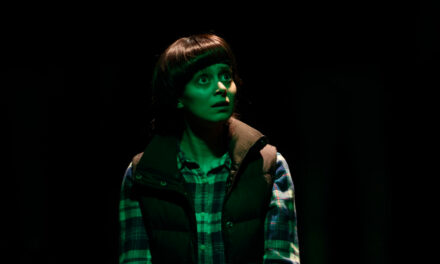
The three actors were excellent. Rois, wearing the red dress we know from Celeste / Kim Basinger in the film, came across as uniquely alien, unused to human shape, human body movements and in particular the human voice. Every movement, every utterance, was part of her exciting journey of exploring human existence, and the range of expressions she went through over the 75 minutes’ duration of the play, were genuinely strong indicators of excellent acting. Kotbong Yang as the alien who has been given the body of Steve’s cleaner followed the cleaner stereotype which Steve pushed her into and showed references to the alien one-eyed tentacle in the bag from the film in her sometimes-acid comments on human life. Aliens in human shape have different personalities, and those personalities may be related to their alien existence as well as to their human persona. Trystan Pütter as the human scientist presented the stereotypical combination of relatively brilliant thinking and nerdiness very well indeed. This was unashamedly high-brow comedy at its best.
This post was written by the author in their personal capacity.The opinions expressed in this article are the author’s own and do not reflect the view of The Theatre Times, their staff or collaborators.