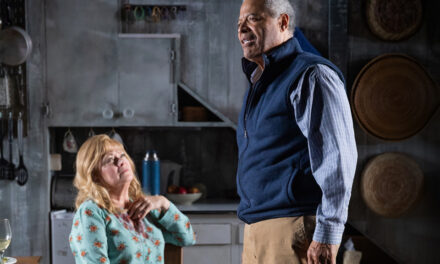

“So high you can kiss the sky” is one of the many iconic lines from With Ruby and I, a debut show by playwright Corrina O’Beirne, which premiered at the Brighton Fringe in 2025 and is up for an International Encore Series award at Soho House, NYC.
Directed by Christine Kempell, it is set in a tower block flat, which gives Withnail and I’s seedy squalor a run for its money – except we are in the mid-to-late 2000s in Brighton, the land of drug and party culture, rather than 1960s London. And it’s Blairite times, rather than Thatcherism, which dominates, backgrounded by the war in Afghanistan.
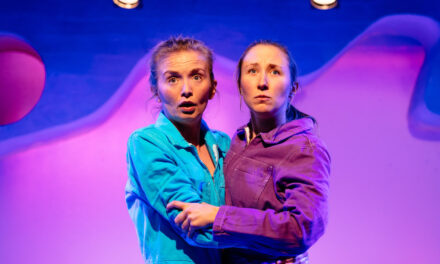
Mags and Ruby, the two 20-somethings who cohabitate in the flat, would also give Marwood and Withnail a run for their money on their aimlessness in life. There is something familiar about Ruby’s doppelgänger character, whose flamboyance hides a shockingly manipulative streak in contrast with Mags’ reckless but directionless energy, which Ruby can mould and shape to suit her needs.

Rach Mullock as Mags, Lexi Pickett as Ruby photo by SamCartwrightPhotography
Into this perfect melee step two other characters to make an uncomfortable quartet – Mags’ dead mum Queenie, who takes up residence in her urn on her onesie in the living room, to whom Mags and Ruby constantly pay homage. And, with rather more vigour, though not much, Tony, an ex squaddie back from Afghanistan, who is struggling with PTSD. The pursuit of his old fling with Mags is what drives the plot of the play and kick-starts Ruby’s insecurities about her relationship with Mags, with whom she is in love.
The energy and dark humour combined with a lightness and playfulness of line and punchy jokes from O’Beirne, lulls the audience into a false sense of security – because this is really a tragic story of Martin McDonagh, even Terence Rattigan, proportions. Indeed, tragedy slips in and is barely acknowledged by the main characters.
So what’s this play about? Yes, it’s a love triangle of sorts, where Ruby and Tony vie for Mags and Mags willingly plays along, even setting up Ruby, which magnificently backfires. Ruby and Tony both need Mags, but does Mags really need either of them? She is too passive with one and has to fight all the harder to gain control, whilst with the other, she is required to be the more mature and motherly. Ruby can, in the end, stroke Mags’ ego just enough, whilst Tony, with his broken, haphazard way with words and out-of-control sexual desire, is just too demanding.
But this is also a critique on the loneliness, poverty and solitude of lives lived around the 2000s drug and party culture, and it is not a romantic or sentimental tale, even if the audience thinks it is. These characters are clearly portrayed as existing for this drug and party life, whilst, conversely, wanting to escape it. It is also the promise of an escape from it, not quite fulfilled, which, amongst other things, arguably keeps Mags and Ruby’s relationship strong, whilst Tony’s desire for real change and to get it together almost drives them apart.
This is a beautifully realised debut play. Rach Mullock as Mags gives a realistic portrayal of someone vulnerable to the likes of Ruby and Tony, which heightens her own aggressiveness. Lexi Pickett’s Ruby is pitch-perfect as the dysfunctional and nearly outwitted plotter in chief, a kind of female Stanley from A Streetcar Named Desire. And Sam Cartwright, sporting a macho moustache of the kind soldiers were made to wear until 1916, paints a complex picture of a man at war with himself, his past behaviours and PTSD. This was not a fun time for many, despite all the partying and drugs and PTSD was also vastly misunderstood.
The play combines farce and melodrama, with a critique of UK culture in the 2000s. And it may owe something to Withnail and I and the like, but, ultimately, it has a harder bite.
This post was written by the author in their personal capacity.The opinions expressed in this article are the author’s own and do not reflect the view of The Theatre Times, their staff or collaborators.
This post was written by Verity Healey.
The views expressed here belong to the author and do not necessarily reflect our views and opinions.