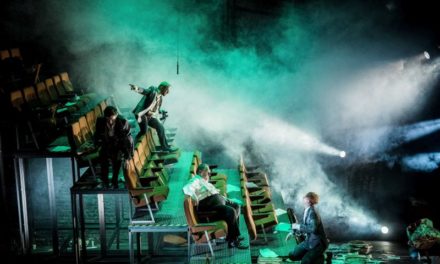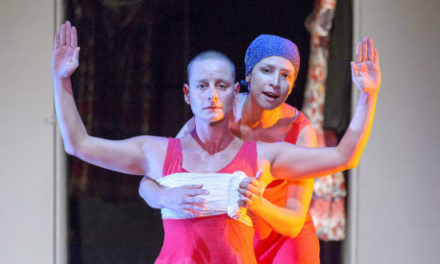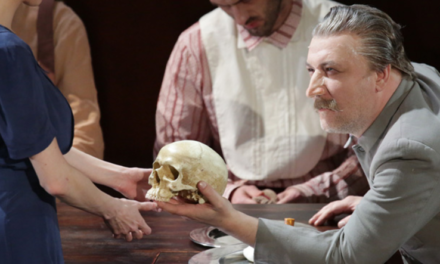
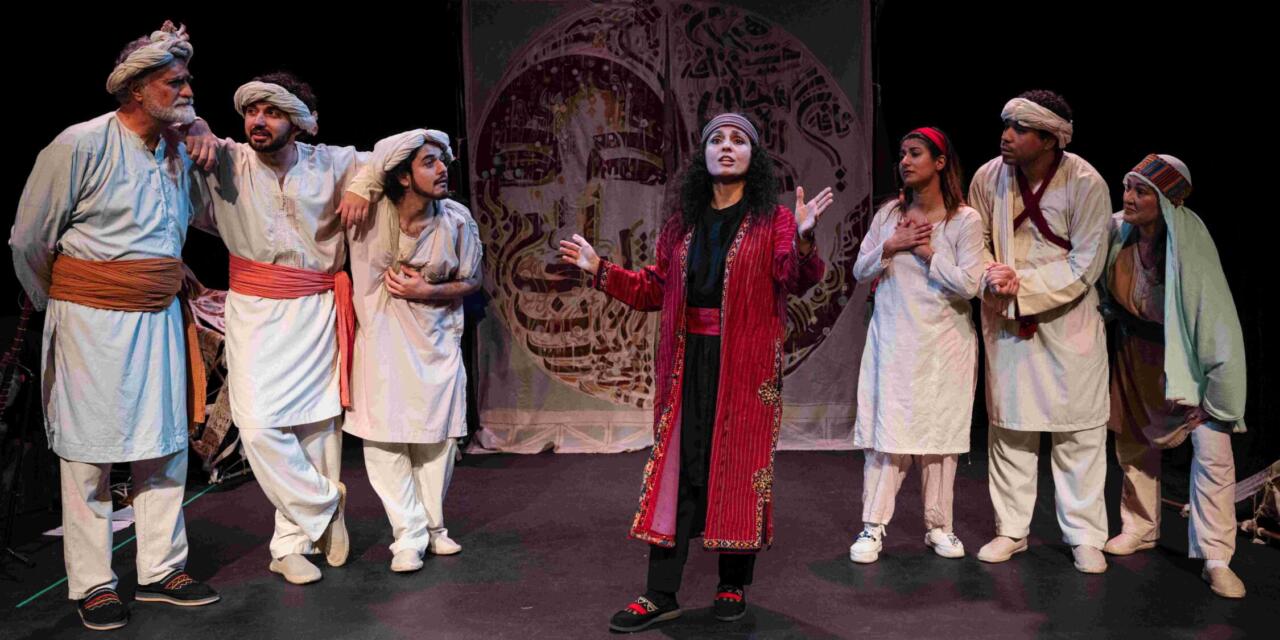
We all know the iconic closing lines: “For never was a story of more woe / Than this of Juliet and her Romeo.” But after experiencing a recent performance of Leili and Majnun at Central Stage (located just off the Central Ave exit in Richmond, CA), on November 7th, I am tempted to rephrase that famous couplet: “Run, don’t walk, and do it soon, / To experience the tale of Leili and Majnun!” OK, I know: Shakespeare has nothing to worry about!
Written in 1188 by the celebrated Persian poet Nizami Ganjavi, Leili and Majnun predates Shakespeare’s Romeo and Juliet by over 400 years, yet the parallels are striking. The story follows Qays, a young poet who falls hopelessly in love with Leili. Their love is pure and transcendent, expressed through poetry and passionate devotion. But like the Montagues and Capulets, their families forbid the union. When Leili is forced to marry another, Qays loses his mind, earning the name “Majnun”—literally meaning “possessed” or “madman.” He wanders the desert, composing verses to his lost love, while Leili suffers in her estranged marriage, pining for the one she truly loves.
Where Romeo and Juliet find their tragic end in a tomb, Leili and Majnun’s fate is even more heart-wrenching—they die separately, never reunited in life, their love existing only in poetry and longing. Yet both stories ask the same timeless question: What is the cost of love in a world that will not allow it?
This production brilliantly honors both traditions. Nizami Ganjavi’s work stands as one of the Middle East’s greatest literary treasures, influencing countless poets and storytellers across cultures. Seeing these two star-crossed lovers from a Persian lens reveals the universality of the story—love, family opposition, societal constraints, and tragic separation transcend geography and era.
Written and directed by Torange Yeghiazarian (Founder and Artistic Director Emeritus of Golden Thread Productions), this production exemplifies storytelling at its finest. According to the program notes, the work “fuses Naghali, traditional Iranian epic storytelling, with contemporary ensemble and musical theater,” while its visual language draws from “Persian miniature painting mingling with contemporary Iranian graffiti art.” The production not only succeeds in achieving this aesthetic vision—it transcends it.
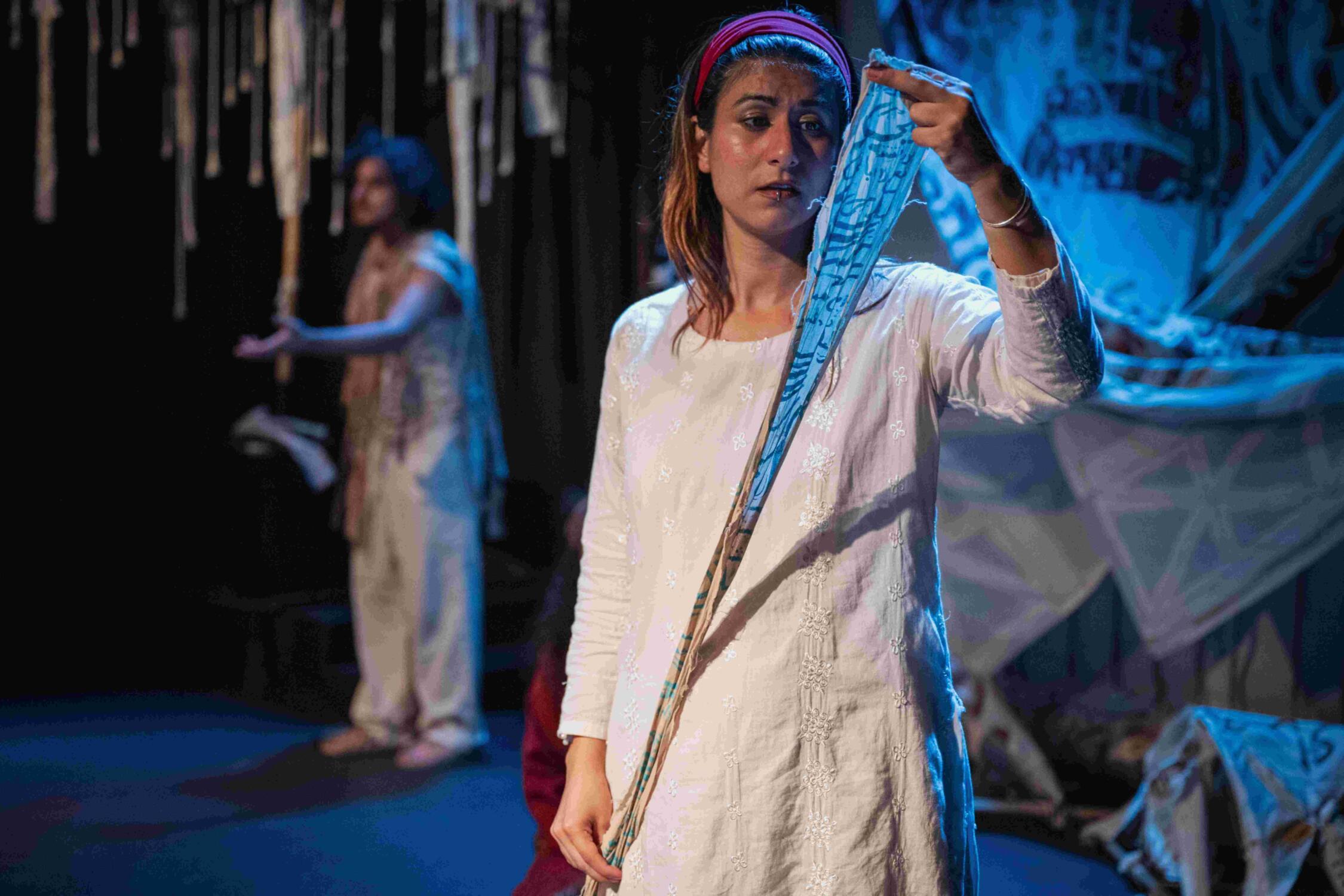
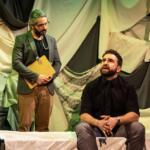
Yasaman Asgari (Leili) reading Majnun ‘s letter with Roeen Nooran (Majnun) in the background. Photo credit: Ako Salemi.
An audience member was quoted as saying, “This is a truly immigrant production, one that fuses multiple cultures seamlessly”—and nowhere is this more evident than in the extraordinary music by composer Sirvan Manoobi. As he reflects in the program, composing the score required him to “bridge the desert landscape of Arabia, the poetic Persian language of Ganjavi, and the adaptation’s English language.” What initially seemed an impossible challenge became, he realized, a reflection of his own daily experience “as a Persian-speaking Iranian immigrant speaking English in San Francisco and specializing in the oud, considered the most important instrument in Arabic music.”
The result is breath-taking. Manhoobi’s composition weaves together Iranian, Arabic, Kurdish, and Western musical modes and scales, layered with rhythmic patterns drawn from all these rich traditions. The music does not just accompany the story—it embodies the cultural crossroads at the heart of this production, honoring the tales of Arabian desert origins, Persian poetic soul, and its contemporary American staging. It is a sonic representation of the immigrant experience itself: carrying multiple worlds within you, speaking in many musical languages at once, and creating something entirely new from ancient roots.
I sat in a theater filled with members of the Iranian community who were instantly transported to their childhoods through what the program describes as “the most popular love story in the Middle East and the many cultures influenced by the region’s literary treasures.” Though this was new territory for me, I experienced the same joy. I found myself clapping my hands, tapping my feet, leaning forward, and becoming fully engaged with the exceptional performances of Sophia Ahmad, Yasaman Asgari, Brandon DiPaola, Behzad Golemohammadi, Zaya Kolia, Roeen Nooran, and Dina Zarif, accompanied by live music from Sara Saberi and Josh Mellinger.
Yeghiazarian’s work holds a special place in my artistic journey. In 2015, I had the privilege of playing jazz composer, pianist, and arranger Billy Strayhorn in her masterful Isfahan Blues at African-American Shakespeare Company, directed by Laura Hope with music by the incomparable Marcus Shelby. Her distinctive voice as a writer continues to inspire.
This production stands out as one of the highlights of my theater season. Central Stage has earned a place on my must-visit list, and I eagerly anticipate their future offerings—and so should you!
This post was written by the author in their personal capacity.The opinions expressed in this article are the author’s own and do not reflect the view of The Theatre Times, their staff or collaborators.