
Bremen’s Packhaustheater set its agenda with a focus on the local, so as not to compete with the municipal theatre, the two comedy theatres, the Bremer Shakespeare Company and the theatre specializing in crime drama. Lale Lili Marleen was the first production under that remit (see review here). A play inspired by the first visit to Europe by Elvis Presley on 1 October 1958 in the port of Bremerhaven (the second city of the two-city federal state of Bremen, some 50 miles north of Bremen) followed, Meine Nacht mit Elvis (My Night with Elvis), also written and directed by the Packhaustheater’s artistic director, Dirk Böhling. We encounter Marianne and Dagmar, two Bremerhaven teenagers, in Marianne’s bedroom, excitedly awaiting Elvis Presley’s arrival, and planning to be at the pier on the arrival of the troop ship. They leave a large sign with the words “welcome Elvis” in the window, which they want to take to the pier the next day. Dagmar goes home and some time after Marianne has fallen asleep, Elvis knocks at her window. She allows him in, and what follows is along scene between them, written as a clever combination of factual information, funny moments of misunderstandings due to the language barrier, and the opportunity for the performer playing Elvis to sing several famous Elvis songs, accompanying himself on the guitar. In due course, Elvis has to leave. Marianne oversleeps, misses his arrival at the pier, is confused as to what may have just been a dream, also in conversation with Dagmar, who returns and talks about what she was able to see of Elvis’s arrival. In the end, Marianne finds the bracelet Elvis gave her, reassuring her that it was not a dream after all.

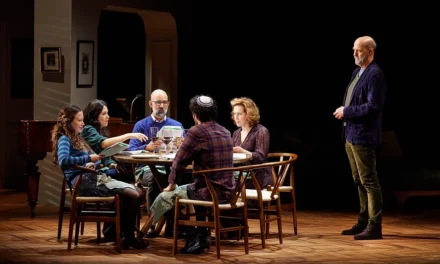
Men and Women … Duett Surprise, at Packhaustheater Bremen. They booked the cruise holiday before they decided to get divorced. © Packhaustheater, Sascha Schröder.
Meine Nacht mit Elvis premiered at piccolo teatro Haventheater in Bremerhaven in 2023, with Meike Lehmann as Marianne, Maja Rodigast as Dagmar and Robin Katona as Elvis. It ran there for 24 performances and was revived there in 2024 for a further 10 performances, with the same cast except for Vania Brendel replacing Rodigast as Dagmar. Böhling revived the production for the Packhaustheater with the same cast as the original 2023 production.
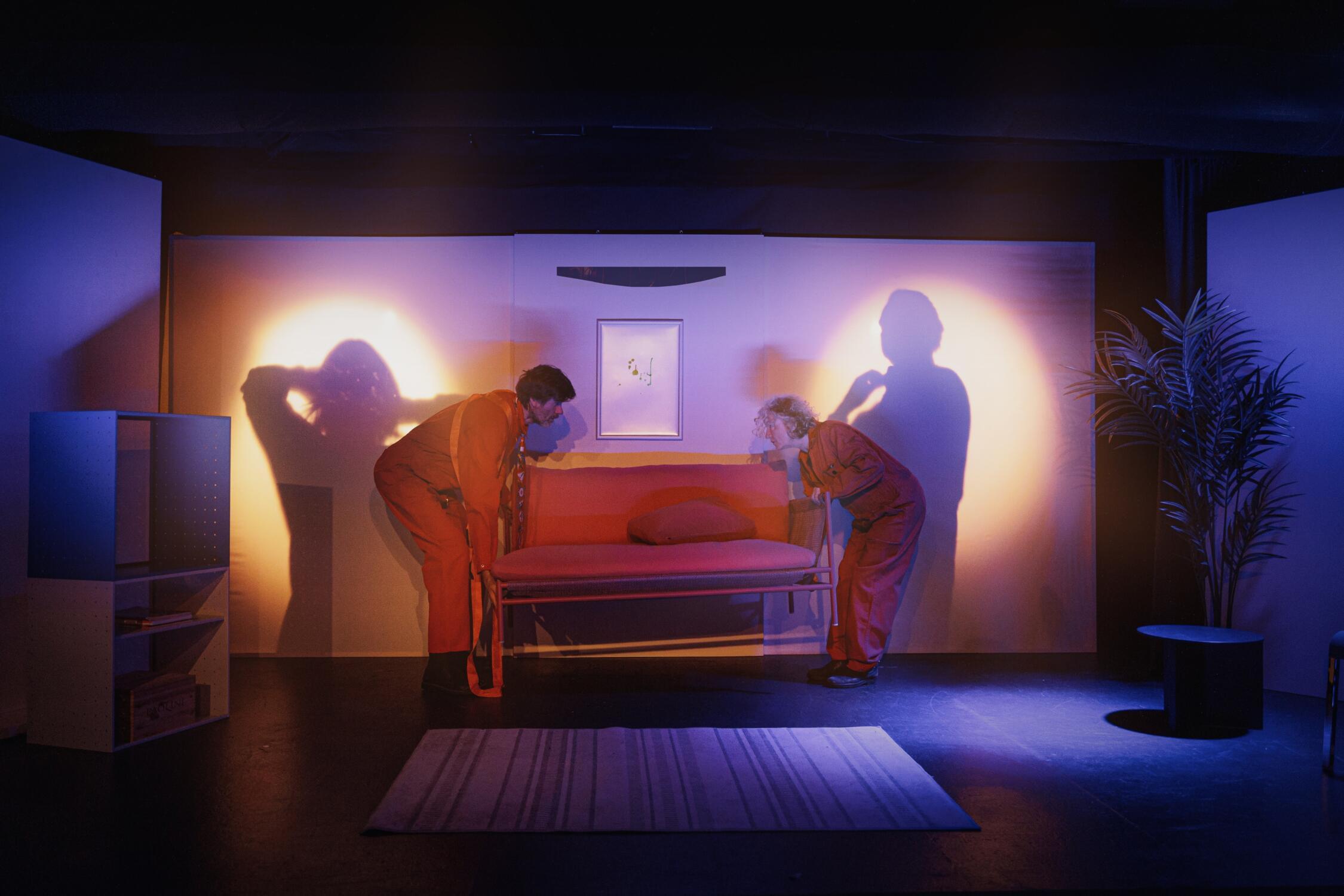
Men and Women … Duett Surprise, at Packhaustheater Bremen. Scene change © Packhaustheater, Sascha Schröder.
In addition to scheduling one-off visiting shows that come ready-made on the touring market locally and further afield, the third production after Lale, Lili Marleen and Meine Nacht mit Elvis is Men and Women … Duett Surprise, a German version of a play by UK dramatist Peter Quilter (b. 1965). The play stars Heidi Jürgens and Christian Bergmann, two actors very familiar indeed to Bremen theatre audiences for decades for their work across the range of theatres in Bremen. They thus provide the aspect of the local central to Böhling’s artistic agenda for the Packhaustheater. He directed the production. The play consists of five self-contained parts of some 15 minutes duration each, in which Jürgens and Bergmann play five different women and men, respectively. A man and a woman on their first date, two have-been actors about to leave their home to attend an award ceremony, a woman preparing a birthday party for the man she has been working for and been in love with for a long time – too bad he’s gay… A married couple on a cruise holiday they booked before they decided to divorce. And a woman about to get married in an encounter with her cynical brother, who is to give her away. Under Böhling’s direction, Jürgens and Bergmann displayed excellent comic timing; their range of characters was refreshing, impressive and funny. The expert input of Bianca Vespermann (costume) and Carolin Ghodoussi (advice on specialist make-up) added to the actors’ skills of developing their many characters’ many nuances. Bianca Oostendorp’s set design was simple and functional. The same pieces of furniture, on loan from the local branch of a national furniture chain, were arranged in different locations. Those scene changes became pieces of entertainment in their own right, with Oostendorp and production technician Ulf Nazarenka, both dressed as removals people in strikingly red dungarees, shifting the furniture as a form of dance accompanied by different pieces of music. At the same time, Jürgens and Bergmann were seen changing costume and wigs as shadows behind a screen. As an insider joke, one of the paintings on one couple’s wall was of German painter Paula Modersohn-Becker (1876-1907), a famous representative of the artist’s colony in Worpswede, just outside of Bremen. Her life and work will be at the centre of the next play and production at Packhaustheater from March 2026 onwards.
This post was written by the author in their personal capacity.The opinions expressed in this article are the author’s own and do not reflect the view of The Theatre Times, their staff or collaborators.