
In late November, Emma Dante brought her latest show, L’Angelo del focolare (The Angel of the Hearth) to Milan’s Piccolo Teatro. Over the last thirty years, this Sicilian writer and director has built an outstanding reputation for an innovative style of theatre that transcends realism to explore the territory of dream and ritual. Like previous work, in The Angel of the Hearth, the playwright delves, with insight, into the dynamics of a Sicilian family.
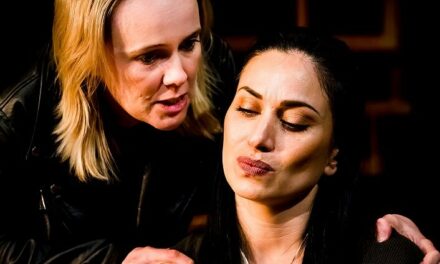
The Angel of the Hearth begins on an almost empty stage, except for a woman’s body (Mother) slumped downstage centre, while on the left, an elderly woman (Grandmother) sits in an armchair. Soon the elderly woman’s son and her grandson enter, carrying a toilet, a single bed, a table, a couple of chairs, putting in place the basic items needed to conjure up a makeshift home. From the outset the family dynamics are deeply conflictual. The Mother and Grandmother – none of the characters have proper names – are intent on pampering the Son, the Grandmother stuffing him with crisps, the Mother, encouraging him to become a singer and teaching him to be gentle and loving towards his future wife. The dialogue in Sicilian brings each character vividly to life; the Husband’s Sicilian, for example, is minimal, showing his lack of education. In sharp contrast to the women in the family, he is bent on turning his son into a macho man. He knocks the boy around, dressing himself and his son in a black shirt and trousers. Grabbing two bottles of gin, he proceeds to ply the young man with alcohol, until he is drunk. He orders the boy to act like a lion which roars fiercely the moment it is baited. His idea of courtship is similarly aggressive, since it entails stalking a woman, like a bird of prey, and in the end, devouring the spoils.
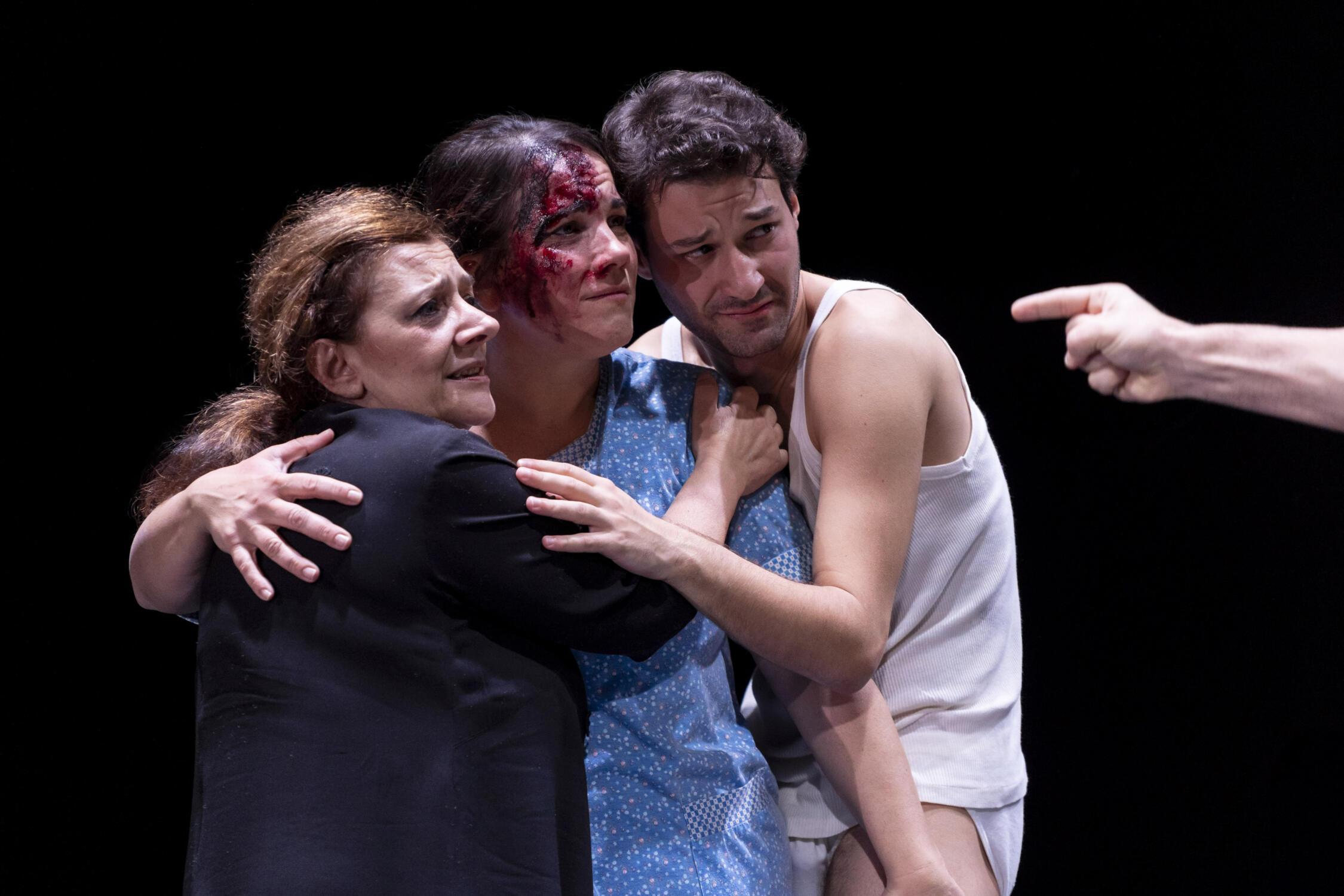
Giuditta Perriera, Leonorda Saffi, and David Leone in L’Angelo del focolare [EN: The Angel of the Hearth]. Photo credit: Masiar Pasquali.
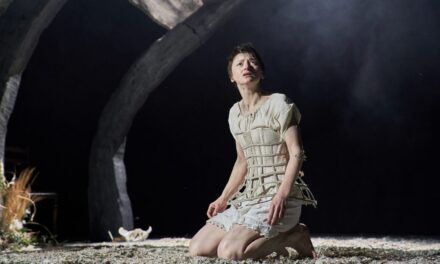
This production – with superb performances by Leonorda Saffi (Mother), Ivano Picciallo (Husband), David Leone (Son), Giuditta Perriera (Grandmother) points to the harsh reality of domestic violence, and its ritualistic, cyclic dynamics. In this case, it leads to the female victim being murdered. The final dance seemed to invite us to dream of a non-violent world, where women and men can live in harmony. As in other works by Emma Dante, the play’s theme transcends her native Sicily, reaching a more universal sphere.
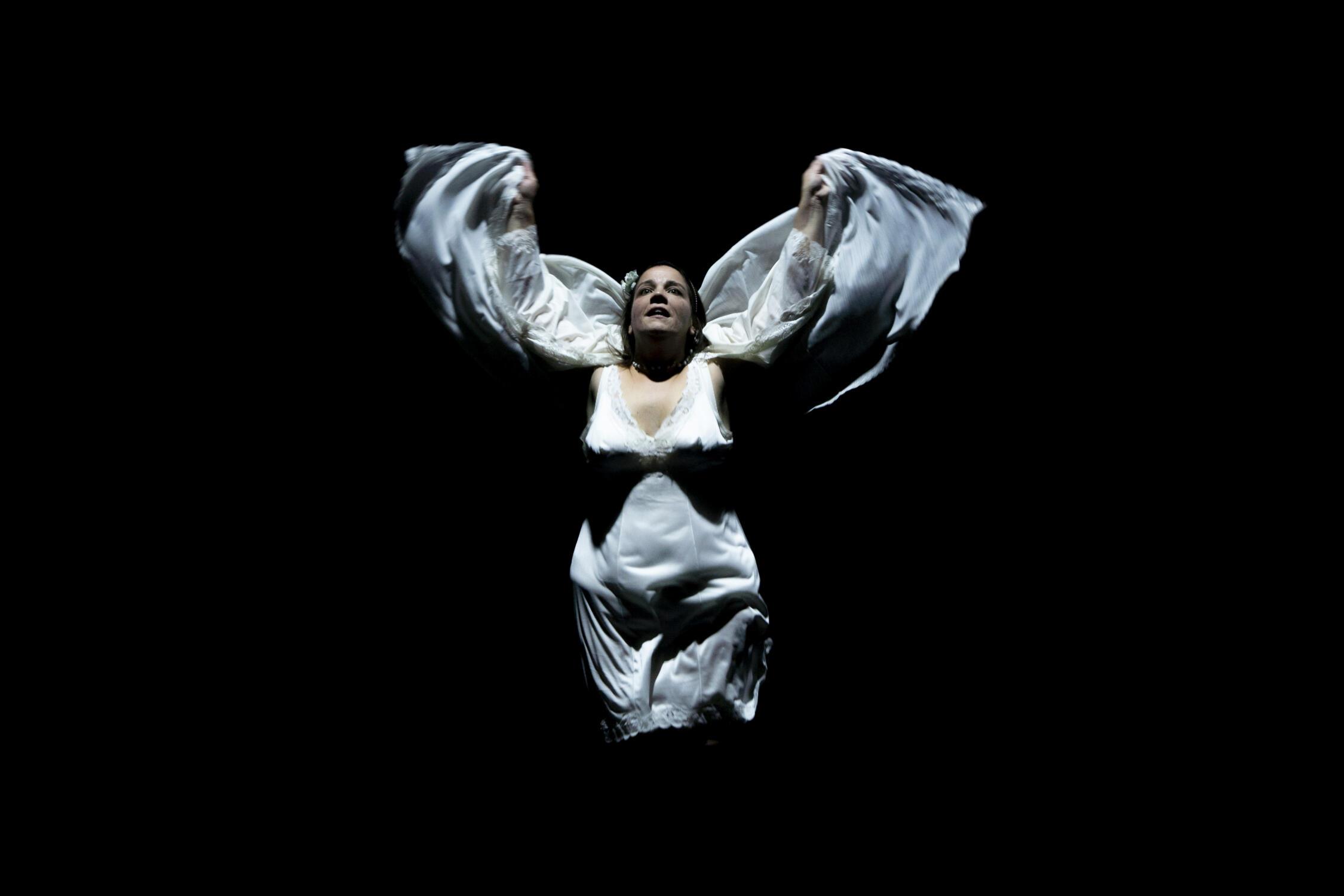
Leonorda Saffi in L’Angelo del focolare [EN: The Angel of the Hearth]. Photo credit: Masiar Pasquali.
The Angelo del focolare is a co-production of Piccolo Teatro di Milano – Teatro d’Europa, Teatro di Napoli – Teatro Nazionale, Châteauvallon-Liberté, scène nationale, Les Célestins, Théâtre de Lyon, La Comédie de Clermont-Ferrand, Scène Nationale d’ALBI-Tarn, Le Cratère, Scène nationale Alès, L’Estive, scène nationale de Foix et de l’Ariège, Théâtre + Cinéma Scène nationale Grand Narbonne, Théâtre de l’Archipel, scène nationale de Perpignan, Théâtre Molière, Sète scène nationale archipel de Thau, Le Parvis, scène nationale Tarbes-Pyrénées, Compagnia Sud Costa Occidentale, Carnezzeria
This post was written by the author in their personal capacity.The opinions expressed in this article are the author’s own and do not reflect the view of The Theatre Times, their staff or collaborators.
This post was written by Margaret Rose.
The views expressed here belong to the author and do not necessarily reflect our views and opinions.