
A Place of Safety, A Journey in the Central Mediterranean, produced by the Kepler-452 Company played at the Angela Melato Studio, Piccolo Theatre, from 6 to 20 December. Founded in Bologna in 2014 by Nicola Borghesi, Enrico Baraldi and Paola Aiello, from the outset Kepler-452 has been interested in a research-led creative process, focusing on issues observed in the world around them. At the beginning of their research, company members didn’t know what they were looking for. They had simply heard about rescue operations happening only a few kilometers from the Italian coast and wanted to investigate for themselves what was taking place on the most dangerous migratory route, where many lives have been lost.
he present show, conceived by the entire company, dramaturgy and direction by Nicola Borghesi and Enrico Baraldi, puts onstage a sea journey across the Mediterranean by a group of activists aimed at rescuing stranded migrants. To create the work, the company carried out months of research, including a stay on the isle of Lampedusa in Sicily, meetings with members of the humanitarian organizations, Sea Watch and EMERGENCY, and last but not least, an almost five-week mission onboard Sea-Watch 5, one of the rescue ships, operating in the central Mediterranean. During this trip, 156 people were rescued and taken to ‘a place of safety’, in this case, the Northern Italian port of La Spezia.
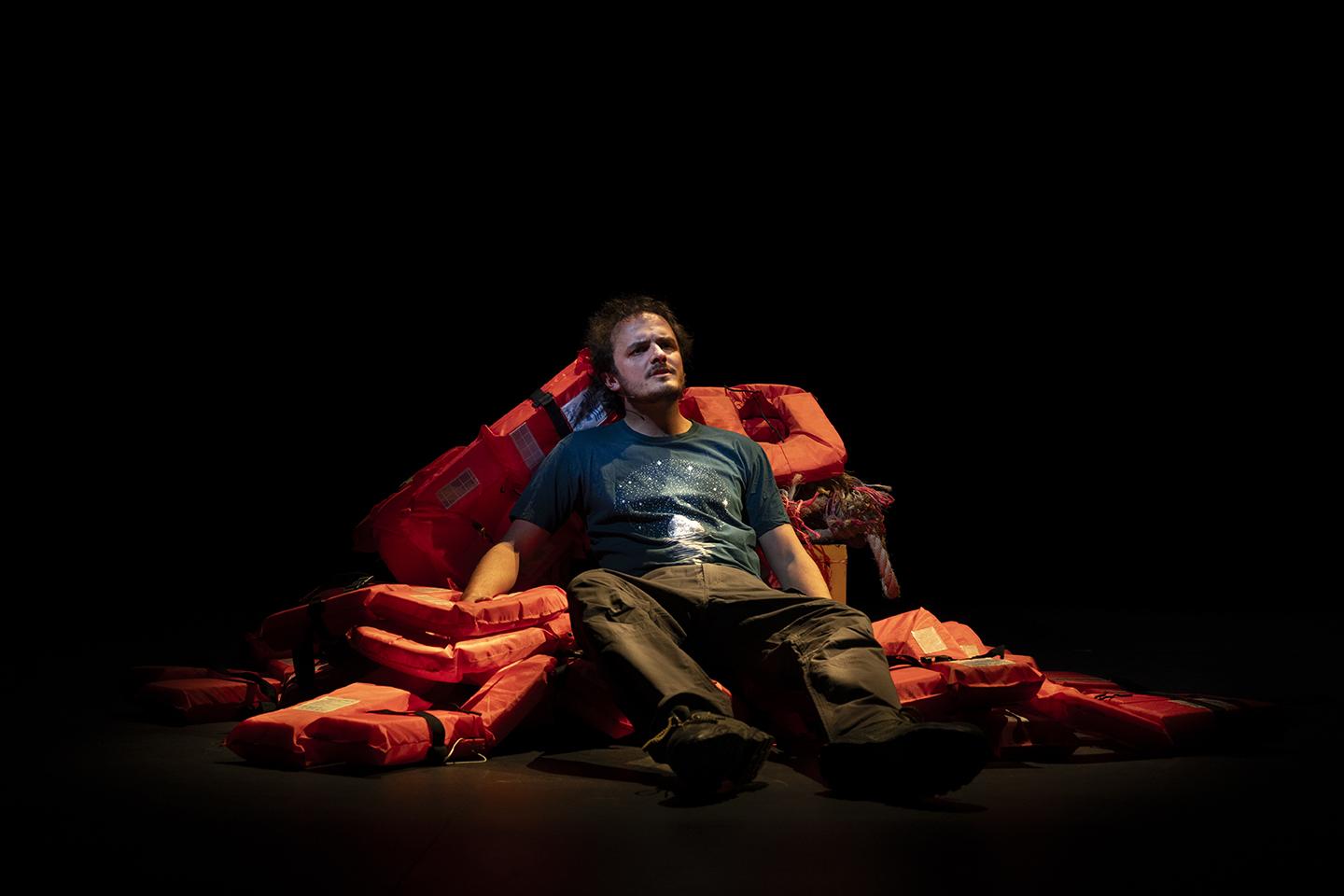
A place of Safety, original idea: Kepler-452, staging and dramaturgy by Enrico Baraldi and Nicola Borghesi. Photo by: Luca Del Pia.
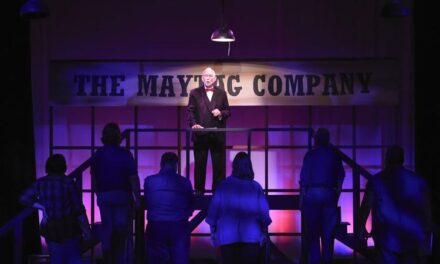
Onstage, as the play starts, a heap of orange life jackets, a bench and a ship’s bridge are suspended precariously high. The work is structured in a sequence of monologues, divided into Acts, with titles. Characters, from different parts of the world, speaking in Italian, Portuguese, Spanish and English, introduce themselves and make clear why they have embarked on what is a very dangerous mission. We meet a 24 years-old deckhand, who is making his first rescue trip. While he manages to save 100 people from what he describes as ‘a vision of hell’, he fails to rescue a young girl and reveals how he feels haunted by the memory. We encounter a journalist, who feels decidedly ill at ease since he hates the sea, but he is committed to writing the story of the rescue and getting it out to his readers. As the action develops, the characters express their apprehension and a shared feeling that they might not succeed. The scene performed by a middle-aged man, who calls himself “the Sailor”, struck me deeply. We watch him climbing onto a high bench and inviting us to imagine the sea below, where migrants are swimming and calling out for his help. His job is to stretch out his hand and assist them as they board the ship. Each of these gestures, he reminds us, is one of recognition that each and every person in the water is a human being in distress. He goes on to reveal that sometimes he has to make the chilling decision to save one person rather than another. Another character, a young woman, has the job of putting identity bracelets on the wrists of migrants, a procedure which helps the crew deal with what is described as ‘the chaos’ onboard. This task sets her thinking about the long and complicated bureaucracy these newcomers will face once they have disembarked in Italy. Characters come and go, and the journalist returns to express his nagging doubt about the function and utility of his job, a state of mind that is probably exacerbated by the hate mail he regularly receives. He wonders whether to hand over a mic to some of these newly arrived migrants, but thinks better of it, saying we (Europeans) aren’t ready to hear their stories. And besides, he asks, “What are we to do with these stories?” In the Epilogue, the outcome of the settlement in Europe of these thousands of migrants is considered, with the conclusion suggesting they will be part of our ‘future humanity.’
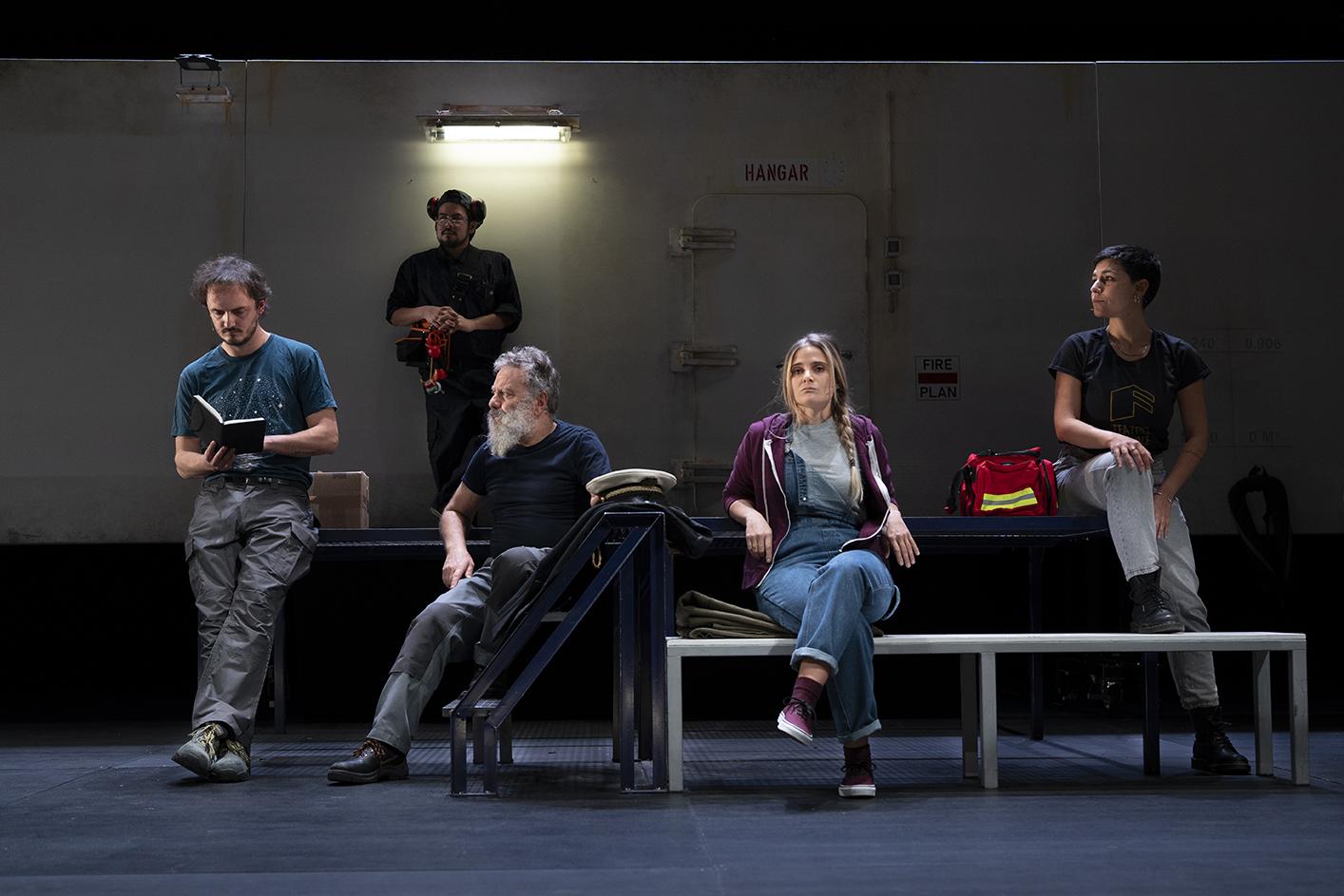
A place of Safety, original idea: Kepler-452, staging and dramaturgy by Enrico Baraldi and Nicola Borghesi. Photo by: Luca Del Pia.
In what might be defined as a documentary play, the two dramaturgs, Baraldi and Borghesi, have carefully chosen the rare moments of video footage, such as the coverage of the final moments of the return journey. They remain vividly in the mind as everybody onboard parties as the boat nears the Italian shore. Still, what prevails are the characters’ monologues, addressed directly to audience members, making you feel you have received what amounts to witness statements at first hand, without media filters. The dramaturgs have done some splendid work with this cast of non-professionals, whose voices, gestures and movements communicate the urgency of their message.
Besides Nicola Borghesi, in the part of the journalist, some of the rescuers, whom the Kepler-452 company met during their rescue mission, interpret various roles. They are Flavio Catalano, a technical officer in the Military Navy; Miguel Duarte, physicist and mathematician; Giorgia Linardi, legal expert and spokesperson for Sea-Watch; Floriana Pati, specialist nurse; José Ricardo Peña, marine electrician. There was a standing ovation at the end as many audience members rose to their feet to applaud what is a moving and truly important work.
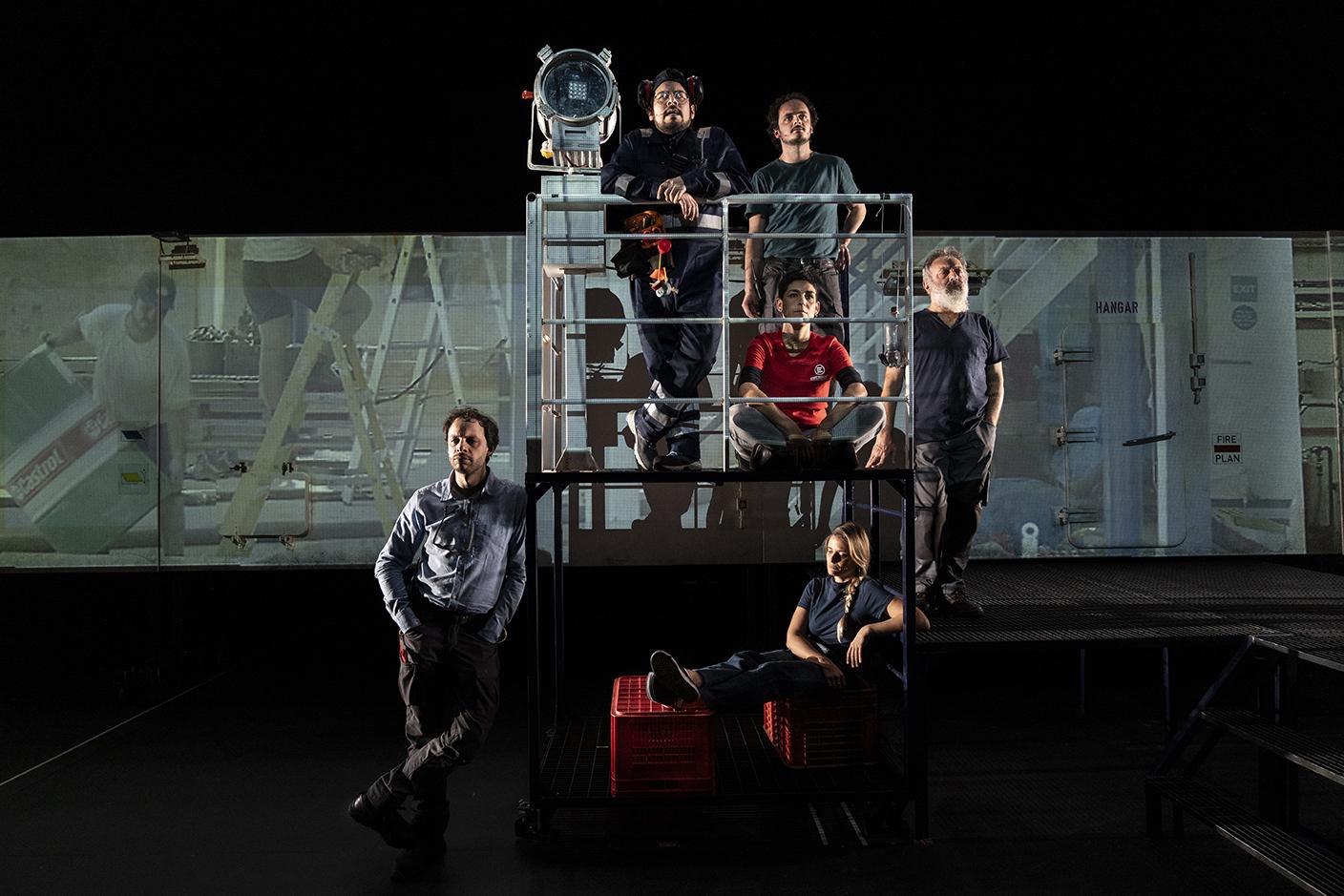
A place of Safety, original idea: Kepler-452, staging and dramaturgy by Enrico Baraldi and Nicola Borghesi. Photo by: Luca Del Pia.
A Place of Safety
Viaggio nel Mediterraneo centrale
original idea: Kepler-452
staging and dramaturgy: Enrico Baraldi and Nicola Borghesi
With the words of Flavio Catalano, Miguel Duarte, Giorgia Linardi, Floriana Pati, José Ricardo Peña,
with Nicola Borghesi, Flavio Catalano, Miguel Duarte/Nuno Pinheiro, Giorgia Linardi, Floriana Pati, José Ricardo Peña
assistant director: Roberta Gabriele
set and costumes: Alberto Favretto
lighting design: Maria Domènech
sound and music: Massimo Carozzi
movement advisor: Marta Ciappina
video project: Enrico Baraldi
dramaturgy advisor: Dario Salvetti
voluntary assistant director and video editor: Alberto Camanni
set built by the ERT (Emilia Romagna Teatro) Set Workshop
Many thanks to Giovanni Zanotti for the fundamental advice on dramaturgy.
Production: Emilia Romagna Teatro ERT / Teatro Nazionale, Teatro Metastasio di Prato, CSS Teatro stabile di innovazione del Friuli Venezia Giulia, Théâtre des 13 vents CDN Montpellier (Francia)
In collaboration with Sea-Watch and EMERGENCY
This post was written by the author in their personal capacity.The opinions expressed in this article are the author’s own and do not reflect the view of The Theatre Times, their staff or collaborators.
This post was written by Margaret Rose.
The views expressed here belong to the author and do not necessarily reflect our views and opinions.