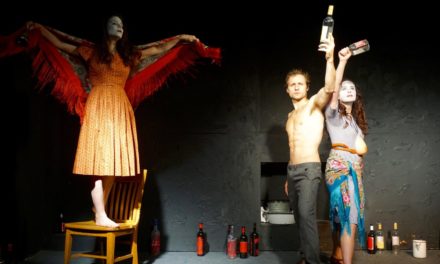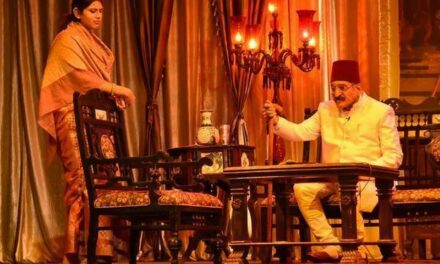

Perhaps one of the strangest experiences one can have when moving to a new place is watching a performance tackling the exact same situation. Luckily, no two re-rooting stories are the same, so the uncanniness of seeing one’s own life from a third person point of view can be put aside.
In February 2026, Forward Theatre Company brought to the audiences of Madison, Wisconsin, Ironbound (written by Martyna Majok, directed by Marcella Kearns), the story of Darja (Cassandra Bissell), a Polish immigrant in New Jersey, and her unwavering determination to make the best of her American dream’s reality, if not for herself, at least for her child. The time that passes between her coming to the US and the “present” of the plot is marked by three relationships, increasingly more detached from the idea of love and more anchored in material wellbeing, or, at least, basic financial safety. Ultimately, the storyline, rather flat in terms of action, but frequently shifting to different points in time, focuses on the main character’s inner journey as more of a crystallization of her desires, and not as a psychological growth spanning two decades.
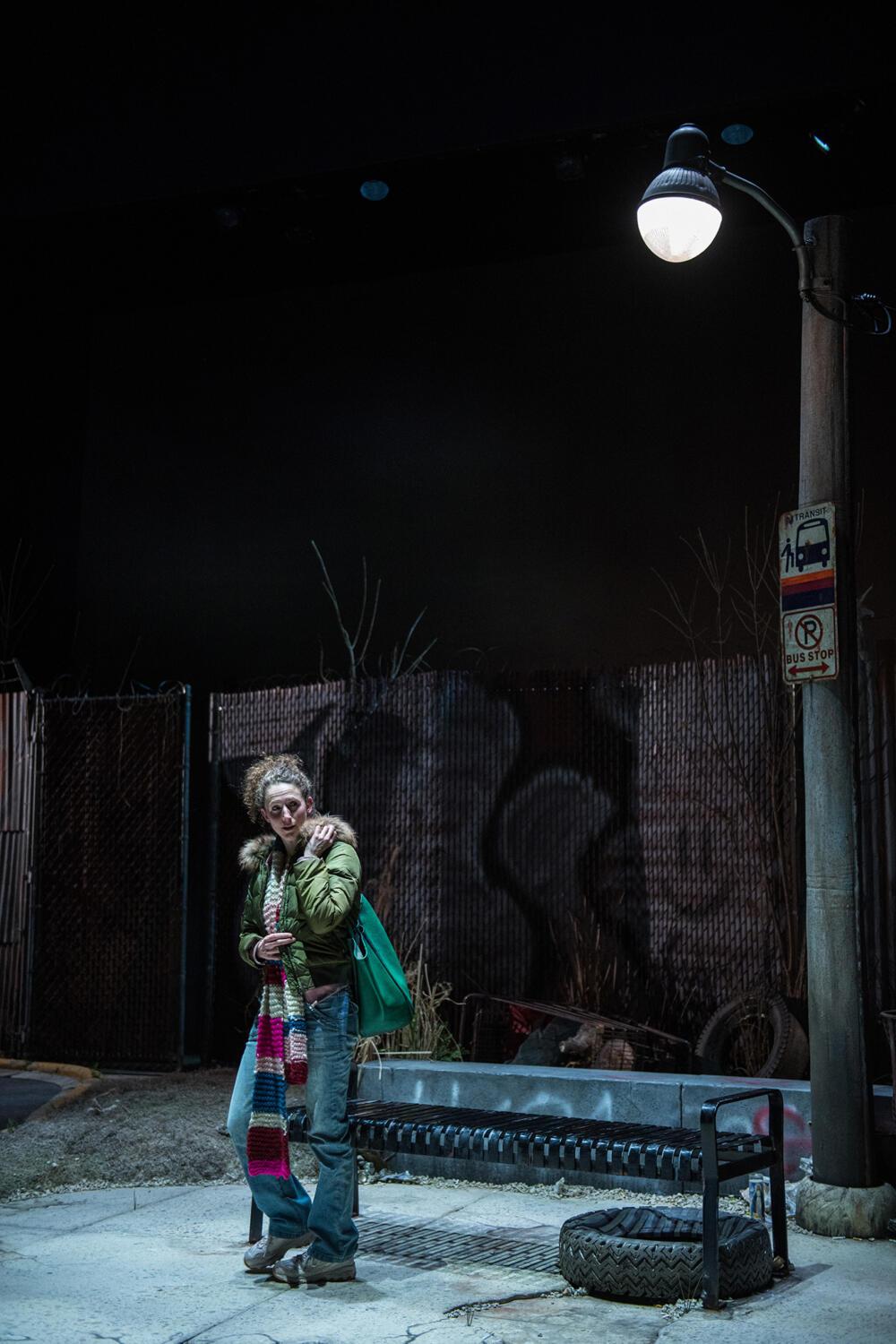
Darja (Cassandra Bissell) in Ironbound. Photo credits: Ross Zentner.
Nevertheless, the entire construction is convincing – left without reference points, as everything around her is new and, to an extent, strange, Darja chooses predictability over hope, initially trying to reason with her first husband, Maks (Josh Krause), that pursuing a musical career might not be the best idea when money is tight and there is a baby on the way. Going on to marry her superior, the main character once again leans towards steadiness, yet finding herself, years later, in a similar place. If, in the first two situations, it is somewhat clear what (whom) she is prioritizing, calculating her every next move thinking about the future of her son, with Tommy (Jonathan Wainwright) a little bit more of Darja-the-woman is visible. Having fallen somehow at peace with the fact that there is a cyclicity of life that cannot be held back, and that she will inevitably end up in the same bus station all over again, the main character accepts an unfaithful, slightly abusive relationship, on the grounds of familiarity and (minimal) comfort.
After the chaos of moving across the ocean and raising a child almost entirely by herself on a minimum wage job settles, the routine encloses her in the life she has built in and around the deteriorating industrial town. As a beacon of hope, however, Vic (Gabriel Anderle) comes around and materializes both dreams and fears she had and has about the now-estranged son. With a fresh mind, hopes and aspirations, the teenager awakes Darja’s memories of the first two important men in her life, Maks and the boy, while also reminding her of the degrading turn lives can take.
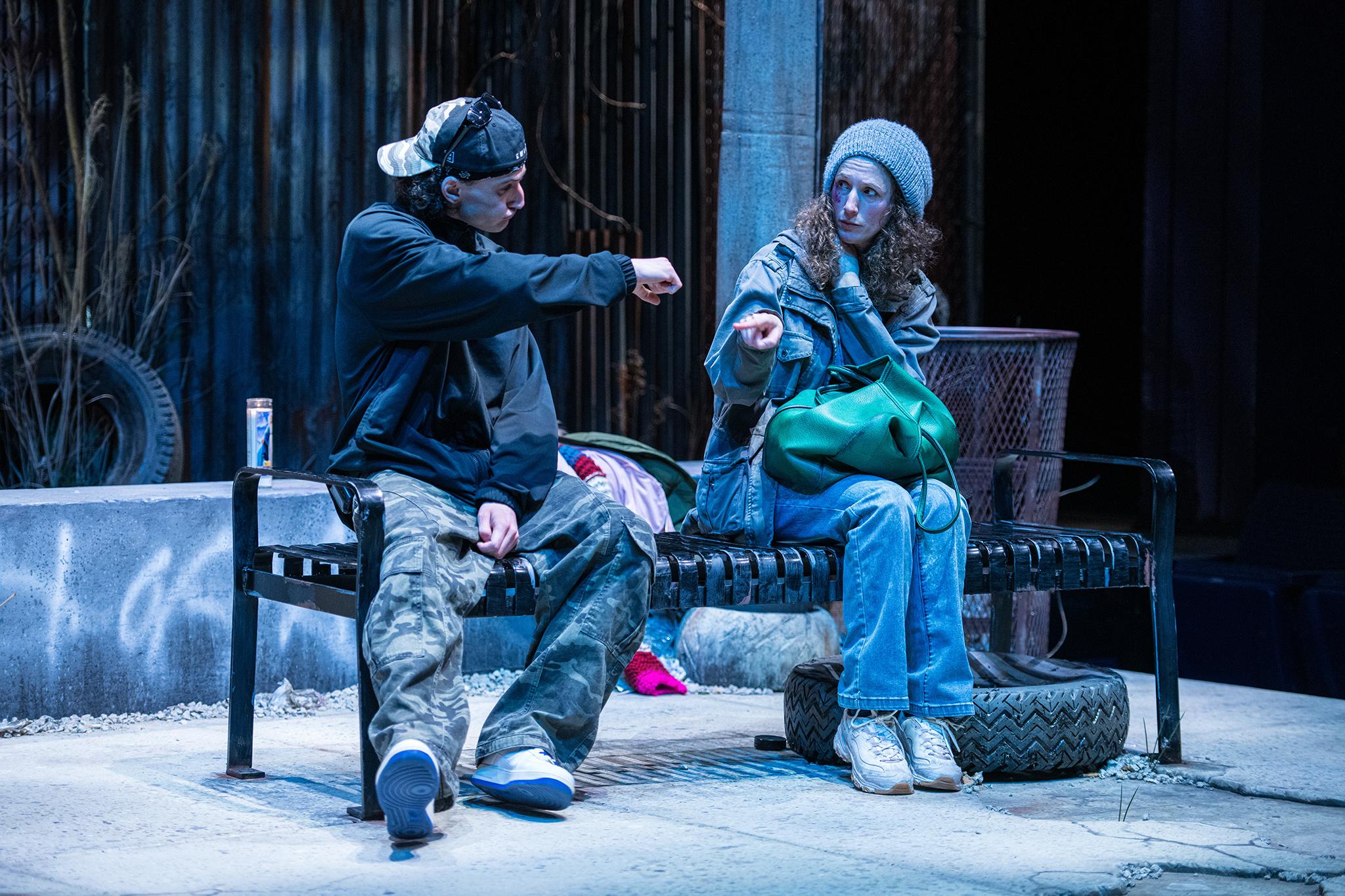
Vic (Gabriel Anderle) and Darja (Cassandra Bissell) in Ironbound. Photo credits: Ross Zentner.
Oscillating between rather grim moments of characters who have lost their way and almost disconcerting lighthearted dialogue, Ironbound brings onto the stage a stylized version of a “starting all over again” story, with its positives and downfalls. This simplification, albeit useful in theatrical settings, where suggestion has to replace exact representation due to several concerns (time, financial etc.), is also evident in the construction of the characters, written as complexified stereotypes. Contrasting with the beautifully hyperrealist set design (Lisa Schlenker), where the town’s ruin is reflected in the crumbling curb and even in the pebbles sitting at the bottom of potholes, the architecture of the people whose lives are presented on stage seems to only be marking elements of who they are and what they want from the “new world”, and not allow for a more in-depth expansion of the great acting potential.
Among both positive and less favorable aspects of the entire spectacological construction, two details stand out from an essayistic perspective – the Beckettian waiting and the very Polish inclusion of music. Relatively annulled by placing the action in a literal bus station, marked accordingly in spite of its decrepit state, the constant, almost pointless state of expectancy is reminiscent of the theatre of the absurd. Darja and, to an extent, all the other characters, are waiting for a salvation, using the bus as a mere excuse, but, as there is no external deliverance and, fortunately, the idea that “we are our own savior” is not being pushed either, the people here make very… human choices. Flawed, approximative, somewhat hasty from certain perspectives, yet still incredibly hopeful, Darja accepting the proposal and, eventually, her and Tommy leaving together reference an alternate (perhaps too happy) ending of Waiting for Godot, where Vladimir and Estragon exit and enjoy each other’s company in a less barren environment.
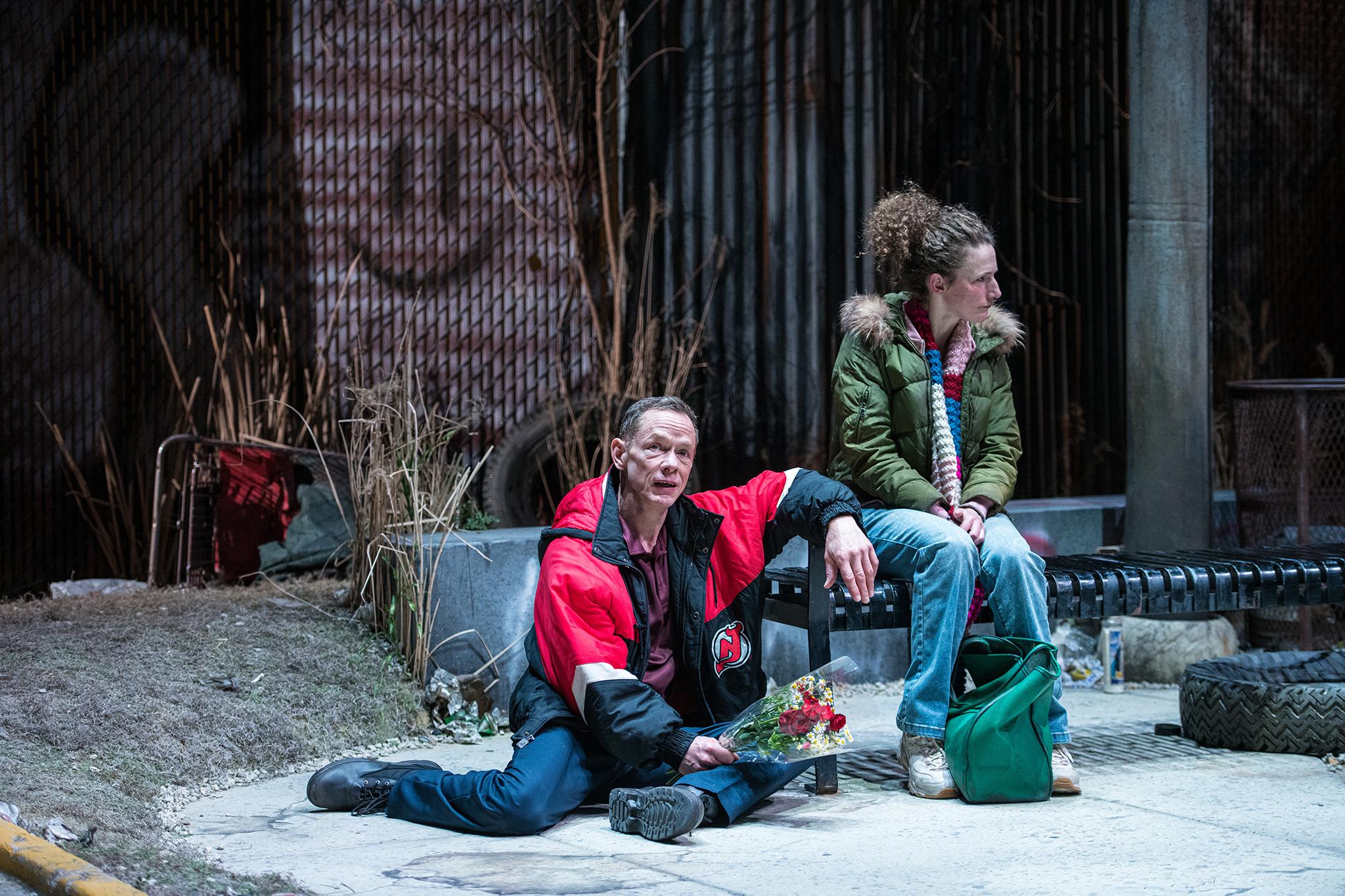
Tommy (Jonathan Wainwright) and Darja (Cassandra Bissell) in Ironbound. Photo credits: Ross Zentner.
In regards to the human-borne soundscape, I could not help but notice (and it was contradicted in the post-show Q&A!) almost a “ghost” of Polish theatre. Much more musical than Romanian performance, it never ceases to fascinate me how naturally integrated songs are in this country’s theatrical landscape. It felt almost as if there was an overarching desire of the characters to express themselves vocally and, indirectly, connect to each other through this need to translate feelings through music. Both Maks and Tommy sing to Darja, Vic plays rap music, and, unknowingly, they create this collective character that survives around the woman as an echo of familiarity, of her “past people-past country”, even after most of the relationships she has with them dissolve.
In its entirety, the production leaves a mark on the viewer, reflecting the human experience of assimilating into a new living place, from both the plane of the text and that of the entire construction. Immersive, Forward Theatre’s Ironbound might not present an entirely believable take on migration, but it surely opens space for discussion, for sharing ideas and experiences, and, ultimately, I believe this is the crux of the matter. In a story of fundamental misunderstandings and inherent solitude stemming from this, the audience and the creative team meeting and confiding in each other completes the picture with a strange, new “off-stage” finale.
This post was written by the author in their personal capacity.The opinions expressed in this article are the author’s own and do not reflect the view of The Theatre Times, their staff or collaborators.
This post was written by Teodora Medeleanu.
The views expressed here belong to the author and do not necessarily reflect our views and opinions.