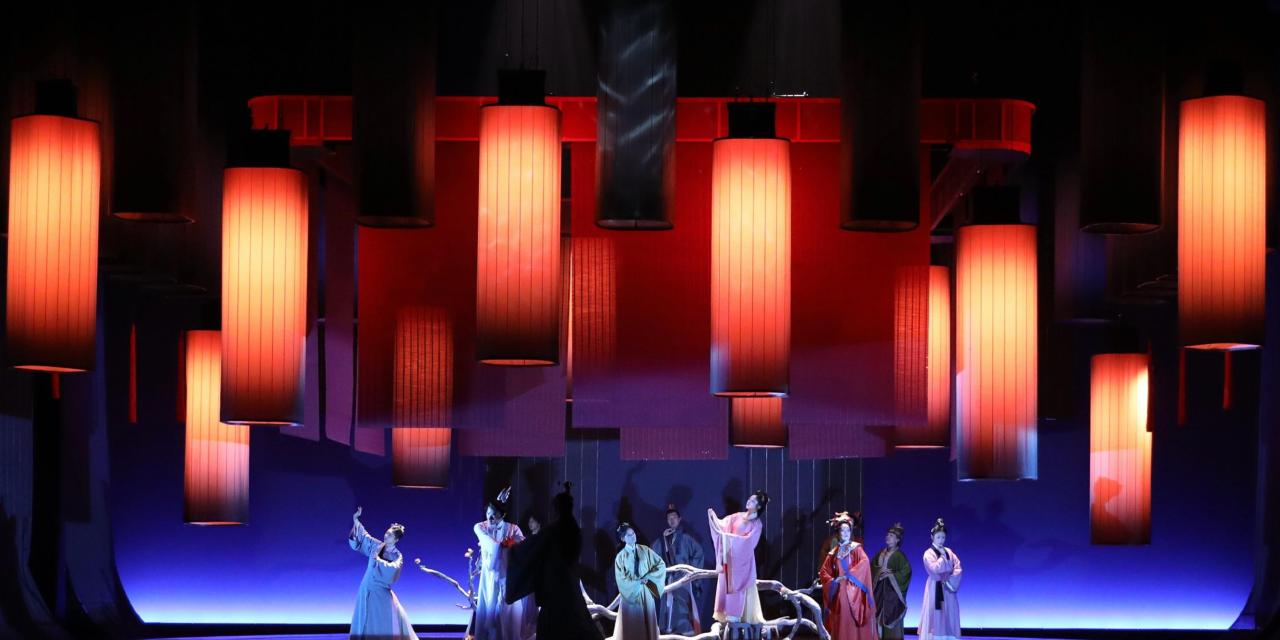
The Chinese musical The Story of the Stone was staged at the 600-seat ARKO (Arts Council Korea) Arts Theater in Seoul, Korea, on July 10 and 11, 2026. This musical, directed by Gao Ruijia, with libretto by Wang Yiwa and music by Jiang Xiaoran, had its Chinese premiere in April 2025 and toured to Korea as a co-production between Arts Council Korea and various Chinese organizations including Nanjing Poly Grand Theatre. At its Korean premiere at the Daegu International Musical Festival (DIMF), the piece was awarded the Grand Prize, the festival’s highest honor, and received rave reviews for its operatic scale, colorful stage spectacle, and the ensemble’s heightened singing and choreography.
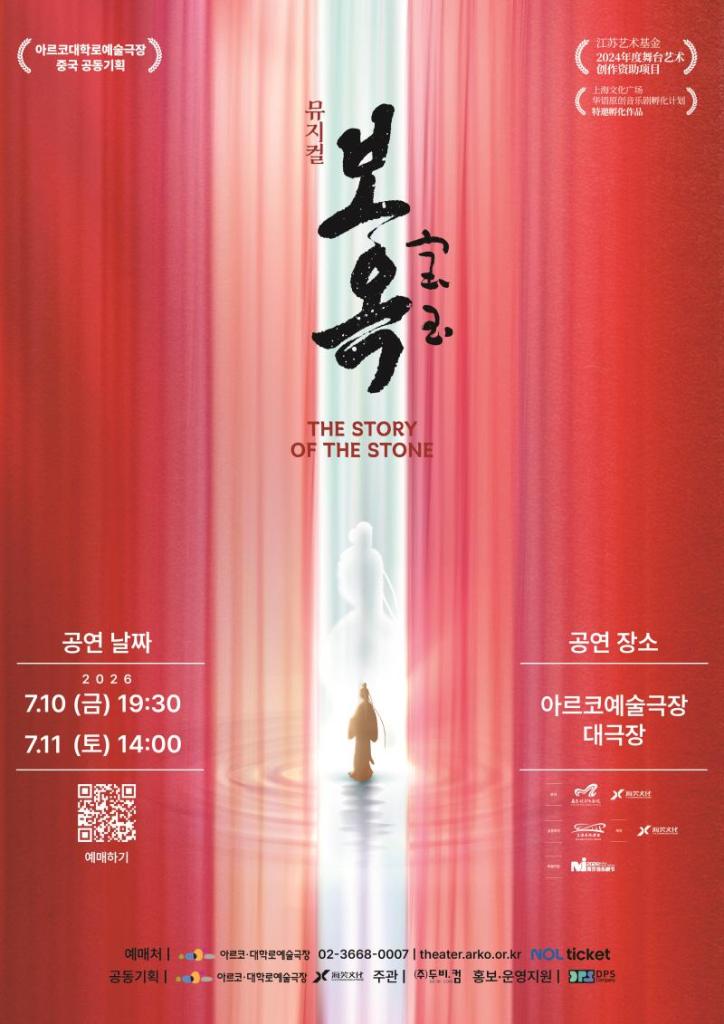
The Poster of The Story of the Stone
The Story of the Stone is a musical adaptation of The Dream of the Red Chamber (also called The Story of the Stone), an eighteenth-century Chinese novel by Cao Xueqin, which is regarded as one of the greatest novels in Chinese literature. The stage invites us to a broad and deep space, characterized by various red fabric sheets hanging from the ceiling and a sculpture made of several gray vases stacked irregularly on top of one another, which resembles a tree, located slightly right of center. The whole ensemble of over ten performers, in red and white traditional Chinese costumes, delivers a grand opening, running and dancing all over the stage to operatic music that combines traditional Chinese instruments and melody and modern symphony. The scale of the stage, the primary colors, the stylized choreography, and the awe-inspiring score immediately transforms the space into a mythical world, where every action carries extraordinary weight and symbolism. As an audience member, this opening felt like a rollercoaster ride to the home of the noble Jia family, opening up to the examination of love, family responsibility, fate, and the boundary between dream and reality.

The Ensemble of The Story of the Stone. Press Photo.
The musical’s protagonist is Bao Yu (played by Zhang Ze), the adolescent heir of the aristocratic Jia family, who is born with a sentient Stone. The Stone was originally a leftover after the goddess Nüwa mended the heaven. It begged a Taoist priest and a Buddhist monk to be sent to earth to experience the human realm, and thus, with Bao Yu, its human experience ensues. Bao Yu has a special bond with his cousin Dai Yu (role shared by Zhang Hui Fang and Chen Tian), who is intelligent and witty and shares his love for music and poetry. However, his family already arranged his marriage to Bao Chai (role shared by Guo Yao Rong and Lin Run Xin), known for her beauty and social grace, from another noble family. To his family, the marriage is not a celebration of love but a means to the family’s survival. Bao Yu struggles between love and responsibility and fights to overcome the obstacles through love. Dai Yu and Bao Chai also form a special bond as they navigate love and friendship. Nevertheless, even with his companions alongside him, Bao Yu’s struggle turns out to be futile in the face of the greater forces of family, societal expectation, and convention. The climax of the piece is the wedding, where Bao Yu believes he is marrying Dai Yu, but the bride turns out to be Bao Chai. In an Aristotelian manner, Bao Yu’s recognition coincides with the reversal of not only his but also the whole family’s fortune, leading to suffering the scale of which pushes the human experience to its extreme. Visually, the fall of the Jia family is represented by a fallen tree branch on center stage, with the gray vases on the ground.
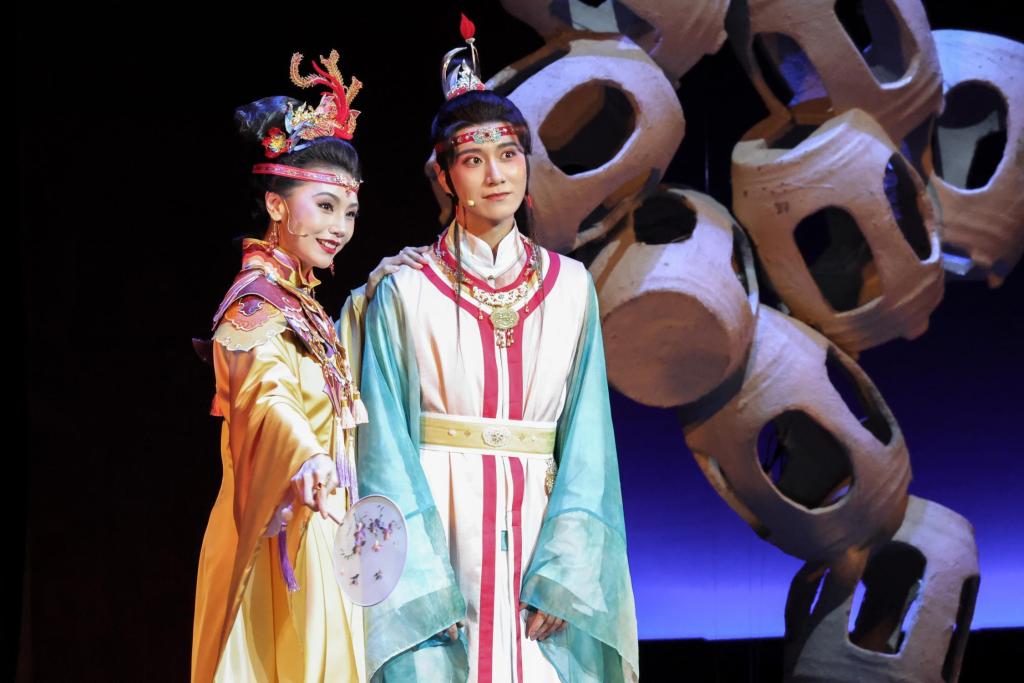
Bao Yu (Zhang Ze) and Dai Yu (Zhang Hui Fang). Press Photo.
In this story, which begins as a love triangle but develops into an epic familial and human saga, the overwhelming plot is, however, less primary. What this musical takes the audience through is more of an operatic journey, where the story flows along with the music and spectacle of the stage. For the duration of almost three hours, the piece takes us through various emotions – in scenes of playful friendship, blossoming romance, familial oppression, and unbearable heartbreak – while constantly enhancing the comprehensive sensory experience with the heightened choreography, the colorful costumes and fabric set pieces filling the whole stage like ocean waves, and the singing to the symphonic score. As the piece proceeded, my journey shifted from trying to follow the narrative to becoming immersed in the world of the piece. My audience experience – that of a mere spectator – seemed to merge with the experience of the Stone, caught in the whirlwind of Bao Yu and the Jia family’s suffering, while being a witness to the toils of humanity. The curtain call, when the performers greeted the audience with a smile and dance, felt like waking up from a dream – an epic dream, that is – and left me in the in-between state of contemplation and reflection for a while. The performance left me with the musing that life is indeed a dream and that all the world is indeed a stage. Yet the deeper significance of this lesson – What makes a good, meaningful life? What actions and decisions should proceed from this lesson? How should we love? – still lay in the realm of inquiry rather than effort for answers and progress. The tragedy of human existence as portrayed in the piece did lead to an appreciation of the room for such questions.
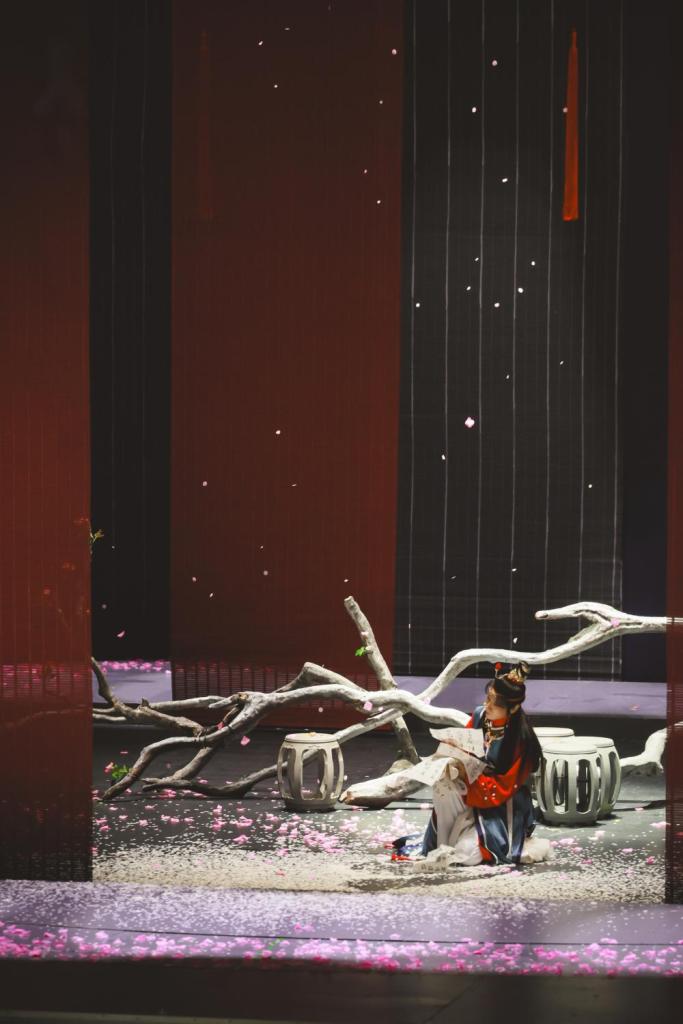
Bao Yu (Zhang Ze). Press Photo.
The Story of the Stone has offered a unique theatrical experience to the Korean theatre scene, where Chinese theatre has yet to find more room on stage. (One of the most significant platforms for introducing Chinese theatre to Korean audiences has been the BeSeTo Theatre Festival, which celebrates its 30th anniversary this year. Established in 1994 as a collaborative initiative among Beijing, Seoul, and Tokyo – from which the name BeSeTo derives – the festival has presented a wide spectrum of fully staged Chinese productions in Korea since a time when cultural exchange between Korea and China was still limited. Over the past three decades, it has played a pivotal role in broadening Korean audiences’ understanding of contemporary Chinese theatre while fostering sustained artistic dialogue across East Asia.) In this environment, The Story of the Stone was a welcoming introduction of not only the Chinese classic novel but also contemporary Chinese musical. To a spectator not as familiar with Chinese culture – including the source material, the staging convention, and the Chinese language – such as myself, the piece could be quite distancing. Nevertheless, the distance was easily bridged by the high level of artistry of the production. Most importantly, it was a treat to be experience a piece exemplifying China’s contemporary musical caliber and be awed by the epic scale in every element of the piece, from the singing, dancing, and acting to the designs and score, and the immersive and transcendent journey.
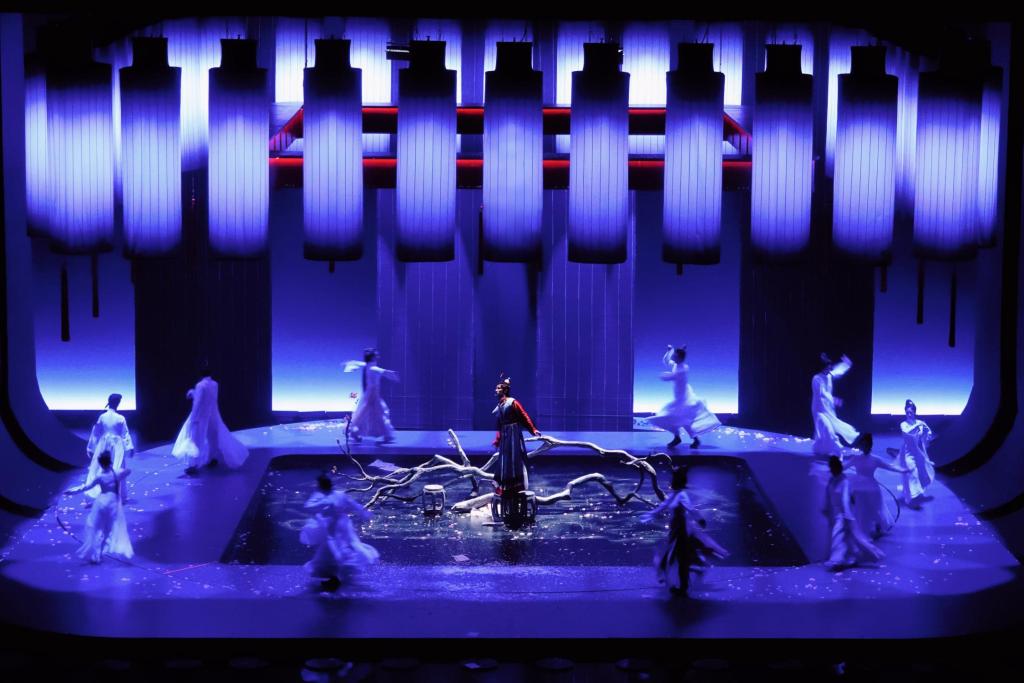
The Ensemble of The Story of the Stone. Press Photo.
This post was written by the author in their personal capacity.The opinions expressed in this article are the author’s own and do not reflect the view of The Theatre Times, their staff or collaborators.
This post was written by Walter Byongsok Chon.
The views expressed here belong to the author and do not necessarily reflect our views and opinions.