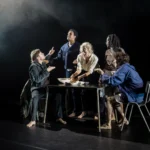

Praised by the Houston Chronicle as “one of the most original voices in American theater today,” Mickle Maher opens up about the challenges and discoveries of adapting Berlin from graphic novel to stage, offering rare insight into the creative process—and what it takes to become a celebrated playwright.
Susanna: Thank you so much for doing this interview with me. You must get this question a lot about Berlin: how did you turn a graphic novel into a play meant to be enacted onstage?
Mickle: I do—and I’ve asked myself the same question many times, because it’s such a rare thing. As far as I know, the only other graphic novel that’s been translated to the stage in a significant way is Fun Home, Alison Bechdel’s graphic novel, which became a Broadway musical. That’s always struck me as strange, because there are so many great graphic novels with stories that are essentially ready to go. Many of them have been adapted into films, but far fewer into plays.
Susanna: What was your overall approach to adapting the graphic novel into a play? Were you trying to preserve the original text and form, or to take a more radical approach? What was the adaptation process like?
Mickle: I was already familiar with the graphic novel as a casual reader. I’d known it for years—it took Jason Lutes twenty-two years to write—so I would come across it in comic book stores and read sections. When I began the adaptation, I did as close a reading as I could, and then I took a fairly haphazard approach to breaking it down. I used four-by-seven note cards and plotted the book out scene by scene, laying the cards across my dining room table. I tried writing scenes directly from the book that way. Then came a long editing process: pulling cards out and asking whether I still had something that resembled the graphic novel—its major characters, plot points, and the world Jason had created. That required a lot of trimming. I cut quite a bit, including whole characters and subplots. Eventually I realized I had to find a way to activate the piece as theatre. What finally unlocked it for me was thinking of the structure as a committee hearing. In the graphic novel, there’s a hearing about the events of May 1st—the riots that led to the deaths of more than thirty people. That gave me a way to frame the story theatrically, allowing the play to move between a present tense and a backward-looking narrative.
Susanna: So the committee hearing scene was your original idea.
Mickle: Yes—it came much later, but it was what allowed me to compact the story into two or two and a half hours and make significant narrative leaps. It gave me a way to include scenes directly from the novel, while also allowing for interstitial commentary—collapsing dates and times so the audience always knows where and when we are, what’s happening historically, and how to gain insight into the characters. Adding a past tense turned out to be necessary, especially given the length of Jason’s novel. It shortened things considerably, but it also introduced a tension that felt inherently theatrical: the tension between present tense and past tense.
You have characters who are looking back and also reliving events at the same time. That creates different theatrical modes. When a character speaks into a microphone about something that happened in the past and then immediately drops into a scene in the present, that’s something the stage can do in a way no other medium quite can. Theatre’s relationship to time makes those shifts especially noticeable. Switching tenses creates a heightened awareness, and it also adds an inherent reflexivity—in this case, a kind of self-reflexivity—that felt essential to the adaptation.
Susanna: What’s your take on the media specificities of the graphic novel and theatre in the adaptation process?
Mickle: If you’re going to adapt a graphic novel for the stage, you actually have to abandon the medium’s greatest strength, which is the visuals—because you can’t compete with them. You can have great visuals in theatre, but they’re not graphic-novel visuals. So it’s almost better to abandon spectacle altogether: giant projections, video screens, images. Instead, you focus on the human body, on what’s live and theatrical, and play to the strengths of the stage rather than trying, vainly and futilely, to translate graphic-novel montage or panel sequences directly into theatre. It just doesn’t work. That said, there are interesting parallels between the script and the graphic novel, especially in how each handles time.
When you read a graphic novel, you’re focused on one panel, but your peripheral vision is taking in the panels below, the page to come, and the panels you’ve already passed. Past, present, and future exist in a kind of tension. Even when you’re focused on a single image, you’re unconsciously aware of what’s coming next—a splash page, for instance. I tried to find an analogue to that onstage. Scenes sometimes bleed into one another, so you get the beginning of the next scene emerging inside the present one. That felt like a way of having a conversation with the graphic novel as a form—its sense of time, of past and present coexisting—and it felt both appropriate and theatrically productive.
Susanna: Yes, I really like the play’s treatment of memory and trauma—how the past, present, and future remain in motion rather than frozen—feels both complex and immediate. Was the cousin already a character in the novel?
Mickle: Not as much in the graphic novel. I foregrounded him. The cousin is part of Marthe’s past: he’s a soldier who dies in the trenches and they were supposed to marry. Marthe is the main character, but how much of her emotional self is bound up in her cousin was something I invented. I used that to push us directly into the trauma of the war and the sense of loss so many people were experiencing in the 1920s. In the graphic novel, she is clearly experiencing loss, and there’s a large mystery around her life: why is she twenty-eight and still at home? What has she done with her life? She hasn’t gone to school, she hasn’t been married, she doesn’t have a boyfriend—there’s no mention of any life at all. I took that as a clue of trauma: that the devastation of World War I in general, and specifically the death of her cousin, caused her to freeze as a person. I thought that was a legitimate reading of what was already there on the page. So I imagined her backstory from the ages of twenty to twenty-eight—a period the original text doesn’t comment on at all. I invented this blank trauma space: a frozen person, a frozen woman, who then begins to come out of that state through the journey to the big city, to Berlin.
Susanna: That’s a really unique choice. The cousin appears almost like a phantom—silent but constantly present. Was that your idea or the director’s?
Mickle: It was both. I didn’t write specific stage directions for Theo. I simply said that he appears—he’s there in the first scene when she speaks to us about his death. The stage direction says that he appears, but after that I don’t specify what he does until the very end, when I bring him back again. You could do the play with him not there at all.
But it seemed necessary—more theatrical and more fruitful—to have him always present. He’s not only the ghost of Theo for her; he’s also the war, and history itself. The dead are always with us. It’s really that simple. He’s just a very present dead person. For people living at that time, death was everywhere. Thousands and thousands of young men had died. Everyone knew someone who was dead. Imagine that level of trauma in a country in the decade immediately following the war—there was no distance from those walking corpses inhabiting daily life.
Charlie, the director, had to think carefully about how to activate him—how to make him present without making him visible. I always found it interesting that he’s entirely invisible to her, but he can always see her. That creates a tension that runs through the entire two hours: these two characters who can’t quite connect—until they finally do at the end.
Susanna: I read your play Song About Himself before and it struck me that you’re deeply interested in connections between people—and just as much in their disconnections: how people relate, react, or fail to communicate. You’re also very skilled at creating parallel worlds that may or may not intersect. Is that a recurring approach in your work, and how does it shape your process of adaptation?
Mickle: I’ve always been interested in invisibility and in the conventions of invisibility, especially on stage. It’s simply something I enjoy playing with. That interest goes back to when I was a little kid. I first encountered it in a college student production where performers were dressed in black leotards, and the narrator said, You see these people? You don’t see them. I was probably six years old, and I still remember thinking, Oh, okay. They come onstage, and when they’re there, you just don’t see them. The narrator was essentially saying: we’re going to tell you something and ask you to believe it. The idea that people could be invisible onstage simply because we say they are—that was fascinating to me. And of course, there are many different ways of conveying that.
Susanna: Was the playwright’s intention to make Hitler character played by the innocent mother character simultaneously?
Mickle: Yes, I wanted Hitler to arise out of Gudrun, out of the mother, the most innocent character, the sort of, the almost stereotypically good character, Gudrun, with no political axe to grind and, not a bad bone in her body. And to have her die and then to have him arise out of her was to me, again, a theatrical gesture that was interesting. Having the Hitler as a woman was partially also to try to just break through the stereotypes around Hitler, but also to play with the stereotypes around Hitler and try to give us a different take on him. I feel like if this had been just a man or from one of the male actors, it would have made the whole play a very different tone.
Susanna: In your opinion, what are some key qualities and sensitivities that make a good playwright?
Mickle: It’s interesting that both Molière and Shakespeare were actors—Shakespeare a minor one, not a big star. A number of playwrights started as actors, often failed actors. David Mamet was a failed actor. I think you have to have some sensitivity to what it feels like to inhabit language—how it feels inside a person’s mouth, inside their skin. You have to be able to crawl inside your characters’ heads, much as an actor does, and really feel what they’re thinking and feeling in any given moment, even when the characters don’t understand one another. Most of the time, though, you’re struggling through a thick haze. It’s difficult to see the whole. Many playwrights start from a single image or a bit of dialogue. You sit down, face the blank page, write Scene One: Enter Herman, and imagine what he says. For some reason, what he says grabs you, and you build from there. But you’re always building from nothing.
The playwright is the one theatre-maker who truly begins at zero, facing the void and trying to make some kind of shape. So almost by definition, you don’t know what you’re doing—but you carry a huge responsibility. Once you get going, you start looking for an internal logic. Every piece has one, and it’s often counter to what you, the playwright, want. There’s usually a moment when what you want the play to be conflicts with where the play wants to go, and you have to follow the play. The process is still mysterious to me. Some of it you can’t teach. For many people, the discovery comes late. For me, it’s been years of figuring out what I actually like, why I like it, and how to make that happen.
This post was written by the author in their personal capacity.The opinions expressed in this article are the author’s own and do not reflect the view of The Theatre Times, their staff or collaborators.
This post was written by Susanna Sun.
The views expressed here belong to the author and do not necessarily reflect our views and opinions.