With more than 4,200 shows making up this year’s Edinburgh Festival Fringe, twenty-four performances can hardly stand in for the whole thing. What follows is a subjective itinerary through a week shaped by my own tastes and curiosities, even if several stops were among the Festival’s conspicuous talking points. Across theater, comedy, clowning, and magic, certain motifs kept surfacing in parallel: the stories we tell about ourselves, the selves we perform for others, the seductions of visibility (both online and off), and the strange uses of laughter as camouflage, release, resistance, or simply a way of survival.
At Summerhall Arts, Hannah Reilly’s Roleplay, directed by Paige Rattray and performed by Reilly herself, has a cunningly contemporary premise. Danielle, an amateur podcaster desperate to sell her work to a media conglomerate, plunges into online sex work in pursuit of controversy, provocation, and an instant audience. Reilly is a magnetic performer, skillfully backed by thumping sound and lighting, and the play moves deftly until its final quarter, when it rather loses the plot. Its questions about commodified pleasure and sexual visibility are compelling, even as its answers remain frustratingly indistinct.
Lightning Rod Special’s Lions, written and performed by Alice Yorke and Scott Sheppard and directed by Sarah Blush, also asks what becomes of a person once converted into a story. The pair eulogize their recently deceased fathers through objects arranged on a long white table. Dressed as quaint Victorian men — the lionized male archetype — they find wry, clear-headed comedy in bereavement’s administrative burdens without foreclosing emotion. Their fathers emerge as flawed, complex presences; only the hour feels somewhat too small for them.
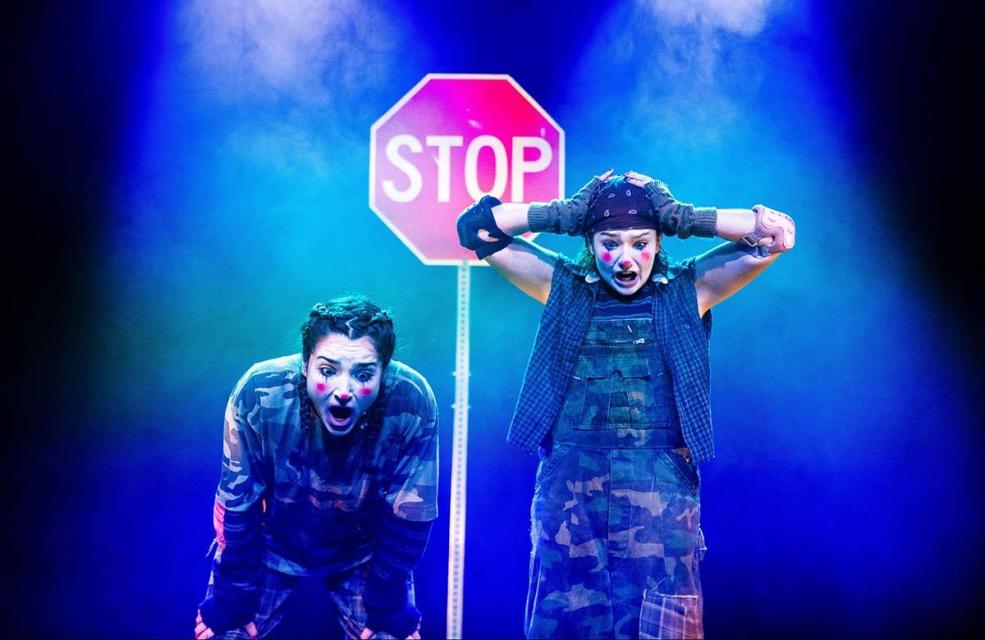
Stories prove considerably more contagious in Xhloe and Natasha’s Bigfoot Ripped My Dog in Half I Saw It. Two teenagers claiming that Bigfoot destroyed a stop sign trigger mass hysteria through an Appalachian town. Clowning, puppetry, clipped dialogue, and the clockwork coordination of sound, light, and movement animate the townspeople while showing how impulsive narratives can distract from troubling social and environmental realities. The piece’s breathlessness can become opaque and, toward the end, repetitive, but the duo’s stagecraft is mighty impressive.
Sam Ward’s As Far As We Know, by the company YESYESNONO, makes uncertainty not a hazard of storytelling but its very subject. A woman investigating humming holes in her surroundings enters a Kafkaesque maze of mysterious detectives, empty offices, and rooftop trees. Suited and seated at a desk, Ward recites her novelistic story from typewritten pages, before projected text and sound effects take over. The anti-theatrical stasis is partly the point: what do we know, what can’t we know, and why must stories have closure? This is intellectually stimulating stuff, though its rich terrain could have been cultivated more thrillingly.

As Far As We Know at Summerhall Arts. Photo courtesy of Mihaela Bodlovic.
Bunny! has no such qualms about the lurid satisfactions of plot. Craig Manson, in sequin dress and blond wig, plays a desperately unemployed actress who murders artistic directors, producers, and then fellow competitors. This hysterical blood-and-guts pity party skewers the Scottish arts industry and its funding bodies with cabaret-style songs, vicious one-liners, Marina Abramovic’s murder, and a riotous cult. Manson’s femme-fatale aura strikingly fills up an almost empty stage, marrying outlandish psychosis with the all-too-recognizable plight of early-career artists.
Gregory Nussen’s QFWFQ, meanwhile, mistakes self-reference for depth. Inspired by Italo Calvino’s novel If on a winter’s night a traveler, the solo show begins with metatheatrical exercises in storytelling before turning to Nussen’s frustrations as a queer Jewish artist, especially in relation to a discomfiting birthright trip to Poland and Israel from years ago. Important questions of identity and community are touched, but the whole thing feels gimmicky, solipsistic, and oddly pointless, with gestures toward other stories only confirming Nussen’s consuming interest in their own.
Over at the Pleasance, Alistair Hall’s extraordinary play Buggers, expertly directed by Alice Wordsworth, offers a poetic autopsy of Francis Bacon and George Dyer’s mutually destructive relationship, from their first night together to Dyer’s suicide and its aftermath. Hall and Peter Clements give towering, lived-in performances as sex, alcohol, violence, and painting tighten their brutal grip around them. Glass screens, a tub, and the smell of burnt toast make the small playing space richly sensuous. Beguiling, dark, and eerily delicate: this is the theatrical equivalent of staring into a Bacon painting.
Tom Brennan’s Overtone, directed by John Hoggarth, is another two-hander about damages that change shape with time. Claire Dargo and Scott Fletcher play Maggie and Paul in parallel narratives split apart by years: as teenagers under a charismatic, manipulative choir leader’s sway, and as a middle-aged married couple whose resentments erupt over dinner. Their subtle age-switching serves the play’s dual structure beautifully, while carefully timed revelations expose the long shadow cast by abuse. Knotty and emotionally nuanced, the piece makes much of the often-subtle mechanics of predation and their seemingly different effects on two young people.

Overtone at the Pleasance Dome. Photo courtesy of Geraint Lewis.
The workings of memory are stranger, if also more predictable, in Jacob Sparrow’s Sanctuary, directed by Josh Seymour. Matthew Tennyson’s Michael, a young man diagnosed with AIDS and sheltering in the countryside, is visited by Richard Cant’s older stranger and goes on to reflect on queer life in London, local prejudice, and his gentle friendship with a seven-year-old boy. Cant is especially assured, and there is welcome tenderness throughout. Yet the supposed twist suggests itself too early, and a promising vein of humor never develops enough to cut through the play’s otherwise apt sentimentality.
Tenderness is emphatically not the opening gambit of Ros Watt’s provocatively titled Trans People Are Awful. A cocky young trans man records an “explanation video” justifying why he murdered fourteen cis men, while planning to implant one victim’s penis onto himself to complete his transition. Watt attacks the role with ferocious energy amid stomach-churning jars of organs, and the grotesquerie can be savagely funny. But the final act veers into implausibility: an important point about the destructive effects of trans loneliness is ultimately driven home with a heavy hand.
Dan Bishop’s satirical play Target Audience finds moral grotesquerie in the supposedly rational world of data-driven TV content. Over one apocalyptic office day, novelist-for-hire Tobias meets American creative executive Angie, sharp-tongued producer Bruiser, and Gen-Z intern Isabelle, before a canceled CEO, a pro-weapons family sitcom, and an impending drone strike raise the stakes. Deliciously funny and superbly written, the play keeps its performances grounded and sharp-edged while probing the fraught relations among art, money, warfare, and corporate pressure. Building on the success of his Brainsluts from last year, Bishop has become one of the safest bets at the Fringe.

Trans People Are Awful at the Pleasance Courtyard. Photo courtesy of Ella Carmen Dale.
Beyond the plays, some of the Fringe’s richest pleasures came from shows where the boundaries between theater, comedy, and clowning seemed increasingly porous. And none was more exhilarating than Elf Lyons Is the Woman on the Edge, which turns the collapse of Lyons’s engagement and her subsequent depression into a ravishing autobiographical performance. Reconstructing Hollywood’s trope of the hysterical, wine-glass-clutching “woman on the edge,” she exposes that figure’s male-authored artifice and tries to define and celebrate herself outside her relation to men. References to Apollo 13, clownish lip-syncing, and shoeless high heels abound to great effect. Lyons is a comic of the highest order, and this masterstroke in sublimating life into art is easily the best show I saw at the Fringe this year.
Frankie Thompson’s Horrible Things takes us into clownier, stranger territory. Like a medium at a séance, Thompson channels her “horrible things” — the nine-year-old Jacob Rees-Mogg, Frank Sinatra’s epic ode to himself, Cliff Richard, Tory whips, and Victorian governesses — through lip-sync, song-and-dance routines, and unpredictable audience terrorizing, retching after each visitation. The list, announced at the outset, is the inspired organizing principle: we know what horror comes next, but never remotely what Thompson will do with it. As the voice of her “assistant” Peppa Pig declares, this is not a work in progress but one “in regress,” even as its many pleasures prove wickedly propulsive.
The larger-than-life heroine of actress-turned-clown Maya Ricote’s Ay Am!, co-created with Dan Lees, is possessed mostly by herself. A campy would-be actress born in 1930, she has been cryogenically frozen and now emerges into the present with enormous breasts and backside — and one audition standing between her and the deepfreeze. The rambunctious romp expands through Ricote’s campy portrayal of a New York taxi driver and a vindictive talent agent, and peaks when audience prompts dictate her pivotal audition. Ricote’s performance is eye-wateringly funny, full of knowing glances, tongue-in-cheek declamations, and farcical mischief.

Ay Am! at the Pleasance Courtyard. Photo courtesy of Gala Ricote.
Joseph Morpurgo’s Highlander 70 finds its characters somewhere else entirely: inside a 1970 Highlander Academy yearbook bought at a car boot sale. Its cut-up and collaged photographs become a madcap PowerPoint, with Morpurgo performing figures from his concocted story, centered on the repressed valedictorian David Moon, while audience members are roped into the proceedings as other students. Demonic faces, awkward tableaux, and weird visual details yield the richest absurdities. It is not consistently laugh-out-loud, but the premise is genuinely fresh, the visual storytelling distinctive, and Morpurgo a damn good comedic actor.
The title of Man Sings the Same Song Over and Over Again for an Hour is less a tease than an accurate description of the show. Australian clown Conk performs a not-to-be-revealed song fifteen times, but each time with a difference: now forlorn, now hyper, recruiting audience voices, instrumental skills, and even a beer order. Repetition with variation makes the room increasingly exuberant. What could have been flat-out cringe becomes goofiness of the golden kind, squeezing as much as possible from the song’s narrative, including many, many bananas. This is an endurance test that turns out to be pure joy.
From these harder-to-categorize acts, I moved into the Fringe’s more readily identifiable terrain of stand-up comedy, though the best sets hardly proved less adventurous. At the Gilded Balloon, Australian comic Frankie McNair’s Huge Ass Mindset turns childhood sexual abuse and its aftermath into a hilarious hour about resilience and permission to laugh at taboo subjects. Her comic storytelling is masterful, and a late reveal transforms the room: laughter gives way to stunned silence without diminishing the piece. McNair begins by insisting that this is a comedy show; by the end, that designation feels like an understatement. Affable and charmingly transparent, she is a living testament to the power of comedy as a buoy in stormy seas.
Back at the Pleasance, Larry Dean’s Hellbent is more conventional in form but every bit as accomplished. The Glaswegian comedian’s proposal and marriage to husband Mikey anchor a fiendishly funny set, with a trip through Texas and Tennessee yielding side-splitting encounters alongside sincere observations on gay life and seeking love. Dean is an expert shapeshifter with brilliant accent work, uncannily well-constructed punchlines, and a composed yet serpentine energy: lanky, jumpy, and devilishly sympathetic. One of the very best hours I had at the Fringe.
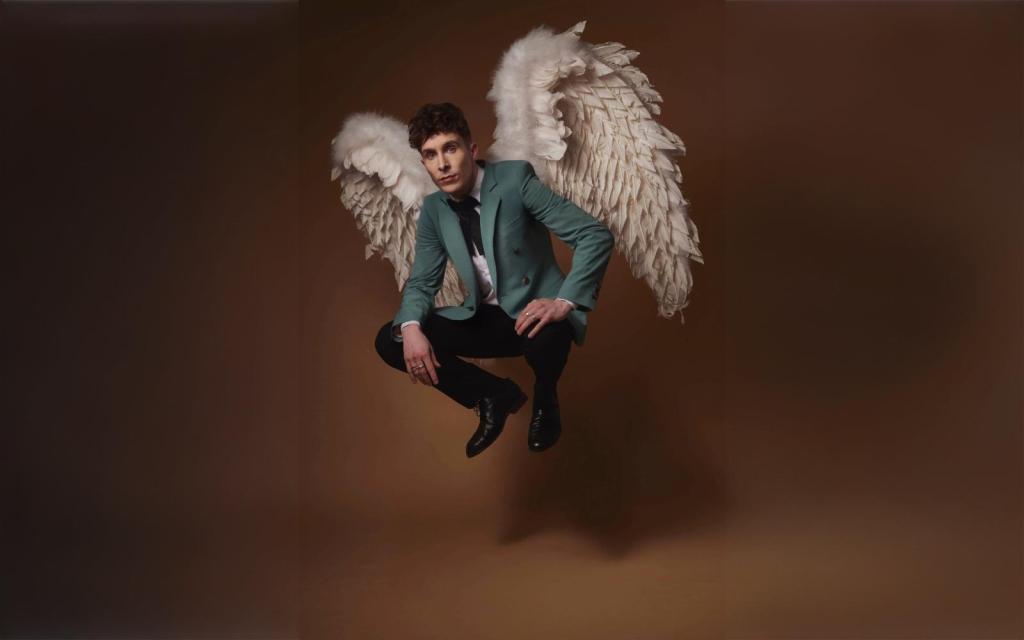
Hellbent at the Pleasance Courtyard. Photo courtesy of Larry Dean.
Where Dean seems intensely at ease in performance, Jordan Brookes makes the very condition of performing oneself bizarrely visible in The Part of You That’s Always Screaming. A simple train episode — eating a croissant while knowing the neighboring passenger is watching — becomes a throughline for living with, and for, other people’s eyes. Brookes is a hypnotically frenetic performer, writhing under blue light in body-horror interludes that suggest who he might be in those rare moments when he isn’t watching himself. The set is also extremely funny, with everyday self-consciousness pursued to the depths of existential humour.
At Monkey Barrel, Mexican-American comedian Lara Ricote’s INKLING tackles another failure of perception: not seeing oneself too clearly, but never quite understanding enough. Ricote, who is hard of hearing, builds her set around “mystery and messages,” turning misunderstandings, half-understandings, and even gibberish into meticulously evasive comedy. Three Delphic maxims (“Know thyself,” “nothing in excess,” and “surety then ruin”) reinforce its elegant, if somewhat diffuse, structure. Ricote’s great trick is making the audience experience incomprehension alongside her, while teasing our costly desire to be perpetually in on things.
Lou Wall’s Where Are All the Tall Grandmas? begins with a mystery of an altogether more ludicrous order. As they age, do tall women simply shrink, covertly stock Ikea’s upper shelves, or get eaten by a particular man? Wall recounts contacting the Australian Bureau of Statistics and scouting grocery shops for tall grandmas, while projected gifs, memes, original songs, and zingy punchlines propel the investigation. The absurd inquiry eventually opens onto Wall’s own relationship with their height and their growing acceptance of it. Even without the deliciously meta layers of their stunning previous show, this is a fiercely original and thoroughly enjoyable departure from conventional stand-up comedy.
Dan Tiernan’s Quartz and All also pursues an improbable answer to a genuine problem. After his phone gets “pinched” in the street, Tiernan discovers healing crystals and becomes increasingly committed to their capacity to improve his life, even as his failing romantic fortunes might rationally suggest otherwise. His staggering self-mockery generates absolutely manic, unhinged energy, but real vulnerability is expertly smuggled inside that feral exterior. “Quartz and all” indeed: what looks like shameless self-exposure gradually reveals itself as something considerably more tender.
Bella Hull’s Mad Cow Disease is looser by comparison. Hull brings girl-next-door ease, fierce intelligence, and nervous laughter to an extended pregnancy routine (including aspirations of raising an incel son) and goes on to deal with her upbringing in a female-only household, casual sex, attic clutter, and teenage poems. Some golden one-liners emerge, and she holds the room comfortably, but no overarching story or theme quite binds these touchpoints together. There is plenty here to like; I just wanted a stronger sense of why these particular bits belonged in this particular hour.
After so much comic traffic between knowledge, delusion, and belief, Ben Hart’s magic show The Labyrinth makes mystery itself the ultimate focus. Card tricks and skeins of red string frame Hart’s central preoccupation with a fundamental human contradiction: our appetite for mystery and our equally powerful urge to explain it away, imposing story and order on what we cannot know. Hart has a charismatic presence on stage, even though some of his transitional spiels fall flat and his delivery could be more precise. But then come a miniature diorama and a final trick that is simply jaw-dropping.
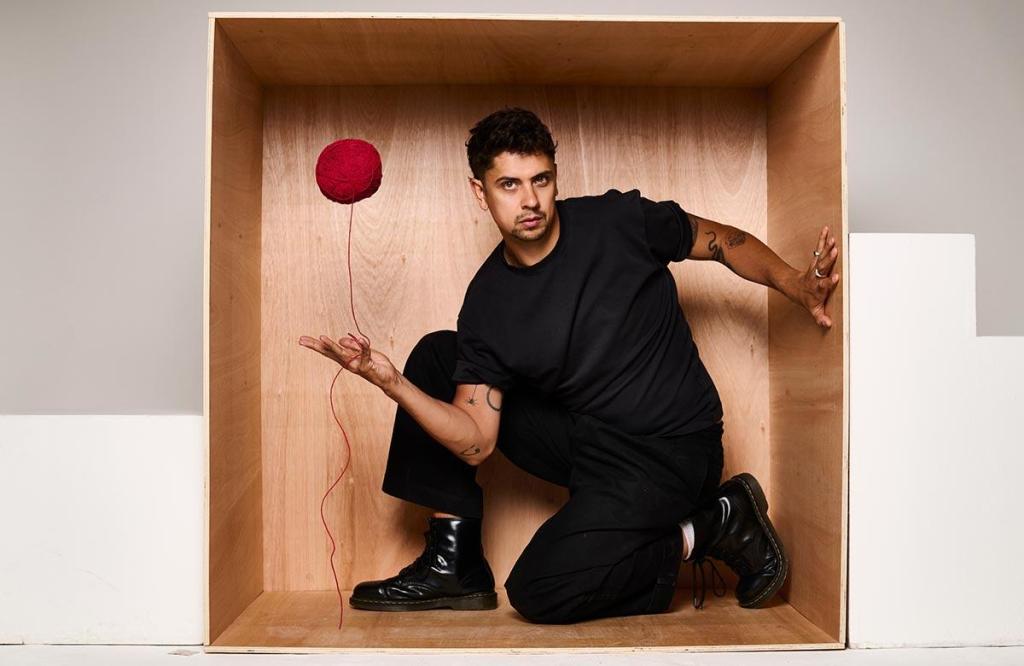
The Labyrinth at Assembly George Square Gardens. Photo courtesy of Matt Crockett.
Any attempt to derive a single conclusion from such a disparate week would be beside the point. If anything connected the best of what I saw, it was their refusal to behave quite as expected: clowning slipped into theatrical territory, stand-up found room for stunned silence, a repeated pop song became strangely exhilarating, and two actors traversed decades with little more than a shift in posture or voice. That unpredictability is hardly unique to Edinburgh, but nowhere else is one invited to encounter so much of it, so quickly. The Fringe’s bold excess can be exhausting, even maddening. But it is also the source of its enduring thrill.
This post was written by the author in their personal capacity.The opinions expressed in this article are the author’s own and do not reflect the view of The Theatre Times, their staff or collaborators.
This post was written by Mert Dilek.
The views expressed here belong to the author and do not necessarily reflect our views and opinions.