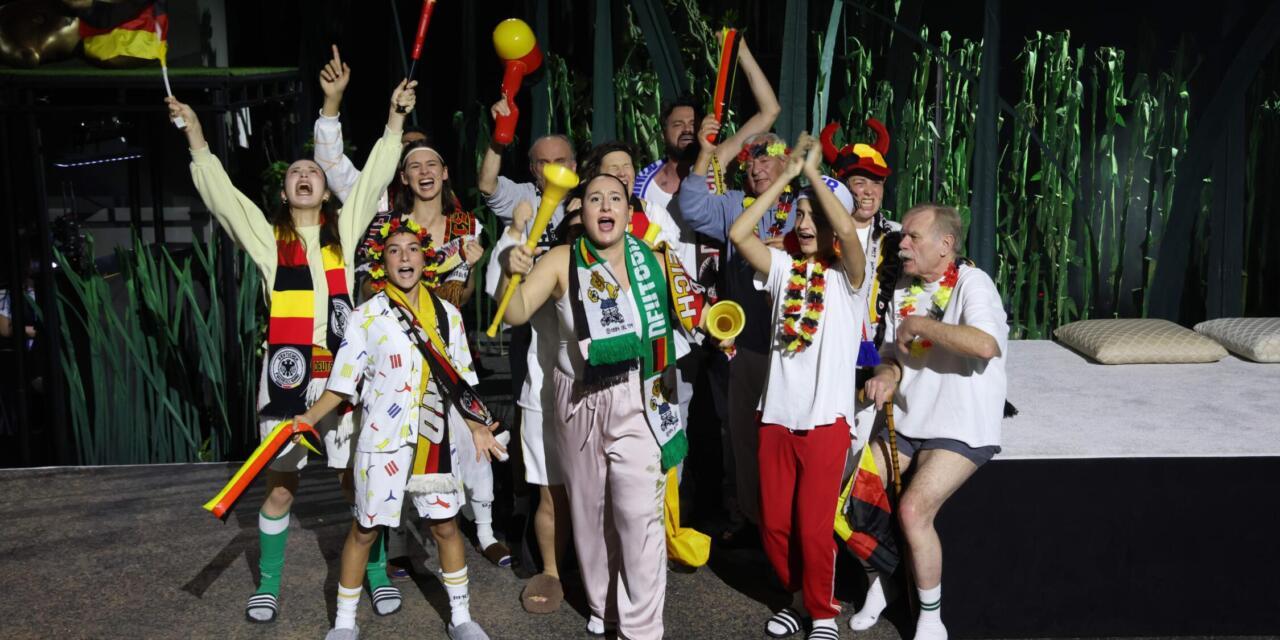
Theater Bremen is currently showing the world premiere production of Der Zauberer von Öz – Eine Fußballtragödie by Akin Emauel Şipal. The play is about football player Mesut Özil (b. 1988). Şipal intricately uses the character and the story of the controversial former star of the German national football team, and a former player in the local football club, Werder Bremen, to mirror some of the current ongoing debates about national identity and migration. The production has been a major contribution to Theater Bremen’s long-running engagement with issues of migration and national identity: in response to rising immigrant numbers from 2014 onwards, the theatre launched its series of events under the heading of In Transit. In the 2014/15 season, there had been 52 separate events under that heading, ranging from conventional productions to facilitating Syrian female refugees to cook traditional meals together and have a meal with family and friends in a stylish environment. At the time, Yana Meerzon and I wrote about Theater Bremen’s production of Wajdi Mouawad’s Incendies / Scorched / Verbrennungen for Critical Stages.
In Der Zauberer of Öz, Theater Bremen took the discussion of issues of cultural identity seemingly away from the immediate issues of ongoing migration but went back to implications of identity for second generation Germans – people born in Germany, and thus by default German citizens, with parents who had come into Germany from other countries for work, Gastarbeiter, often retaining their original nationalities. I remember two occasions of my own life that resonate with issues of Gastarbeiter, and with working in a country of which I am not a citizen: when I moved from one German city to another, in 1969, when I had just started secondary school, and my mother had to decide which school to put me into in the city we had moved to, she was somewhat startled when school officials told her not to worry about children from Gastarbeiter families in my prospective cohort, because those children were “usually not intelligent enough to attend Gymnasium.” I brought up my family as a German citizen in a rural area of Wales. My wife, from India, and I were well-liked by the locals because we were at least not from England. When summoned by the Welsh municipal education authorities because of what was considered too high a rate of absence from school for our younger daughter, we were told that our practice of keeping her out of school for the full duration of an illness was not in line with “the practice we would like to see in our country,” i.e. sending children to school while they are ill (as long as they can possibly still attend, and as soon as possible as they can attend again), and if we disagreed with that expected practice “we were free to return to the countries we had come from.”
Özil was often referred to as an ideal of integration, the German citizen born to Gastarbeiter parents who had made it as an internationally renowned football player on the national team. In May 2018, he and national teammate İlkay Gündoğan had a photo taken with controversial Turkish president Recep Tayyip Erdoğan, triggering a shitstorm in the German media, exacerbated when Germany dropped out of the World Cup early on. Soon after that, Özil published his first public statement after the publication of the controversial photo and resigned from the German national team. He maintained that the photo had not been an endorsement of Erdoğan’s politics, or an act of support for Erdoğan, but had been an expression of esteem for the head of the country of origin of his parents. Earlier documented meetings of Erdoğan and Özil, in 2011, 2012, 2016 and 2017, had remained rather unnoticed in the German media. His more recent taking up a leading position in Erdoğan’s party has been commented on by some as confirmation that earlier concerns were fully justified.
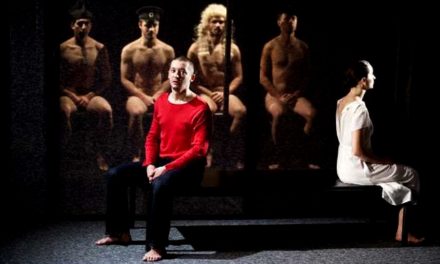
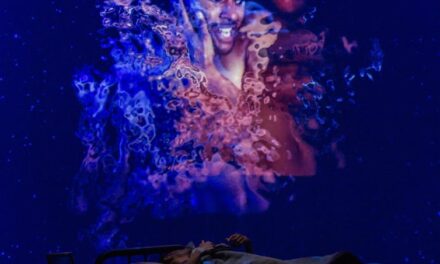
Şipal’s play took up elements of Özil’s life, not in chronological order, but with clearly signposted first half, second half and extra time, altogether some 2 hours without interval. There was some material about imagined life in his family in his childhood and youth, the importance of parents and siblings, and his rise in the field of football. Scenes showed intimate family scenarios over a meal, or narratives presented by the ensemble of actors speaking in unison like a chorus. The football context, especially the national team, was presented in a very funny way with live video capturing the actors playing with Playmobil-like characters on a green Lego board, projected on a large screen. In particular, parody of trainer Joachim Löw’s accent, and his assumed way of talking to the team before and during matches caused much laughter. Video was made use of throughout, often accompanying the scenes performed by the actors, with snippets of world events juxtaposed at incredible speed. The political issues were implicitly encapsulated within the narrative or explicitly debated.
On the accompanying program notes, the actors were listed in two groups, the first group with the six professional actors who played the major parts, and the one musician, in alphabetical order, but without allocating roles to the actors’ names. The website provided links to those performers’ biographies. In the second list of names, headed “as well as”, we found nine names, five of which looked Turkish, with two without a Turkish element and two with potentially Turkish first names. Neither program nor website provided further information about these “as well as” people.
This post was written by the author in their personal capacity.The opinions expressed in this article are the author’s own and do not reflect the view of The Theatre Times, their staff or collaborators.