
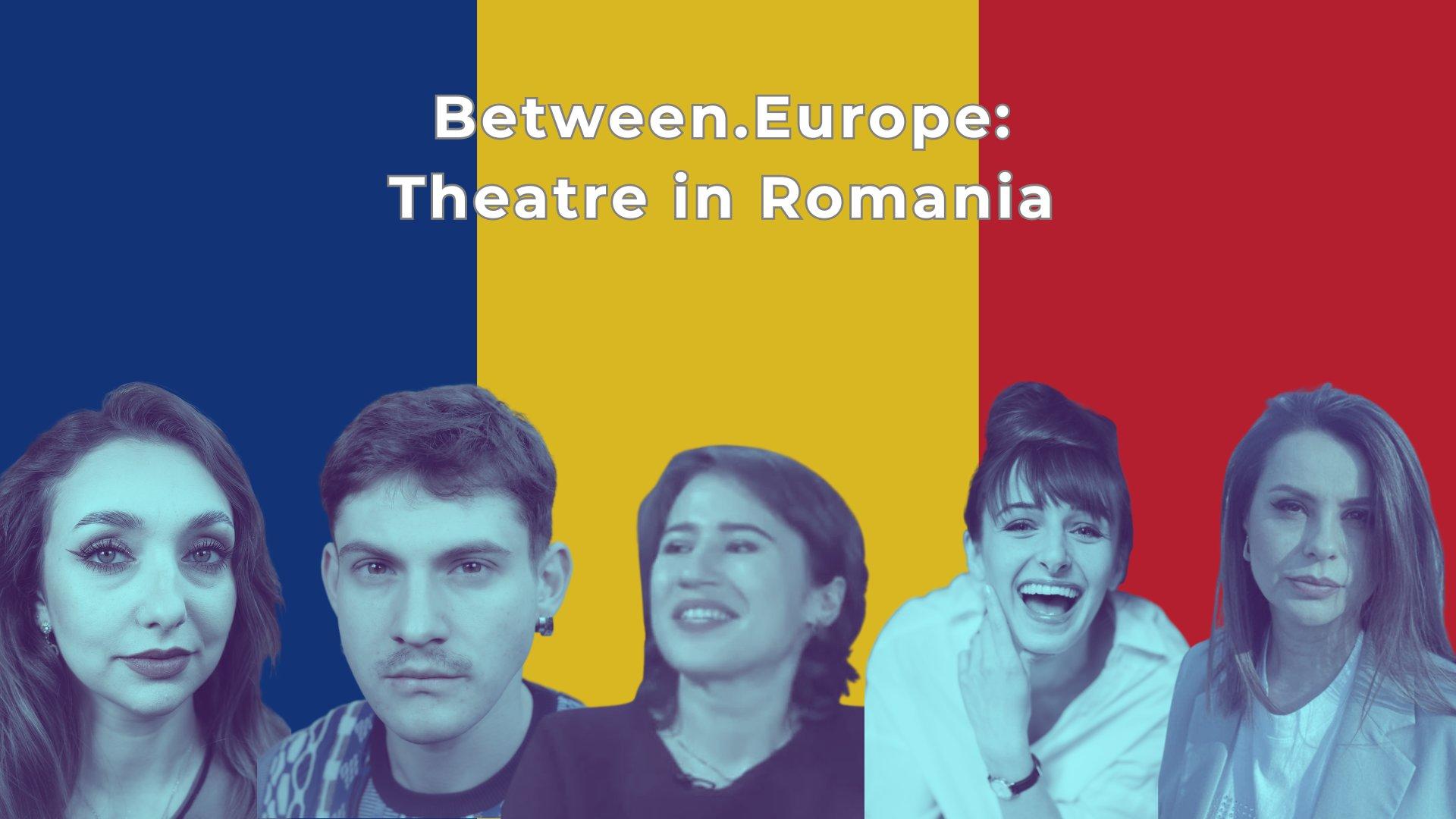
Somewhat on the fringes of the Poland-Romania Cultural Season, the 2025 Between.Pomiędzy Festival follows the pattern of bilateral events, by bridging the cultural worlds of these two countries even further, through the series titled Between.Europe: Theatre in Romania. The seminar discussion was part of the cooperation between the University of Gdańsk (Poland) and the “George Enescu” National Academy of Arts in Iasi (Romania) that dates back to the year 2020.
Comprised, essentially, of two major events – the international conversation and the exhibition –, the 2025 edition of Between.Europe program can be seen as having had a performative prologue, in the shape of a movement workshop, “The Fast Body”, part of the Sharing Crafts Series. Continuing in a not-so-physical, yet no less engaging manner, the festival audiences were invited to take part in a round-table discussion between young practitioners and scholars from both Romania and Poland, comparing the two environments, and, to an extent, criticizing the local policies and peculiarities of each individual creative space.
Different, yet the Same – Conversations on Romanian and Polish Theatre Practices
Natasza Sołtanowicz, the guest from Poland, was not foreign of the Romanian theatre space, as she had signed a the direction of The Anomaly, at the “Marin Sorescu” National Theatre Craiova, production well received by audiences and critical voices alike. With two showcases in the 2024 edition of the National Theatre Festival in Bucharest, the production stood the tests of multiple audiences, both local and international, and its director was now opening up about the backstage stories of working abroad, in an unknown environment and an unknown language.
As Aura Corbeanu (UNITER Vice-president, Executive director RNTF) puts it, the National Theatre Festival “managed to create the necessary framework and to collect the resources for a Best of of the theatre season countrywide, presented in Bucharest. […] The selection in the RNTF has now become an emotion, a hope and an ambition of every state or independent theatre, large or small, in Romania […].”
Attending Between.Pomiędzy for the second time, the Romanian choreographers and performers Alice Veliche and Radu Alexandru, had the chance to make a quite short-term comparison between the two counties’ cultural worlds, as their exposure to Polish artistic praxes was not as extensive as their conversation partner’s. Even so, through logical progression and analysis of facts and memories, the three guests managed to draw a detailed landscape of the struggles and breakthroughs of young Central and Eastern European theatre-makers.
Andrei Măjeri (director, Romania) – “A director is, above all, a craftsman of attention. In this respect, I try to stay in touch with the muddy ages I live in, therefore my way of seeing theatre focuses either on maximalist vulnerability or on minimalist force. It is indeed a theatre of contrasts […]. I see strength in the margins, in the overlooked corners, in peripheries. But I’m also quite a shy disruptor. […] I cannot see an artist with only flow and no stock/substance or vice versa.” (3 March 2025)
Given the fact that the moderators (Tomasz Wiśniewski and Teodora Medeleanu) came from the fields of hermeneutics and theatre studies, the discussion also touched upon the possible constrains each country’s respective audiences can face when attending a foreign language production, as well as what interpretative gaps could form when first facing a play’s translation.
When/How does one become an emblematic figure of a country’s theatre? How could the younger generation challenge the legacy of these emblematic figures? were only some of the questions asked, whose answers were formed during the round-table discussion. None of these was, however, definitive in any way, as, perhaps, the previous generations’ pressure was still being felt. Following the critical observations on the differences in the field of art and analyzing Romanian and Polish productions side to side, there were notes made on the visuality and musicality of each theatrical space, as well as comments on the status of today’s dance-theatre in these cultural spaces, given the fact that none of them has a particular history regarding this form of art.
For an eye not so familiar with the aesthetic peculiarities of Romanian and Polish theatre cultures, the entire discussion was framed by visual cues from recent memorable productions, as well as notes from in absentia guests (such as Gianina Cărbunariu, Andrei Măjeri, and even Dragoș Buhagiar, the President of the Romanian Theatre-makers’ Guild), marking a smooth transition to the exhibition, the second part of the Between.Europe: Theatre in Romania event.
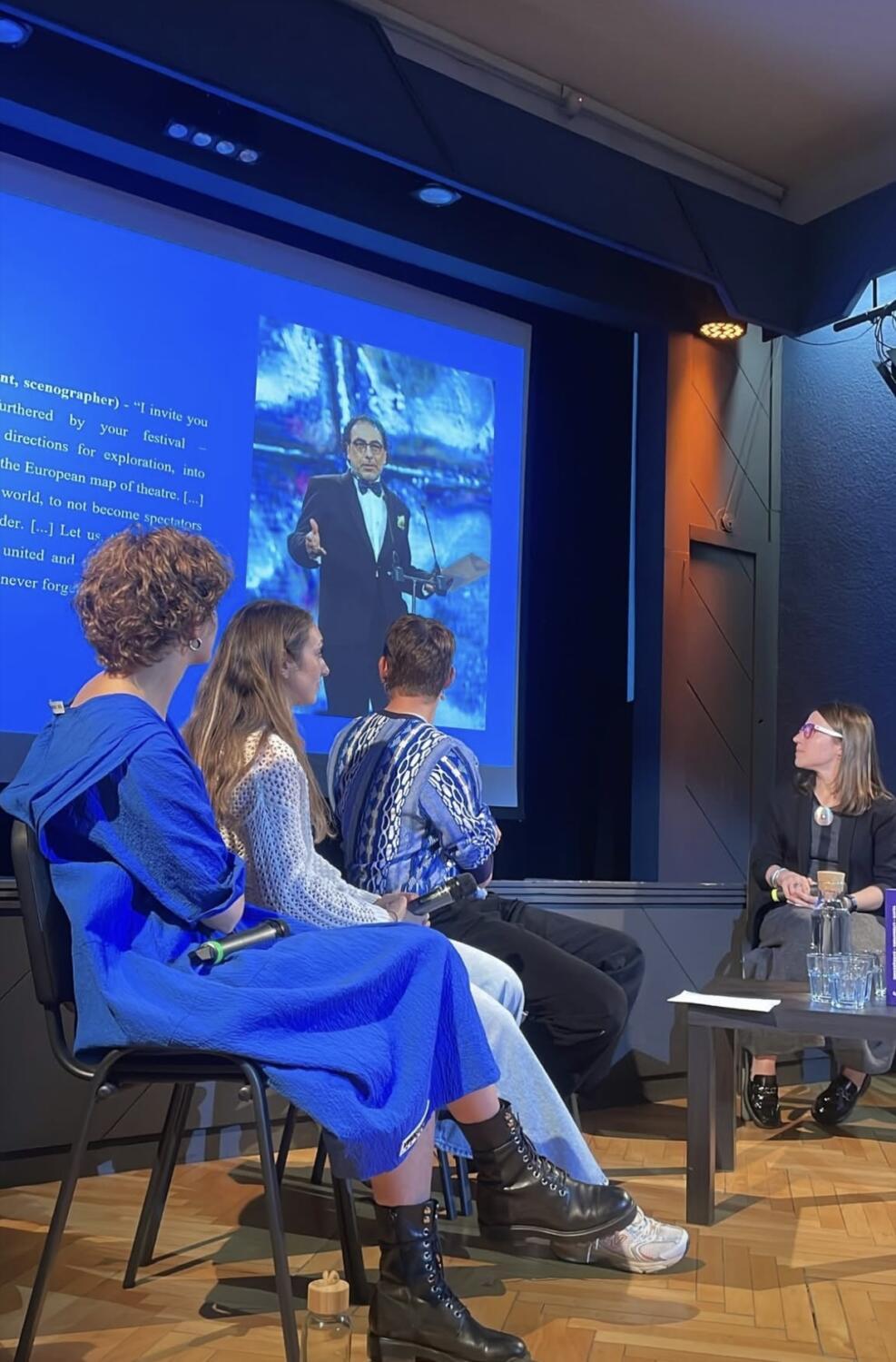
Dragoș Buhagiar, the President of the Romanian Theatre-makers’ Guild sent a message for the Between.Pomiędzy 2025 Festival. Photo: Between.Pomiędzy Archive.
What You See Is What You Get – Visual Encounter with Romanian Performance
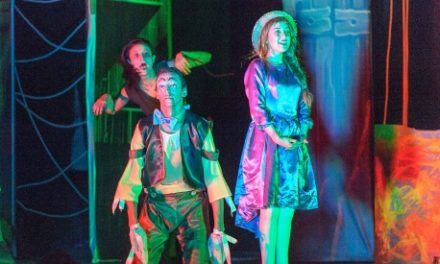
In the heart of Sopot, at Teatr BOTO, 16 images from nine high-grade productions of the last five years were presented not only to the Festival’s audiences, but also to random visitors, who happened to be around. Merging with the external setting of BOTO (much different than that of a gallery), the photographs displayed a wide range of aesthetical choices of contemporary Romanian theatre, thus painting the picture of current trends in stage and lighting design, as well as casting choices, while also drawing the map of the most prominent institutions in Romania’s recent cultural life.
This was not just a small-scale visual presentation – in the context of the Sopot by the Book, whose 2025 edition was focused on Romanian literature, the Between.Europe: Theatre in Romania exhibition stood as yet another landmark in the Romanian-Polish cultural exchanges. From the fact that “We Share a Common Language”, the theme of the Cultural Season, to reaching consensuses in regards to the creative means employed in the paradigm of different-yet-similar cultural practices, the “Romanian corner” of the Between.Pomiędzy 2025 Festival could be perceived as a cornerstone of applied exchanges between the Romanian and Polish performance worlds.
The value of this exchange does not, however, root only in the recent manifestations, but stems from the political climate of more than three decades ago, when collaboration between the Communist satellite states was a lifeline and one of the very few means of cultural survival through mutual feedback. Now, taking the shape of choice, rather than obligation, artistic conversations and institutional initiatives open both sides to sharing crafts, opinions, and modi operandi amidst restrictive funding for cultural activities, tense political environments, and borders with the active war in Ukraine.
Gianina Cărbunariu (director&playwright), on her (then) most recent production “My Beloved Enemy” (National Slovak Theatre in Bratislava) – “I’m working with the team of actors about the reality that is going on right now, the scenario is taking shape in parallel with the reality, which sometimes is confusing for everybody, but at the same time it gives the energy to think, to share things and not to lose hope. And to be able to offer this to the audience as well.” (4th March 2025)
Given the (still) scarce touring of Romanian productions in Poland, this exhibition could also be perceived as a visual introduction in the performance lexicon of the “guest country”, with a limited, yet comprehensive list of motives defining current theatrical trends. A darker color palette and the predisposition for using shadows as a means of expression, rather than light, and the predilection for landscape-format aesthetics, rather than vertical builds are striking for a viewer’s first impression of Romanian aesthetics. (Much like the very musical nature of Polish performances, may I add, from a Romanian’s perspective.)
The printed images, however, could not replicate the soundscape, the audible use of the written text, or even the movement and choreography patterns of the productions used for this exemplification. Only statements of Alice Veliche (who signed the choreography of two of the exhibited shows) could stand as the description of a new layer of the contemporary Romanian stage craft.
From L to R: Alice Veliche, Radu Alexandru, Teodora Medeleanu (RO), Natasza Sołtanowicz (PL), and Gianina Cărbunariu (in absentia guest). Photo: Between.Pomiędzy Archive.
Although international presence has always been a vital component of the Between.Pomiędzy festivals, with recurring participation from guests from the UK, Ireland, and the USA, having a focus-section dedicated to a regional partner can prove itself to be eye-opening. This showcase of shared histories that generate different perspectives, artistic methods stemming from common roots proves that yet, they all progress towards vastly different outcomes.
Even given the diversity of the means employed for presenting Romanian theatre to the audiences in the Tricity area, one conclusion became indisputable – the actual theatrical encounter could be prefaced or accompanied by such endeavors, but could never be replaced. There is a need for direct conversation between the instances of theatrical reception in order for a relation to be established between the creative spheres of two geographical spaces, i.e. touring, performance festivals. Conversations and multimedia additions can only substitute so much of the actual need for discovery, nevertheless they ignite curiosity and set the basis of a directed (somewhat disciplined, though the guidelines it suggests) approach to a different cultural world.
This article is part of the report on Between.Pomiędzy Festival 2025, available on TheTheatreTimes.com.
This post was written by the author in their personal capacity.The opinions expressed in this article are the author’s own and do not reflect the view of The Theatre Times, their staff or collaborators.
This post was written by Teodora Medeleanu.
The views expressed here belong to the author and do not necessarily reflect our views and opinions.