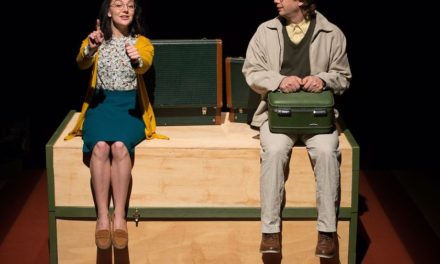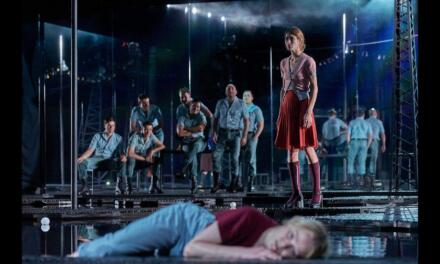

Nikolai Kolyada’s The Cherry Orchard begins after loss has already become the furniture of the world. In the Witkacy Theatre’s Polish-language production, presented at MİTEM, the Madách International Theatre Meeting in Budapest, Chekhov’s orchard is no longer a shimmering memory waiting to be auctioned. It is gone. What remains is not nostalgia but residue: plastic cups, rough human need, the sour comedy of people who have outlived their own excuses. This is a severe and unexpectedly tender reading of Chekhov’s last play. Directed and designed by Kolyada for the Witkacy Theatre in Zakopane, the production places a familiar drama of dispossession inside a landscape already damaged by appetite. The cherry blossoms have disappeared; in their place, there is plastic, rubbish, and the embarrassed theatricality of survival. The gesture could easily have become didactic. It does not. Kolyada was too much a man of theatre to lecture where he could wound, amuse, and expose.

Photo by Iwona Toporowska
At MİTEM, the production occupies an important place in the festival program not only as a strong Polish contribution but also as a kind of farewell encounter. Kolyada died this year, and that fact shadows the evening without needing to be announced. Theatre often becomes sentimental when death enters the auditorium. Here, the opposite happens. His Cherry Orchard feels brutally alive: noisy, vulgar, playful, sorrowful, and resistant to embalming. It reminds us that a major theatre artist is not lost because his work becomes beautiful in retrospect, but because it still has the force to disturb the present tense.
Kolyada’s Chekhov is not the Chekhov of porcelain melancholy. His stage is closer to a shelter, a wake, a carnival, and a courtroom all at once. The characters do not glide through the end of an era; they stumble, drink, perform themselves, and cling to rituals whose meaning has leaked away. Vodka and boiled eggs become not props of local color but instruments of repetition. People eat, drink, talk, delay, and then delay again. In Chekhov, postponement is always action disguised as inaction.
Dorota Ficoń’s Ranevskayais central to that clarity. She does not arrive merely as a ruined aristocrat returning home, but as someone whose presence reorganizes the air around her. Ficoń gives the role a theatrical radiance that is never allowed to harden into glamour. Her Ranevskayais fragile and dangerous because she cannot stop believing in the emotional truth of her own gestures. She is generous, selfish, wounded, ridiculous, and unbearably human. One watches her not to judge whether she deserves the orchard, but to understand why people continue loving those who lead them toward disaster.

Photo by Iwona Toporowska
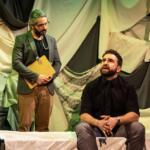
Piotr Łakomik’s Łopakhin is the necessary counterforce. In less interesting productions, he becomes the emblem of practical modernity. Here, he is harsher, more arrogant, and more frighteningly recognizable. He does not simply want to buy; he wants to make the world submit to the logic of profit. Yet the performance avoids turning him into a flat villain. Łopakhin’s brutality has the nervous energy of a man who cannot bear the old world but has learned nothing more beautiful than how to monetize its ruins. When the future enters through him, it does not feel clean. It feels like another form of devastation.
Photo by Iwona Toporowska
Around them, the ensemble builds a society of evasions. Krzysztof Łakomik’s Gayev carries the helpless eloquence of a man addicted to speech because speech costs less than decision. Joanna Banasik’s Varia gives the evening one of its most painful lines of tension: practical, watchful, emotionally trapped, she seems to understand more than others and yet remain just as powerless. Agnieszka Michalik’s Anya and Dominik Piejko’s Trofimov bring youth into the production not as easy hope but as an unstable promise. Their idealism is present, but Kolyada does not let it float untouched above the wreckage.
The production’s achievement lies in its refusal to separate comedy from ruin. There are moments that invite laughter, but the laughter never frees us. It implicates us. Kolyada’s grotesque is not excess for its own sake. It is an ethical form. He enlarges behavior until we can no longer pretend it is harmless. The drinking, the shouting, the absurdity, the almost cabaret-like energies of the evening – all of them circle back to one question: what happens to a culture when everyone knows what is coming, and almost no one acts?

Photo by Iwona Toporowska
That question gives the plastic cups their force. They are evidence of a civilization that has replaced bloom with convenience. The cherry orchard, once a place of beauty, memory, and useless abundance, has been traded for disposable matter. Chekhov’s orchard was always more than property. In Kolyada’s hands, its absence becomes more eloquent than any painted trees could be.
The final movement, with its image of destruction and the survival of something small, crawling, almost prehistoric, is less a conclusion than a verdict. Human beings have failed the orchard, failed one another, and failed the future; life continues, but not necessarily in a form that flatters us. The production does not say that nature will triumph. It suggests something more chilling: that life may continue after humanity has made itself unworthy of the world it inherited.
And yet this is not a nihilistic Cherry Orchard. Its positivity lies deeper than consolation. Kolyada’s faith is in actors, in the stubborn vitality of theatre, in the possibility that looking clearly at ruin is itself a moral act. The Witkacy Theatre ensemble plays as if Chekhov’s people were not museum figures but our contemporaries: afraid of decisions, intoxicated by memory, seduced by money, and secretly waiting for someone else to save them.
At MİTEM, this production lands with particular force because festivals are places of encounter, not only between national stages but between theatrical languages. Kolyada’s language is unmistakable: rough, excessive, compassionate, unsparing. His death makes the encounter more poignant, but the performance refuses to become a monument. It is too restless for that. It kicks, sings, drinks, collapses, laughs, and leaves behind a silence that is not empty.
Chekhov called The Cherry Orchard a comedy. Kolyada seems to have believed him, but with the wisdom that comedy is often the last honest form tragedy takes before the lights go out. In this production, the orchard does not bloom. It has already been destroyed. What blooms instead is theatre itself: wounded, unruly, and still capable of telling us the truth.

Photo by Iwona Toporowska
This post was written by the author in their personal capacity.The opinions expressed in this article are the author’s own and do not reflect the view of The Theatre Times, their staff or collaborators.
This post was written by Emiliia Dementsova.
The views expressed here belong to the author and do not necessarily reflect our views and opinions.