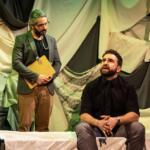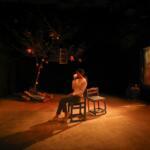

A shimmering Andes mountain range made of light and weave. The sound of rattling bells. A brown-skinned man dressed in a colourful poncho, walks through the mountains, arriving at the stage lights—this is the opening of Indigenous and Argentinian artist Tiziano Cruz’s Wayqeycuna. This winner of multiple awards has toured major theatre festivals, including Zurich Theater Spektakel, Festival d’Avignon, and Montreal’s Festival TransAmériques, before making its latest stop in Toronto as part of the #BeyondTO program at Theatre Passe Muraille.
Wayqeycuna, meaning “my brothers” in the Quechua language, is the final piece of Tiziano Cruz’s autobiographical trilogy Tres Maneras de Cantarle a una Montaña (Three Ways to Sing to a Mountain). As the closing chord, Wayqeycuna represents the artist’s homecoming to the Andean village in northwest Argentina, where he spent his childhood, as well as his reflection on his journey into the (First) world. As the title “my brothers” implies, Wayqeycuna is about the search for home, for community, and for a collective common. Through gestural, visual, and aural storytelling, Tiazno weaves together the thorny threads of mourning and celebration, resistance and reconciliation. The outcome is a genre-defying performance that could be described as post-dramatic, political, intimate, lyrical, and ceremonial.

Tiziano in front of a video that documents his return to the village of Santa Bárbara in Salta, Argentina. Photographer: Noorullah Azizi.
Wayqeycuna is a manifesto—one that exposes the violence and exploitation by colonialism, capitalism, and neoliberalism with a calm face and a quiet fire. Tiziano positions himself as a traveler between two worlds. On one side lies the First World— the Global North, the Euro-Anglo hegemony—where the culture industry calculates his worth as cheap labour and exotic artisanal object; where customs categorize him as an outsider, a noncitizen, who may stay but is not allowed to truly live. On the other side is home, where the mountains offer both grass for sheep and lithium for mines; where the artist first learned the meaning of happiness, yet where poverty continually threatens the health and survival of his loved ones. Combining the most radical political enunciations with the most intimate memories and imaginations, Wayqeycuna makes visible the lives of the poor, the rural, and the indigenous in the Andean communities in Argentina, and asserts their bodies against disappearance under systemic poverty, chemical pollution, consumerist economy, and labour exploitation caused by the expansion of colonial-capitalism. Its radical energy lies not in shock, but in truth. As Tiziano reminds the audience: “For some, politics is a way of positioning themselves in the world; for me, it is life and death.”

Tiziano with the bread figure of the winged dog, a mythical creature that “carries the souls of dead children from this sick world” (performer’s words). Photographer: Noorullah Azizi.
The thread of resistance is symmetrically completed by the thread of reconciliation. This reconciliation derives its power from the community, and community, according to Tiazno, is our hope under neoliberalism. For the Tiazno, the archetype of community is his home village, and in Wayqeycuna, he transforms his personal memory into a tool to communicate and connect the living knowledge of community / commons / collective across the audience. In the face of neoliberalism’s agenda to individualize politics and divide people, the mixing and gathering of people into a community is perhaps the most radical action. Tiziano thus starts his own revolution in the theatre—in the form of baking and sharing bread. Bread-making and bread-sharing are acts of collaborative living and labour. On the Day of the Dead, the villagers come together to bake bread figures in symbolic shapes as an offering to the dead, and share them among villagers and visitors alike. For every run of Waycquecuna in every city, Tiziano organizes a baking workshop called “Bread for the World,” free and open for audiences to participate. The bread figures they bake together would become the tools for storytelling in the mis-en-scene and are shared among the audience after the performance.

Tiziano uses bread figures to represent his village. Photographer: Noorullah Azizi.
On the day of the performance, I saw a bread figure of an old lady holding a cat, made by an audience to commemorate their grandmother. Bread embodies another leitmotif in the performance: mourning. Mourning for loss, of death and dispossession, where political violence and natural disaster become indistinguishable. Tiziano used bread figures in the shape of the people, animals, and plants of the village as puppets to tell the most painful part of his family history: the death of his young sister. This loss is connected to the greater loss: the loss of childhood, the loss of home, the loss of community…everything we love that’s been lost in the past, and will be lost in the future. As Tiziano reminds us, “nothing can defend us against death.” Wayqeycuna could also be described as a ceremony of mourning, repeatedly returning the audience to death—an experience that has been denaturalized, privatized, and stigmatized in mainstream North American culture. for “nothing can defend us against death.” Insisting on our shared vulnerability in the face of death, Tiziano makes space that unites all human lives. Through collective mourning, Tiziano reconciles us with life’s inescapable end, while drawing attention to deaths produced by political realities—and asserting the right to live as a political demand.

Tiziano shares bread figures with the audience. Photographer: Noorullah Azizi.
Mourning, in this gesture, gives way to the celebration of life. Wayqeycuna can be understood as a form of theatrical communion, where death is not denied but transfigured into rebirth. Through the performance, Tiziano shares part of himself—his labour, his life, his symbolic body—which the audience quite literally receives when he descends from the stage, a basket of bread figures in hand, and places them one by one into waiting palms. Tiziano frames this communion artistically and tactfully as an offering and an invitation, distinguished from the motifs of cannibalism and exploitation associated with the marketing and consumption of art in the “free market.” To “take” the bread is to take part. Audience members and staff alike assist in the distribution, ensuring that everyone receives a share. Flowers too are passed around. Carried by a festive rhythm, the audience joins Tiziano’s singing and dancing when leaving the theatre, where more drinks and bread await in the lobby, extending the gesture of sharing. Borders dissolve, performance spills over, and the fête takes over the world. Having passed through the enunciation of injury and loss, Wayqeycuna ultimately leads its audience into a celebration of life—of joy, resilience, and a delicate but insistent hope for the future.
The communal act of bread-sharing and celebration collapses the boundary between producer/performer and the audience/consumer. All people inside the theatre house, regardless of the division of labour or backgrounds, become a collectivity in the forming through the shared space and gestures of singing, dancing, and eating. As a result, a small, temporary utopia is created. In this small, temporary utopia, Tiziano places in our bodies a piece of happy memory: the happiness of occupying space together, of acting collaboratively, of making peace—at last!—in this world. In Tiziano’s final blessing, “May all be well!”, I come to understand that resistance and reconciliation cannot stand apart; only together do they complete the possibility of happiness. During this challenging time of the transnational rise of fascism and right-wing governments in South America, North America, and Europe, I shall carry this utopic memory as a seed and an amulet.

“May all be well!” Photographer: Noorullah Azizi.
Wayqeycuna will come to Vancouver’s PuSh festival on February 6 and 7! Get your tickets here.
Wayqeycuna
Jan. 24 & 25, 2026
Theatre Passe Muraille, Toronto
Conceived, written, directed, and performed by Tiziano Cruz
Dramaturged and Assistant Directed by Rodrigo Herrera
Artistic Collaboration by Rio Paraná (Duen Sacchi + Mag De Santo)
Video, Photos, Sound, Music Design, and Technical Coordination by Matías Gutiérrez
Lighting Design by Matías Sendón
Costume Design and Artistic Production by Luciana Iovane
Produced by ULMUS & ROSA Studio
All photos in this review are shared by Theatre Passe Muraille.
This post was written by the author in their personal capacity.The opinions expressed in this article are the author’s own and do not reflect the view of The Theatre Times, their staff or collaborators.
This post was written by Yizhou Zhang.
The views expressed here belong to the author and do not necessarily reflect our views and opinions.