
There are directors who have gotten us accustomed to treading on unconventional paths. They have trained us to expect the unexpected, the off-the-beaten-track. And we appreciate them, not because we always agree with them, but because they leave something behind: an idea, an unease, a trace that pushes the viewer to wonder, to question, to think.
The English director Katie Mitchell clearly belongs to this special category of probing, demanding, and perpetually restless creators who stubbornly reject convention and seek new ways to converse with a world in constant transformation. That’s why every new work she creates raises expectations. Even when a member of the audience feels those expectations have not been completely fulfilled, this does not diminish the value of her work; it simply reminds us that even major artists do not operate only in peaks.
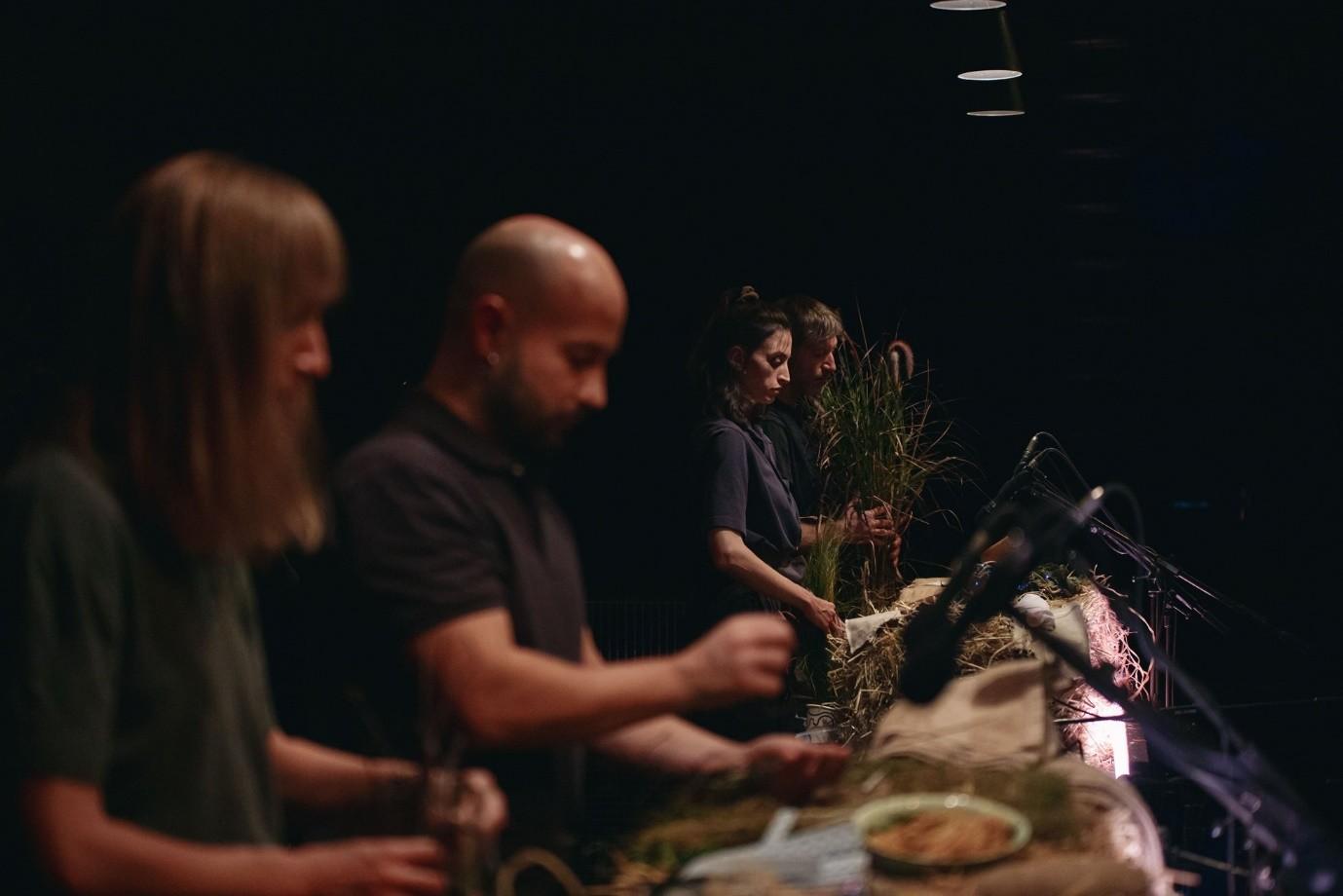
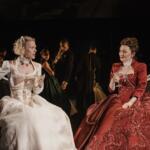
The four performers—Alexandros Zotaj, Christos Thanos, Joanna Toubakari, and Korina Kokkali—use objects and gestures to bring the forest to life through sound. Photo: Valeria Isaeva. National Theatre/Athens. Media Gallery.
Human / Nature
The relationship between human beings and their environment has been at the heart of Mitchell’s work for years. She consistently takes risks in her attempt to reinvent ecological theatre, its necessary tools, and its spaces, from Atmen, in which performers generated the electricity needed for the performance live on stage, to 2071: The World We’ll Leave Our Grandchildren, where she turned a scientific lecture on the climate crisis into a theatrical event, and A Play for the Living in a Time of Extinction, part of a broader experiment on sustainable theatre production.
These risks are both material, in the form of recycled sets, green-friendly choices and reduced carbon footprint, and narrative, as Micthell repeatedly engages with the crisis of biodiversity, species extinction, and the human–ecosystem relationship. She believes that theatre need not rely on text or classical dramaturgical structures in order to be political and communicative. For her, form, sound, space, and our relationship to the natural environment can themselves constitute political discourse. Indeed, this is what she attempts in her latest work, with the simple yet revealing title Cow / Deer, created in collaboration with playwright Nina Segal and sound artist Melanie Wilson. It’s a bold, timely project with a clear intention, and it marks the first collaboration between Greece’s National Theatre, as co-producer, and the Royal Court, the cradle of contemporary British playwriting. The Greek version is staged by Irene Fanarioti, who spent time in London during the development of the production.
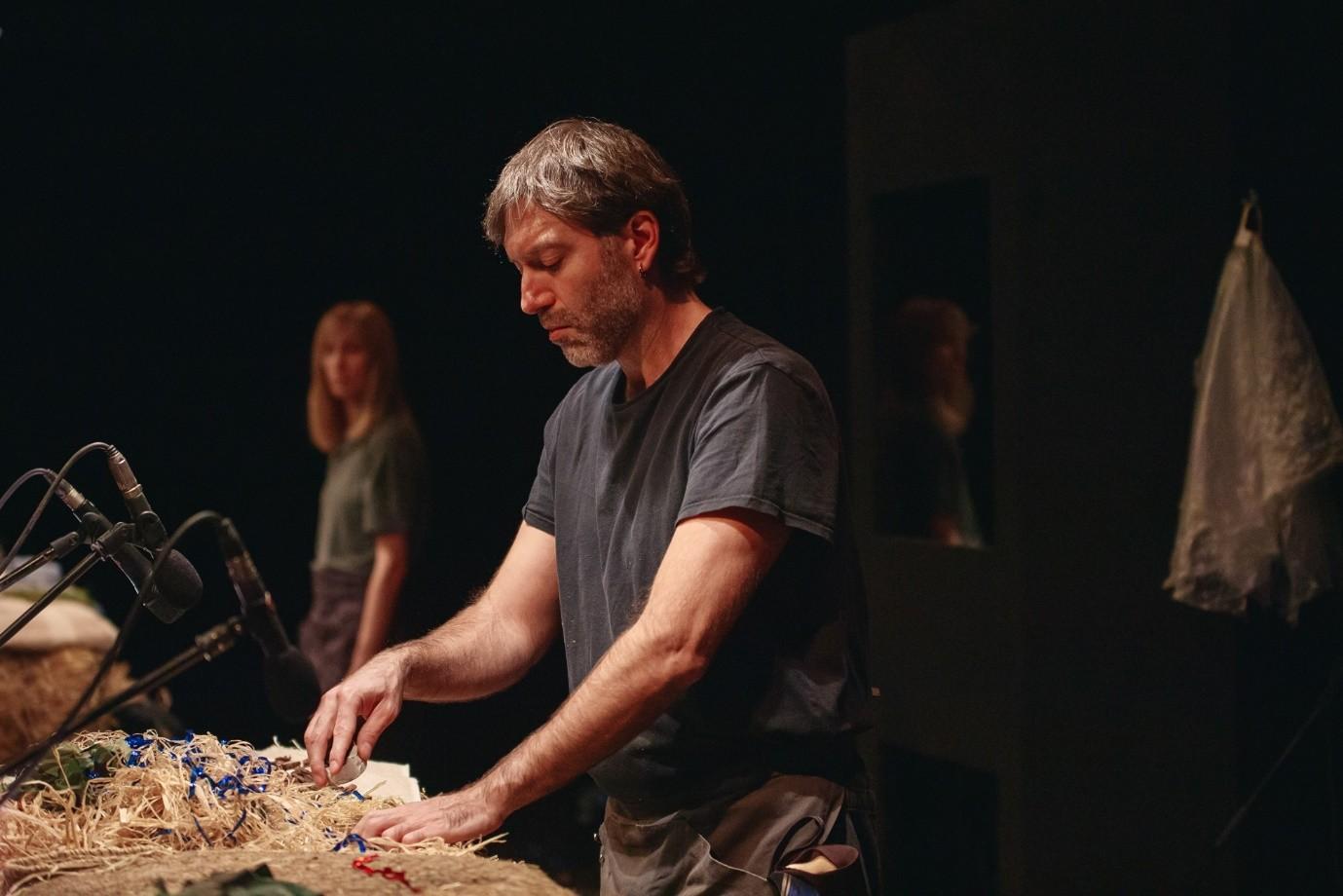
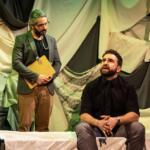
Performer Christos Thanos creates textured forest sounds by rubbing and manipulating small bundles of hay. Photo: Valeria Isaeva. National Theatre/Athens. Media Gallery.
To the Point: What is it About?
The performance presents itself as a work without words, an attempt to represent a non-human world through sound and gesture. The intention is compelling and entirely consistent with Mitchell’s ecological and aesthetic vision. The obstacles, however, are significant, and the questions raised are inevitable. Thus, the viewer may wonder if the performance manages to realize this ambition, if it is convincing and whispers what cannot be heard, or if it instead remains at the level of a strenuous stylistic exercise.
The Scenic Environment, and Some Questions
Entering the Nikos Kourkoulos stage of the National Theatre in Athens, the audience encounters a set resembling an outdoor agricultural laboratory, realized as bundles of hay which serve as platforms for producing sounds, a water tank filled with pebbles, scattered objects and microphones. The lighting is low and largely unchanged from start to finish.
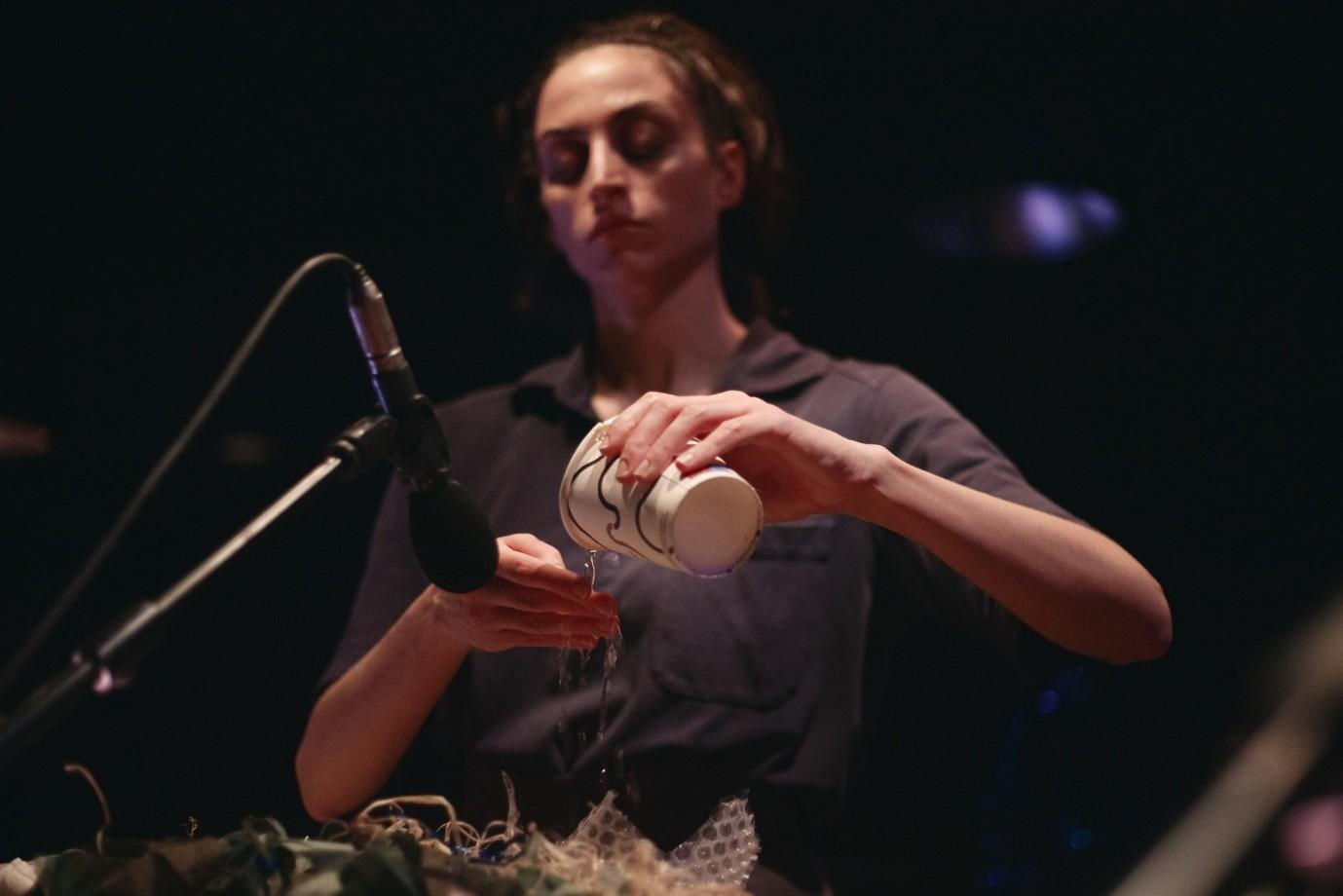
Performer Korina Kokkali pours water to conjure the soundscape of a rainy forest. Photo: Valeria Isaeva. National Theatre/Athens. Media Gallery.
While we’re prepared for a wordless experience, almost immediately after the performance begins, the upper part of the stage displays short narrative cues, like silent-film intertitles or alternatively like a Brechtian intervention, similar to chapter headings that foreshadow the unfolding narrative, for example, “We wonder what happens next?” This choice, though helpful in terms of communication, undermines the purity of the silence promised by the creators.
However, if the goal is to activate our hearing and provide an acoustic immersion, one wonders why the spectator needs surtitles which function as explanatory crutches. So, for example, if we removed the words, could we still follow the action? Could we understand the cow’s age or her pregnancy? Could we discern the narrative episodes, the spaces of action, the complex and varied biorythms of the forest and the animals that shape them?
What I sensed was that the performance implicitly admits that it doesn’t quite trust the audience, that without words we would understand nothing, and perhaps this is the case. Yet the use of surtitling limits the power, the challenge and the clarity of the experience.
I was also troubled by the choice to focus on only two animals, one of which lives on an organized farm, already within human culture. I wonder if this choice is sufficient for us as spectators to find a point of entry into the vast, wild natural world and inhabit it imaginatively, to feel it but not necessarily understand it, within less than sixty minutes.
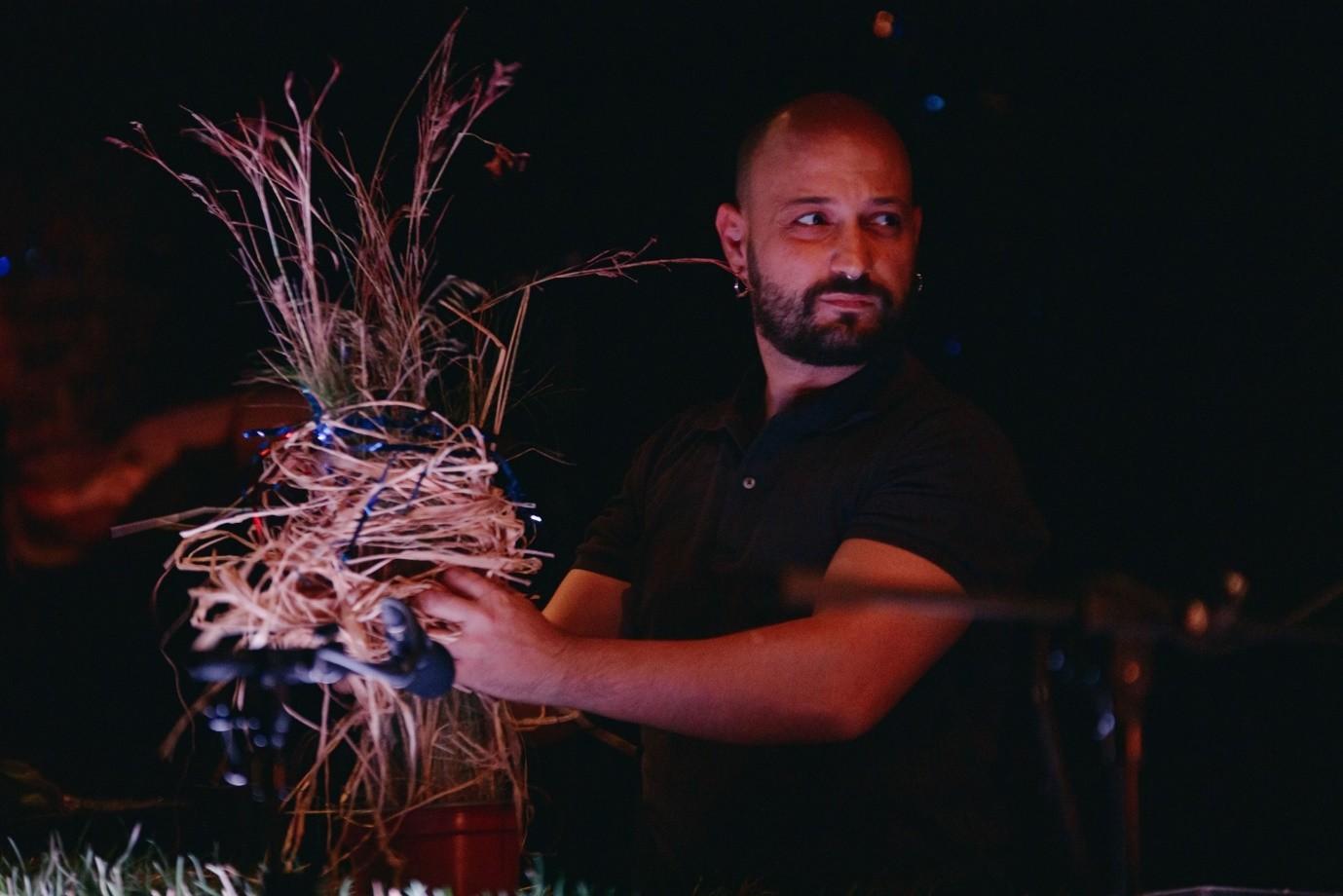
Performer Alexandros Zotaj transforms a bundle of dry weeds and hay into a sound instrument. Photo: Valeria Isaeva. National Theatre/Athens. Media Gallery.
The Attempt to Listen
The four performers, Alexandros Zotaj, Christos Thanos, Joanna Toubakari, and Korina Kokkali, operate like a tightly unified, well trained orchestra of sound production. Pebbles, ropes, hot water bottles, watering cans, herbs being ground, snapping branches, hay, water, rustling leaves, the sudden flight of birds, even a balloon bursting to signify the cow’s giving birth, all merge to create a handmade environment, a performative, mechanical score of precision and perfect coordination.
As the play progresses, however, the sounds begin to resemble one another; the rhythm flattens, as does the intensity, and the dramaturgical arc becomes blurry. Although the performance asks us to drift and surrender ourselves to its sonic allure, it doesn’t quite create the conditions for us to do so, not even with our eyes closed, as I tried. The play also fails to generate the pleasurable sense of anticipation and the experience of escalating or expanding time. Instead, it moves along a steady line, without the necessary curves, and where they do appear, they aren’t easily perceptible.
The only exception is the recorded noise of machines, cars, airplanes and agricultural equipment, where the sounds truly make their piercing, distinct presence felt and thus provide a sonic commentary on humanity’s destructive presence. This intervention creates a sense of intensity and perhaps even threat. Unfortunately, it is not enough to save nearly an hour of acoustic monotony.
Since the performance is already anthropocentric, with four actors producing handmade sounds, it might have been more effective to use, alongside the objects, the human voice. The attempt to present a purely natural setting seems highly unnatural, when the actors themselves stand visibly before us, producing the illusion of nature and its soundscapes. With the voice or in combination, the material would have been richer, including breaths, vibrations, cries, choices, crescendos, tones and semi-tones, a bodily energy that could give life to the project. What we saw instead relied more on technique than the project itself could support.
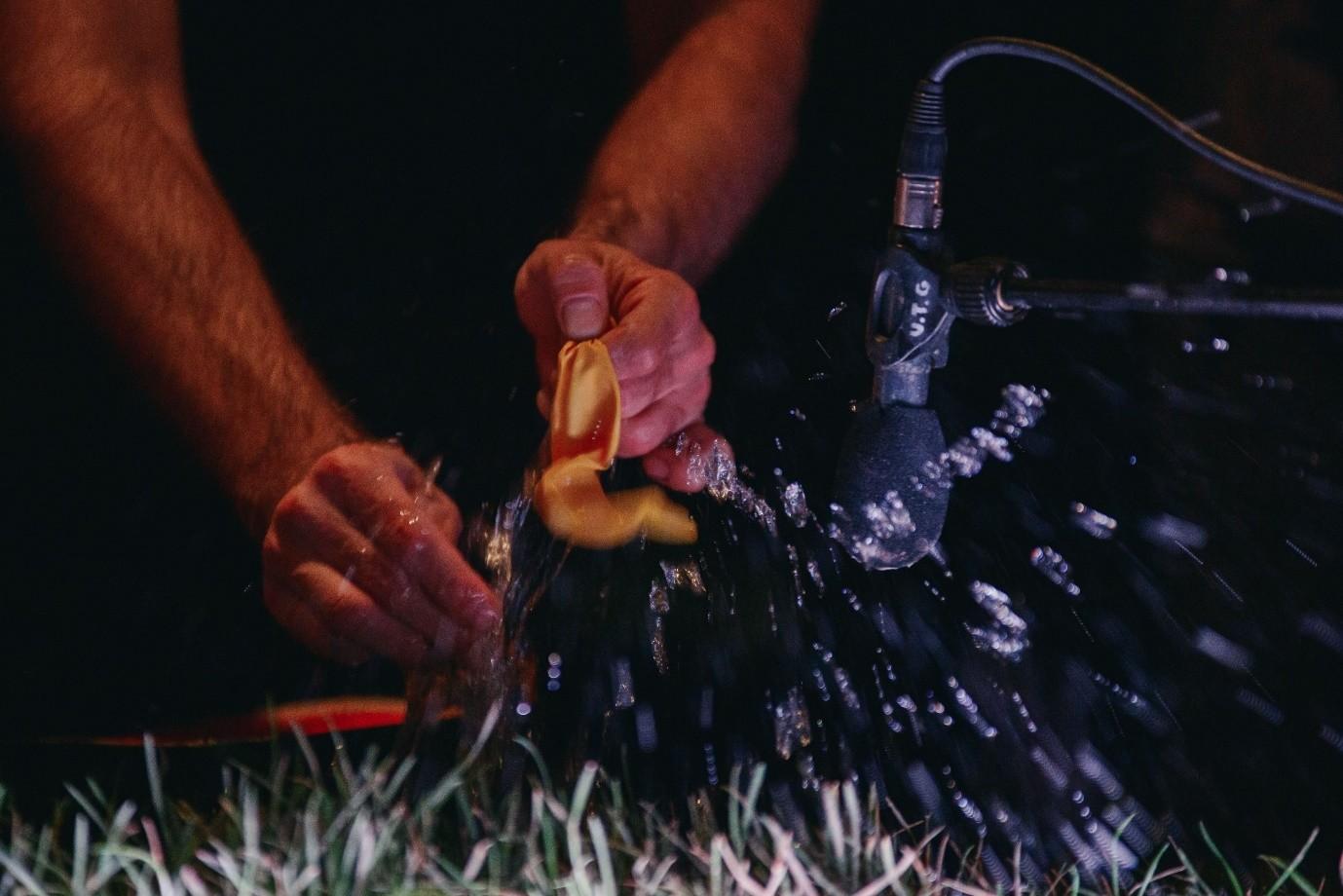
The rupture of a water-filled balloon evokes the moment of a calf’s birth. Photo: Valeria Isaeva. National Theatre/Athens. Media Gallery.
The Political Statement and Its Limits
From the outset, the opposition between so-called innocent nature and destructive humanity clarifies the political and social orientation of the performance. I understand Mitchell’s concern regarding the imbalance in this relationship. But the almost idealized and idyllic picture of nature presented here, like a new pastoral Arcadia of the 21st century being invaded by the noise of cities, oversimplifies a far more complex and expansive issue involving two jungles: the animal kingdom and the urban world, each governed by its own laws.
At the same time, Mitchell has stated she seeks a feminist reading of the performance. I assume she refers to the old tradition of linking nature, fertility and female experience: the earth gives birth as women give birth; wild nature is to be tamed, analogous to the women whom the organized system of patriarchy once sought to control. Although this is an interesting possibility, the performance itself offers neither time nor sufficient material nor real space for this kind of vertical reading to develop, especially when the protagonists are two extremely vulnerable female animals. Many of these old conceptual parallels have lost much of their force. The feminist movement, at least in the West, has won many of those more basic battles and has shifted the discussion elsewhere.
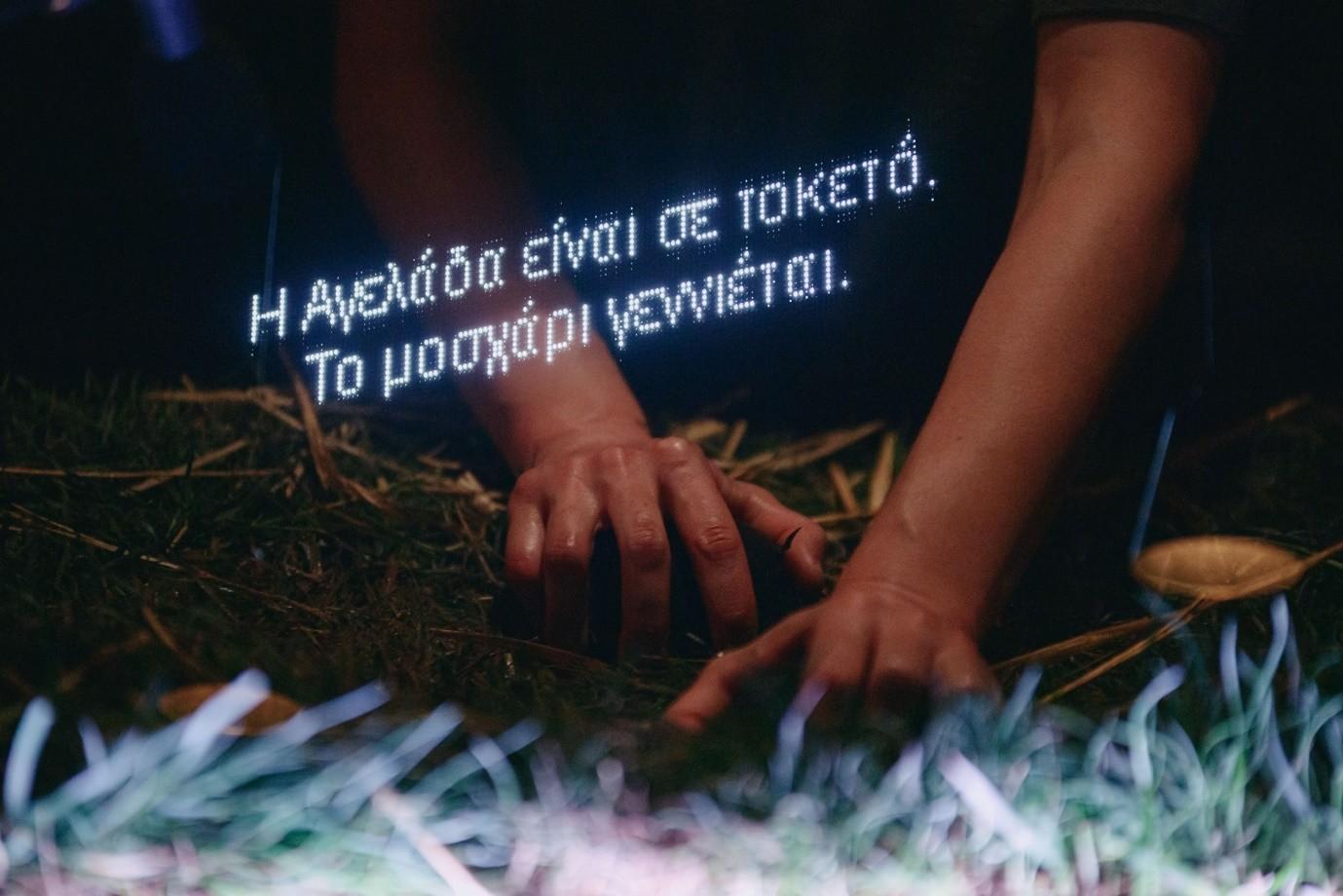
Cow in labor. Calf born. Photo: Valeria Isaeva. National Theatre/Athens. Media Gallery
A Draft Rather Than a Full Performance
In my view, Cow / Deer feels more like a draft than a fully realized performance. It is as if we’re watching a very interesting experiment that stopped before finding its final form, before gaining personality, before deciding what exactly it wants from the audience. The necessary narrative coordinates are missing, those that would allow the spectator to walk, imaginatively, within its world. Imagination, the most crucial tool when words are absent, is not effectively activated. The sonic events are clearly interesting, but they do not evoke genuine emotion. The entire experience oscillates somewhere between exercise, trial, and installation, without achieving the completeness of any.
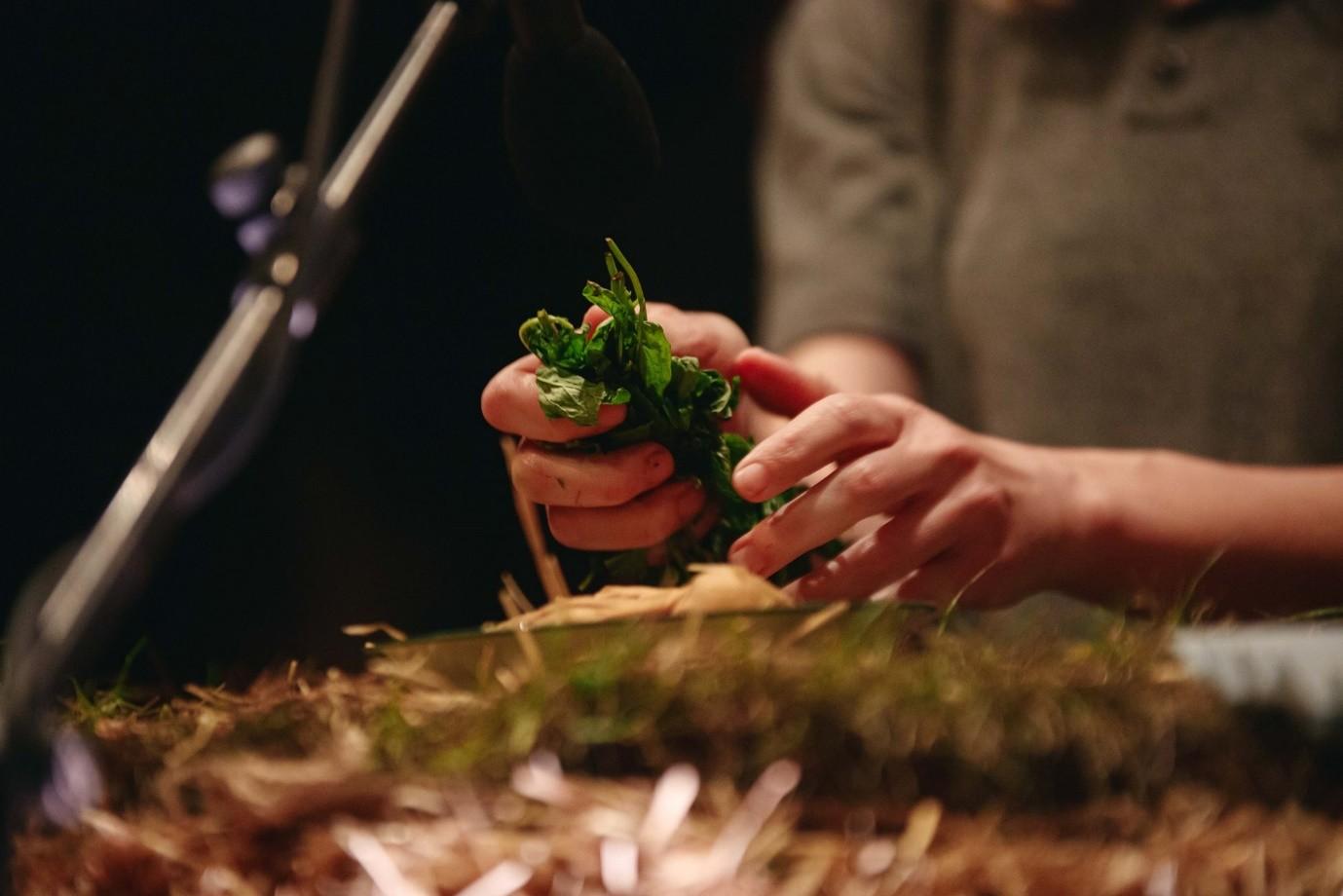
Dry leaves held and shaped to create sound. Photo: Valeria Isaeva. National Theatre/Athens. Media Gallery.
And Yet Something Remains
Despite these weaknesses, however, I cannot claim the performance lacks value. It may not have won me over, but I remember it clearly. And that strange fact means something. Perhaps it left me with something I haven’t yet realized.
And with that final thought, I recommend to everyone to go and see it: to hear the world in ways words cannot capture; to remember that listening is an art and an adventure.
Go see it, for a remarkable artist unafraid to push boundaries.
This post was written by the author in their personal capacity.The opinions expressed in this article are the author’s own and do not reflect the view of The Theatre Times, their staff or collaborators.