What does it mean to be honest with your partner? This is the premise that governs Salomé Lelouch’s entertaining two-hander, Mejor no decirlo/You Shouldn’t Have Said So which presents a couple in their sixties (or possibly early seventies), played by María Barranco and Imanol Arias; it is his second marriage, less is known about her past, but both have a tacit understanding of when to keep quiet and when to speak out. Only She — we never find out their names — has told her mother-in-law that the cake she makes every Sunday was on the dry side, tantamount, in her partner’s view, to telling her it was awful. And that leaves the couple wondering what it means to be honest and whether honesty is a good thing or not. She thinks it is; he is not so sure.
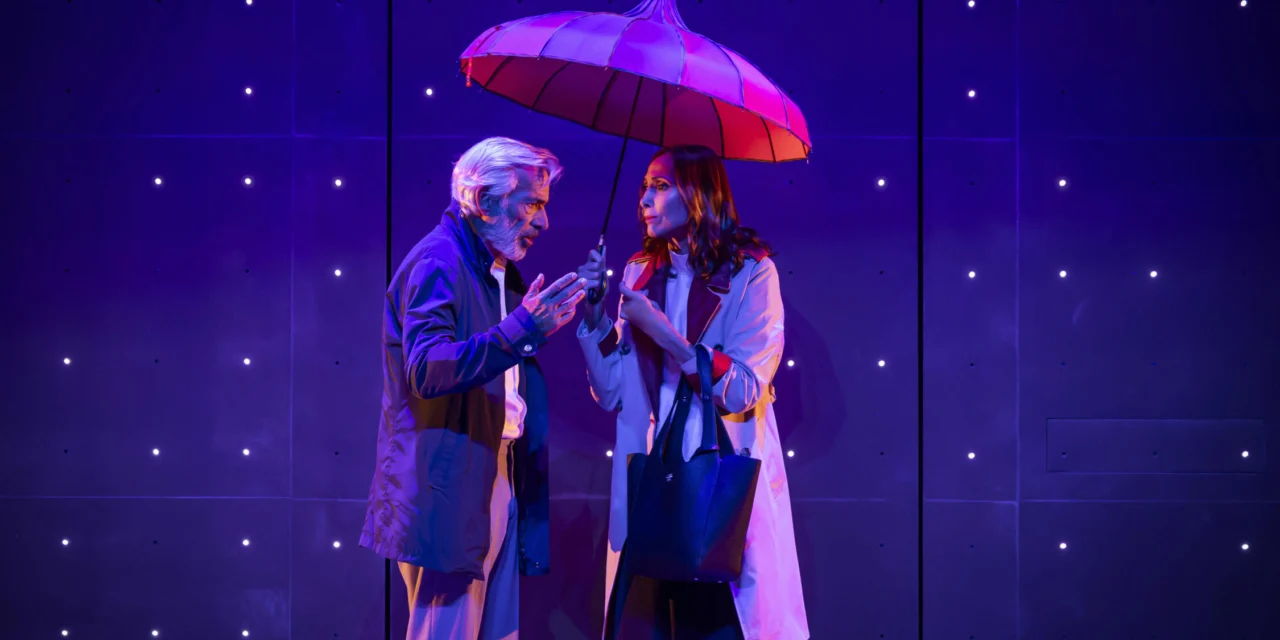
Mariana Tirantte designs a warm wooden set: a back wall with tiny lights that flash to create different scenarios. A bench, bed and wardrobe are pulled out, creating the different landscapes where the action evolves. A packed tube carriage allows for the couple to show their easy camaraderie: standing by the door of the carriage to stop characters crowding in while they reflect on his mother’s Sunday lunch. Guido Berenblum’s brilliant sound design creates the noise of the metro, the stops and doors opening. A visit to the conservatoire to look at a place for his granddaughter sees her shush those practising, much to his annoyance. A Tai Chi class allows the couple to show that they are synchronised but only to an extent. Can they really share what they are thinking all the time? Can they be as honest as they intend to be?

Existential conversations during Tai Chi in Mejor no decirlo / You Shouldn’t Have Said So © Enrique Cidoncha
The play is made up of a series of short episodic scenes that show the cracks in the relationship that both are prepared to live with. In bed, he wants to see the porn she views, only she has erased her viewing history. She wants to keep her independence. He ends up erasing his history so he can keep his viewing private. Sharing, the play shows, can only go so far.

The bedroom as the place for revelations in Mejor no decirlo / You Shouldn’t Have Said So © Enrique Cidoncha
A number of the scenes occur in the bedroom, in or around the bed, as they prepare to get dressed or go out: changing to go to the cinema, or to their son’ Fede’s wedding to his partner Max. There’s an argument over his paying in a restaurant. She doesn’t mind him paying, she minds him performing his gesture of magnanimous generosity in front of the restaurant staff. Both have a need to perform and neither really notice the extent to which it irritates the other.
There’s a gardening episode on a terrace – with birdsong helping to keep the tone light and springlike. A red umbrella under the rain sees the couple bickering while trying not to. Theirs is a relationship where they have learned to live together and accept what they may like and like less. He doesn’t want her to be that honest, and she wants him to be a bit more honest. There’s a surreal dream where he wakes up in a panic – perhaps he needs to face up to the fact that his unconscious is disturbing his sleep. She wants him to accept that he is no longer a man of the left, having voted for the right at the previous election. He denies that it makes him a man of the right. He is determined to keep the rhetoric alive that he is a leftie but the evidence, his wife points out, suggests the contrary. How far can we ever be what we think we are rather than how others see us?
What people say and what they do are not necessary the same thing in Mejor no decirlo. And things come to a head at his son Fede’s wedding to Max where he realises that he needs to tell his mother the truth. He’s been keeping a secret from her for 30 years: can he be honest with his wife but not with his mother and others in his life? Truth, the piece shows, is only relative. His father left his mother for another woman, but he told her that he perished nobly saving a family. The heroic myth must be maintained. But when he decides after much deliberation to tell his mother ‘the truth’, it’s one ‘truth’: that her Sunday cake is on the dry side rather than the truth of his father’s abandonment of the family. And this is the play’s final theatrical coup as he delivers the news to his elderly mother by phone encouraged by his wife, across the crowded wedding venue.

Revelations tumble out at the wedding in Mejor no decirlo / You Shouldn’t Have Said So © Enrique Cidoncha
Argentine director Claudio Tolcachir’s production has already enjoyed a successful run in Buenos Aires with tours to Montevideo and Asunción. Here, a Spanish cast of two actors with extensive film trajectories, has helped secure sell out performances in Madrid, on tour and now in its four-week run at Barcelona’s Goya theatre. Imanol Arias and María Barranco offer appealing, seductive performances. They move across the stage like dancers, swapping clothes, dressing and undressing, sitting and standing with the lithe energy and physical dexterity associated with farce. A wardrobe of elegant suits for him, of impeccably cut shirts and dresses for her that are picked up and discarded. Shoes come on and off and the effect is that of constant, smooth movement. The physical performance style is effortless, much like Salomé Lelouch’s light comedy interrogating how far people with different views on life might stay together. The comedy is based on the actress-playwright’s mother Evelyne Bouix, an actress who had a relationship with actor Pierre Arbiti after splitting with her husband, film director Claude Lelouch. The production’s strength lies in taking the small things the couple argue over — like a cake that is on the dry side and who’s paying for dinner — into an exploration of existential issues, on different approaches to seeing the world, to accepting difference, to how language operates and what it says about you. Matías Sendón’s lighting creates pockets of action across the Goya’s stage, allowing for intimacy at all moments wherever the couple find themselves.
Fernando Masllorens and Federico González del Pino’s translation, in a version by Pablo Kompel captures the wit of the French original. Claudio Tolcachir directs with his habitual dexterity and attention to impeccable comic timing. Guido Berenblum’s evocative sound design evokes the ambient sounds of the different locations – from the background noise of the wedding to the pattering of rain as the couple make their way home. The performances have a veritable fizz with a palpable onstage chemistry between Barranco and Arias. I saw the production on Barcelona’s day of theatre with its motto of cap butaca buida (no empty seat); a full house gave the piece a standing ovation with Arias thanking the audience for ensuring the theatre was full and culture supported. ‘Thank you for your performance’, replied an audience member. Thank you indeed.
Mejor no decirlo, produced by Pablo Kompel, 11 T’AI Creaciones and Pentación Espectáculos, plays at the Teatre Goya Barcelona from 18 March to 12 April 2026.
This post was written by the author in their personal capacity.The opinions expressed in this article are the author’s own and do not reflect the view of The Theatre Times, their staff or collaborators.
This post was written by Maria Delgado.
The views expressed here belong to the author and do not necessarily reflect our views and opinions.