
Luciana Acuña is one of the most exciting figures in contemporary dance. Her energy lit up La edad media/ The Middle Ages, the 2022 Covid-19 lockdown film she co-directed with her partner, filmmaker Alejo Moguillansky. With Grupo Krapp, the company she formed with Luis Biasotto in 2000, she injected a veritable multidisciplinary dimension into contemporary dance: the company’s productions at the intersection of danztheater and art installations felt urgent, necessary and dynamic. Grupo Krapp always provided a world in motion but it was infused with the absurdism of life in all its complexities. The company was named after Samuel Beckett’s 1958 play, Krapp’s Last Tape, and Beckett is always a palpable presence in the work of Acuña and Moguillansky.
Following on from the fabulously invigorating street film Efectos especiales (Special Effects, 2023), comes Bailarinas incendiades (Dancers in Flames), first premiered in 2024, which takes as a starting point the chronicles of a series of nineteenth-century ballet dancers who suffered serious burns when their tutus caught fire as they were performing under the gas lights that illuminated so many theatres of the time. This is not, however, historical reconstruction, rather a jazz-like riff on these tales (researched by Ignacio González and sourced from magazines and press of the time) that offers a starting point for exploring freedom and movement in dance. What does an informed choice mean when dance can cost you your life? Dancing in the delicate but extremely flammable tulle tutus under the gas jet chandeliers that were such a feature of so many mid-nineteenth-century theatres was a risky business.
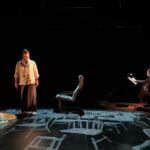
The set, designed by Mariana Tirantte, is an open dance floor. Two tables with DJ decks face each across the space, screens offer spaces for projection. A giant neon light hovers above the stage, modernist in design. A loose row of audience chairs provides seats for audience members who can’t or don’t want to stand or sit on the floor. The dancers are already in the space as the audience enters, warming and loosening up; lights flash in ways that evoke a nightclub. The space feels in transition, unfinished in the best sense of the word; it points to a show being made with the audience.
“Esto no es una obra” (This is not a show). “Es una fiesta” (it’s a party) appears on the screen to contextualise what is to come as a prologue. Only this is contradicted almost immediately with “En realidad, si es una obra” (In fact, it is a show). Bailarinas incendiadas refuses to fix what it is: a play but not a play; a party but not a party; a historical play but also resolutely contemporary; participatory but not karaoke; the audience can dance if they want to, but don’t have to. We have a huge degree of freedom as audience members to wander where we want to. We are invited to make of the performance what we will.
Act 1 invites the audience to imagine Paris in 1842, the year of the birth of dancer Emma Livry. Spectres of the past haunt the stage as Luciana Acuña narrates Livry’s short life: a star who was the illegitimate daughter of ballet dancer Célestine Emarot and Baron Charles Chassiron. The inspiration for Offenbach and choreographer Marie Taglioni’s 1860 ballet Le Papillon, she was admired for her ephemeral elegance as a performer.
Her refusal to wear a tutu with flame repellent material because it was ugly and impended her movement, led to her skirt catching fire during a rehearsal of Auber’s opera La muette de Porticci in 1863; she died eight months later of septicaemia resulting from her burns, at just twenty years of age. Even when desperately ill, she remained resolute that she would never wear “ugly” flame-treated tutus.

Agustín Fortuny, Tatiana Saphir, Luciana Acuña and Carla Di Grazia in Bailarinas incendiadas(Dancers in Flames). Photograph: Woportillo
Julián Cabrera, dressed in a black tutu as an agent of death, narrates that 385 theatres burned between 1801 and 1877. Dancers catching fire was seen as less important as theatres going up in flames. Centring the body as the site of conflict, Acuña and Carla Di Grazia spin around the space, in white tutus, trainers and trainers. They swerve and run, they spin and swirl. Collisions are only just avoided as the bodies — the sites of carnage and flames for the dancers in the tales narrated by the performers (Acuña and Di Grazia are joined by Tatiana Saphir, Cabrera and percussionist Agustín Fortuny on stage. The latter, in tutu and football shirt, mixes the soundtrack; predominantly techno-punk that pulsates through the space. At times there is music, at times distorted voices, at times he plays the piano or drums, at times he dances: movement comes through the different sound registers and in his shifts through varied musical forms and genres. The classical is just one of the many sonic languages of the piece. The screen projects a short film made by Moguillansky: flickering images of dancers engulfed by flames. Degas’s dancers intersect with sepia photographs. The images are poetic rather than literal: a collage of consumption and disappearance, of dancers at the mercy of a system of illumination over which they had no control.

Carla Di Grazia, Tatiana Saphir, and Luciana Acuña in Bailarinas incendiadas (Dancers in Flames). Photograph: A. Persichetti
The performers read from a clipboard with a detached sense of formality: tales of dancers who were cremated on stage may have taken place in different cities but they have a striking similarity: Gas-lit chandeliers in Stockholm’s theatres created a veritable furnace: half of the city’s 900 gas jets were deployed in its theatres. Closer to home for this Argentine company, Buenos Aires, frequently referred to as the Paris of the southern hemisphere because of its abundant theatres and lavish Parisian inspired architecture and urban planning, suffered the burning of the Gran Coliseo Estable de las Comedias theatre in 1832. Clara Webster died in her flat soon after her skirt caught fire while performing in The Revolt of the Harem at the Theatre Royal Drury Lane in 1844. Philadelphia’s Continental Theatre went up in flames in 1861 during a performance of Shakespeare’s The Tempest, killing nine dancers, including the four Gale sisters. It is thought the crinoline costume of one of the sisters caught fire as she came into contact with a gas jet. “Blazing ballerinas” a newspaper headline read after the fire; blazing is presented as a deadly concept in Acuña’s production.

Luciana Acuña and Carla Di Grazia in Bailarinas incendiadas (Dancers in Flames). Photograph: A. Persichetti
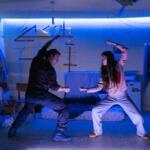
Acuña and Di Grazia whirl and cascade with speed across the stage. The legend of “La Telesita”, the teenage girl from Santiago del Estero who danced as if possessed until she fell exhausted into a bonfire and perished, presents dance not a means of escape but rather a commentary of sorts on immersion to the point where thought is completely displaced. Acuña and Di Grazia don’t become the dancers in flames, rather they enter into a dialogue with these figures. It’s a conceit that feels slyly Brechtian.

Matías Sendón, Agustín Fortuny, Tatiana Saphir, Luciana Acuña and Carla Di Grazia in Bailarinas incendiadas (Dancers in Flames). Photograph: A. Persichetti
Dance takes many forms in the piece. It is present in the choreography of the two spotlights that “dance” to the opening of Auber’s La muette de Portici which Livry was rehearsing when she suffered the burns that led to her death. Cabrera orchestrates the lights to move as lithely as the dancers onstage. Cabrera projects images of lighting plans and designs in nineteenth-century theatres. Static and discursive, it is as if he is delivering a lecture. (Cabrera has replaced Bailarinas incendiadas’ lighting designer Matías Sendón who took this role on the production’s opening.) What struck me is what lay outside of Cabrera’s lecture: why were safely measures not introduced and followed to protect the dancers? Why were these women seen as so expendable?
Acuña and Di Grazia dance as if their lives depend on it; they proffer movement and action, dexterity and technique. They illustrate a way of understanding through embodiment. And they invite the audience to do so to Cher’s “Believe” during a five-minute “interval” (which is anything but an interval), another of the glorious contradictions and tensions in the piece. Nineteenth-century theatres may have been regimented and hierarchical spaces, but these different tiers are not present in the open performance space of Bailarinas incendiadas, where it’s possible to dance face to face with Acuña, Di Grazia and Saphir.

The audience take over the stage in the interval of Bailarinas incendiadas (Dancers in Flames). Photograph: Woportillo
Repeatedly Acuña, Saphir and Di Grazia narrate tales of women’s bodies charred and destroyed. The impact is amplified by the microphones that swell the sound. Bodies are expendable commodities in Bailarinas incendiadas but the defiance of Di Grazia and Acuña provides a culture of resistance. Part dance, rave, history lesson, the production sees dance as an evolutionary form where moves are reimagined as necessary; a ritual where the theatrical space breathes new life into forms and lives, not to imitate but rather to re-imagine their potentialities. The ghosts of theatre dance in Acuña’s piece – defiant, dynamic and among us (literally) in a performance where theatre, memory and history intersect to glorious effect. Bailarinas incendiadas invites its audience to experience theatre as an embodied engagement with the past to understand how cultural capital works in the present. It’s an invigorating 70 minutes and one that feels timely, original and political.
Bailarinas incendiadas (Dancers in Flames), produced by the Festival Internacional de Buenos Aires and Arthaus Central, played at Teatros del Canal, Madrid, 18-21 March 2026; subsequently touring to Sesc São Paulo, Brazil, 4-5 April; Festival Curitiba, Brazil, 9-10 April; Bio Bio Festival Chile, November; Dansa Metropolitana Barcelona Spain, March 2027.
This post was written by the author in their personal capacity.The opinions expressed in this article are the author’s own and do not reflect the view of The Theatre Times, their staff or collaborators.
This post was written by Maria Delgado.
The views expressed here belong to the author and do not necessarily reflect our views and opinions.