
I first saw Rainer Werner Fassbinder’s Film, The Marriage of Maria Braun not long after it first came out, when I was an undergraduate studying theater and film. We were interested in European “Art Films,” those of Bergman, Felini, Fassbinder and another world famous German filmmaker, Werner Herzog. My interest in Thomas Ostermeier and the Schaubühne came via my interest over the years in auteur theater directors, from Meyerhold to Brook to Andre Șerban to Ivo Van Hove and on to Thomas Ostermeier. I was primarily interested in two aspects of this production: how the film was adapted to the medium of live theater and how the interpretation of the story was similar and different from Fassbinder’s film.
The events of the story are as follows: Maria marries Herman Braun and spends a night with him before he goes to war. He is declared dead and then Maria becomes involved with a black American solider. As they are about to have sex, Herman shows up at the door. Herman and the American soldier fight and Maria kills him. Herman says he is the one who killed the American and is sent to prison. She becomes involved with her employer, Oswald, who, behind Maria’s back, leaves money for Herman as long as he does not come back after his release. Oswald dies, Maria and Herman are reunited after ten years. They have become complete strangers to each other. In the film, Maria turns on the gas to light her cigarette but does not turn the gas off. Not long after, the house, with Herman and her inside is blown-up.
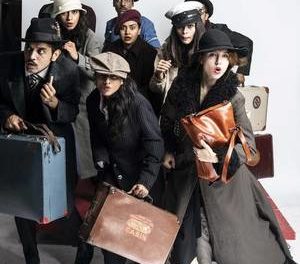
The story, in both the film and the production at the Schaubühne are about remembering one’s history, no matter how painful, so as not to repeat it. In the film Maria and her husband are being married as bombs fall about them. We then follow them into the post-war period. In the stage adaptation, a frame is added at the beginning. As the audience enters the theater, the actors are milling about the stage quietly, in low light, in costume. Are they the characters? Are they themselves, the actors? Then, an old fashioned slideshow begins, which documents Hitler and the Nazi era. This is coupled with the actors reading adoring letters written to the Fuhrer from school children at the time. This frame operates on many levels at the same time. However, there is also the reality of a modern day German audience bearing witness to these same images and words.
As an American, and as a human, I was reminded of the dangers of totalitarianism, a concept that has some resonance in the US now, where some fear a too powerful executive branch. Seeing the images of facism and hearing the voices of those who supported it feels especially important given this production is happening at a much farther remove from WWII than the film was when it was made in 1978. Here we have one use of the production of the Alienation Effect, a device made popular by Bertolt Brecht. We are invited to reflect as audience members on Germany’s descent into facism. This Alienation Effect continues throughout the production in various ways: the actors visibly carrying a smoke machine around, the actors facing outward towards the audience, the ensemble of four male actors playing all the subordinate roles, including female characters, by changing wigs or pieces of costume. Fassbinder also interrupts our immersion in his film as well: through use of melodramatic music, and through stagey actions, like when the character of Maria Braun kills her lover in an awkwardly staged scene. Another alienation effect present in both the film and the production is the use of radio broadcasts. Here have the political tier, as we hear first that West Germany will not rearm, and then years later, that they will rearm.
At the end of both the film and the production we have the announcement that Germany has won the World Cup. This places us once again firmly in time. Both in the film and in the production, we understand little of how Maria feels about killing her lover except that she says she was fond of him. Psychological motivation is eschewed. This keeps us from identifying with the character as people. We learn only the facts – that her husband decides to take the blame. Perhaps we are left to reflect on how the need to survive, the need for money to eat, in short how capitalism has created these tragic consequences.
To turn to the stage adaptation, there are many examples of Ostermeier utilizing the art of live theater. For example, there is the scene of the bombing during Maria’s marriage ceremony. We see images of airplanes flying, projected on a scrim behind the couple, rather than any effort to duplicate the “realism” that is done in the film by Fassbinder, where we hear and see bombs falling about the couple as they take their vows. Instead of cuts from scene to scene in film, transitions are made by the actors: an actor transitions to the character of the doctor by simply putting his hands through a coat backwards, and holding them up as if he is wearing sterile gloves and is ready to operate.
As an American, I was aware of a cultural difference. While it was logical theatrically, to have a white man play a person of color (after all, the men play women), this might be a more problematic choice in the US given our history of slavery and Jim Crow. It was a good choice for the actor not to play a “black man,” but simply through a change of voice define him as smooth.
Though Ostermeier’s production hues closely to the film in many respects, there are some differences. One difference in the production is that Maria deliberately strangles her lover, whereas in the film she simply knocks him over the head with a bottle, where the intent to kill is less clear. It follows logically in the Schaubühne production that it is a conscious decision for Maria to blow up the new home, herself and her husband. By contrast, in the film, Fassbinder left this ending ambiguous. Hana Shugyla plays Maria in an absent minded state at the end and there is the possibility that she forgets to turn off the gas. In Fassbinder, the Life and Work of a Provocative Genius, Christian Braad Thomsen writes that it was at the urging of Hana Schugula that Fassbinder changed the ending from deliberate homicide/suicide to something more unclear: prehaps deliberate, perhaps unconscious. In the Schaubühne production we have a Maria propelled by the circumstances of needing not only to survive, but in her desire to preserve her marriage in a capitalist society where she excels but in the end feels empty. The effect of the betrayal by both her husband and lover in the ending were clearer to me at the end of the stage production.
Though I admired the inventiveness of the ensemble and their abilities to find many colors in their portrayals as well as abundant humor, I often felt put at a distance, more so than in the film. I was happy to be able to identify the relationship between Maria and her employer/lover, Oswald. The actor Thomas Beding’s adoration of Maria and his vulnerability was palpable.
It was fascinating for me to watch Ostermeier’s adaptation of The Marriage of Maria Braun at the Schaubühne for its theatricality and its particular slant on Fassbinder’s film, as well as the skill of the performers. And, after all, in the final analysis, film belongs to the director and theater belongs to the performer.
The Marriage of Maria Braun
After the original by Rainer Werner Fassbinder
Script: Peter Marthesheimer and Pea Frohlich
Directed by Thomas Ostermeier
Ursina Landi as Maria Braun, with Sebastian Scwartz, Thomas Beding, Robert Beyer and Martz Gottwald.
This post was written by the author in their personal capacity.The opinions expressed in this article are the author’s own and do not reflect the view of The Theatre Times, their staff or collaborators.