Okay, this is odd. The original novel, Les Liaisons dangereuses, first published in 1782, features a rich and powerful man and woman positively exulting in their manipulation of a much younger woman. Okay, so it’s a moral book, and the manipulators pay a heavy price at the end of the story, but not before both of them revel in their power. Now revived at the National Theatre in Christopher Hampton’s classic 1985 stage version, this production features Lesley Manville and Aidan Turner. But, at a time when the Jeffrey Epstein case is constantly in the news, even if unresolved, is this a play that resonates with genuine horror, or just entertains because it’s a witty costume drama?
The story, written by Pierre Choderlos de Laclos as an epistolary novel, concerns the Marquise Isabelle de Merteuil (Manville) and the Vicomte Sébastien de Valmont (Turner), two amoral former lovers who amuse themselves by seducing and ruining vulnerable young women. In revenge for being dumped by the younger woman’s husband-to-be, Merteuil wants to corrupt the teenage Cécile de Volanges, while Valmont is attracted to the challenge of seducing the virtuous and married Madame de Tourvel. Because he wishes to resume his affair with Merteuil, she promises to spend the night with him if he can prove he had sex with Tourvel. Meanwhile, Cécile falls in love with the Chevalier Danceny — but none of these things go according to plan.
Les Liaisons dangereuses is a study of a particular ancien regime aristocratic amorality, in which desire is expressed through power, especially sexual power, and by means of a studied cruelty. The fun, for the experienced Merteuil and Valmont, is the pain they cause, and their pride is in being untouched by regret, or by guilt. They excel in witty dialogues, displays of hypocrisy and clever plotting. Desire is about the chase, the triumph of feeling superior, winning the war of the sexes without getting emotionally involved. For them, falling love is as big a disaster as an unwanted pregnancy.
Clearly, Laclos delights in these antics, and it has to be said that his sensibility is that of the 18th-century rogue male, a kind of toxic brew of studied indifference and predatory lust. After all, Cécile is barely 16. Delighting in his own careful if exuberant penmanship, he makes Merteuil into a woman who takes on masculine characteristics in order to succeed in this monied patriarchy. She mirrors the male contempt for love, and family, claiming that cruelty and revenge on faithless menfolk is her prime motive for living. Whether this is psychologically astute, or just a literary device to make the contest between men and women fairer, it has a critical edge. The upper classes are dissolute — and the Revolution is coming.
Despite the fact that Merteuil, in her own words, “was born to dominate the opposite sex and avenge her own”, plus a smattering of feminist sentiments, the gender politics of the play remain problematic. The game of love, the story implies, means that teenage girls are unable to discover their own sexuality by themselves, but must instead be tutored by much older men. Likewise, there is a strong suggestion that virtuous women secretly crave their own corruption, and that their erotic desires are a mystery to their own pious selves. If, in the end, Valmont and Merteuil get the comeuppance they deserve, the same can, alas, be said for their victims: the paragon of virtue dies in agony, the corrupted virgin takes on the character of her corrupter.
If this leaves a rather rancid taste, and certainly feels all wrong in the post-#MeToo context, director Marianne Elliott attempts to reflect the contemporary desire for large-scale entertainment, whose main message is that we live in a surveillance society of gossip and that glossy surfaces matter more than human emotions. There is no updating of a play whose previous productions hang like a heavy diamond around the neck of this revival: the original Royal Shakespeare Company’s cast included Lindsay Duncan as Merteuil, Alan Rickman as Valmont, Juliet Stevenson as Tourvel, and even Manville, this time as Cécile. Subsequent restagings and film versions give it a familiarity which Elliott’s creation fails to challenge.
So Rosanna Vize’s design features vistas of mirrors, first reflecting us the audience and then the machinations of the characters, under a frieze whose voluptuous bodies suggest the Venuses and Cupids of painters such as Botticelli and Bronzino. Under this, the combat between Manville and Turner becomes increasingly impassioned, with a couple of memorable moments. Manville has a nice way of flicking her wrist or jutting her chin to make a point, and in one passage swallows oysters with suggestive sensuality. But she also has a look which could chill the warmest heart, while Turner, less impressively, sports an Irish charm which occasionally tends to dangerous fury.
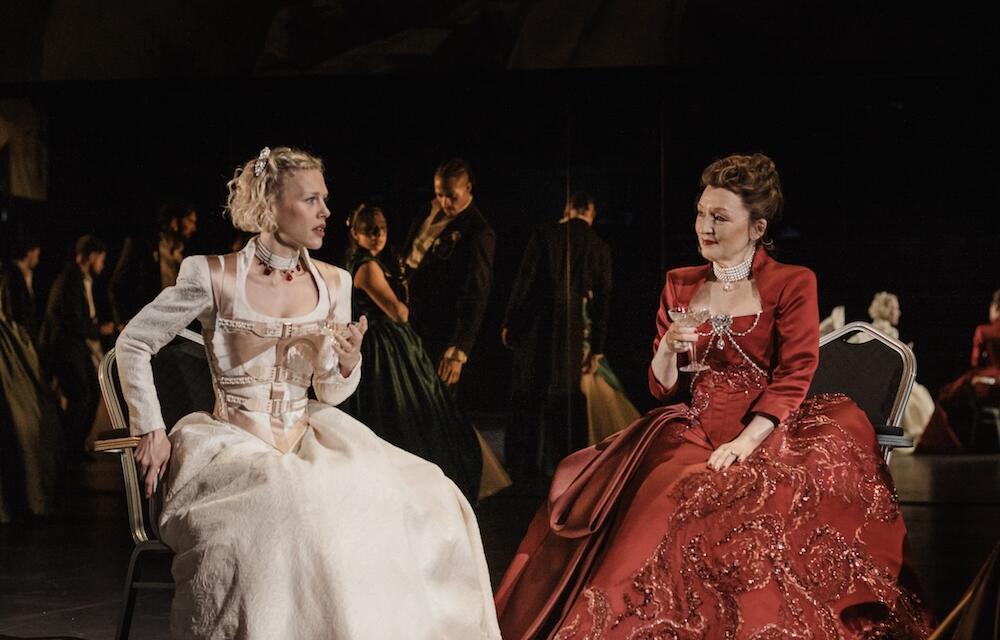
With a cast dressed in Natalie Roar’s postmodern costumes, which mix old and new with contemporary bondage strapping and frills, flounces and furbelows, this is a visual extravaganza. Elliott uses the resources of the National to create a large chorus, which slides the set’s salon and bedroom walls into place, and performs Tom Jackson Greaves’s choreography. These dance sequences are entertaining, but tend to distract from the action, and stretch the show into two hours and 45 minutes of playing time. While the peopling of the stage by the ensemble suggests watchful prying moralists, it also obscures the main actors. Only twice does the choreography deepen our sense of the erotic, when it suggests the sexual dreams of a pair of characters. Otherwise the chorus at best is redundant, at worst overwhelms the emotional value of the acting.
So this production never really engages with the present, having nothing to say about consent or indeed l’amour fou, and is only tentatively sexy, despite all the strutting and posturing of the ensemble. There is one episode which examines our voyeuristic assessment of female bodies, where Merteuil (in black lace underwear) and Cecile (in white dress) appear, the one quickly covering her mature body while the other strips off, but that’s about it. And although Hannah van der Westhuysen’s Cecile does make a journey from innocence to experience, Monica Barbaro, making her stage debut as Tourvel, is more erratic. But in general this is a missed opportunity — all spectacle and no emotion.
- Les Liaisons Dangereuses is at the National Theatre until 6 June.
This post was written by the author in their personal capacity.The opinions expressed in this article are the author’s own and do not reflect the view of The Theatre Times, their staff or collaborators.
This post was written by Aleks Sierz.
The views expressed here belong to the author and do not necessarily reflect our views and opinions.