Having been a teacher at The Actors Studio, following in the footsteps of Lee Strasberg, Lyle Kessler is a Playwright whose work seen all over the world. He received a Rockefeller Foundation Playwriting Grant for his full-length play, The Watering Place. His play, Orphans, has been running for over 35 years, in such places at London, Japan, Brazil, and France.
Lyle Kessler speaks to Theatre Times Editor Marcina Zaccaria about receiving his Lifetime Achievement Award in Playwriting in NYC on April 7th.
LYLE KESSLER: Actors like Ginger Rogers, Patricia Neal, and Danny Aiello have received the award. So, to be a Playwright and get an award like this. It is truly appreciated.
MARCINA ZACCARIA: What’s your strategy to getting your plays continually produced in Greenwich Village?
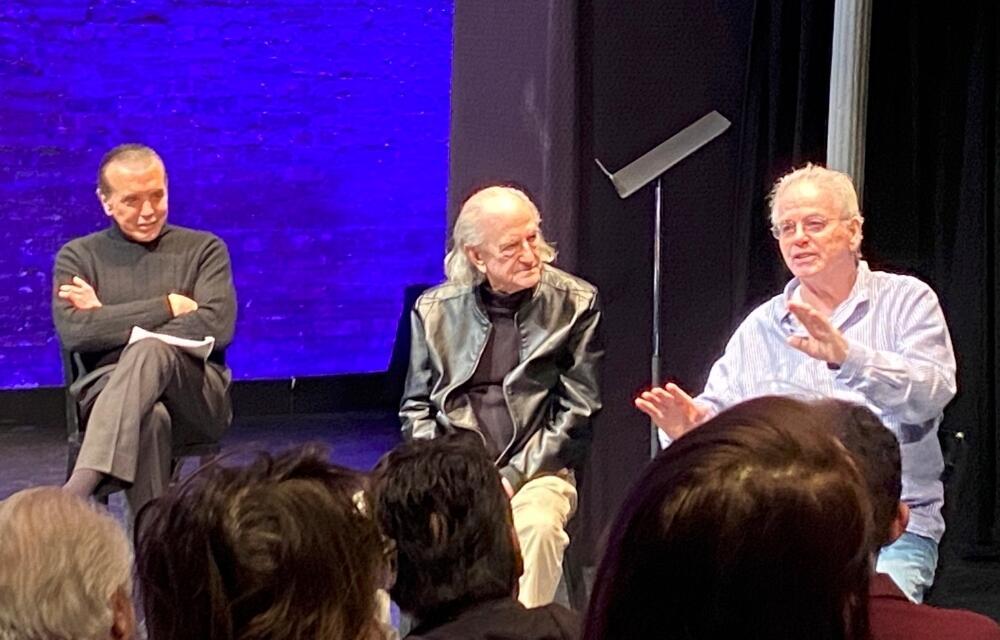
LYLE KESSLER: Since Covid, I’ve written seven new plays. I’ve been having play readings all over the place and Jesse Eisenberg was in one. That photo I sent you of Chazz Palminteri, did that play reading.
MARCINA ZACCARIA: Do you keep a writing, directing and producing schedule? If so, how do you manage it?
LYLE KESSLER: To tell you the truth, I get up at 4:00 AM, and I try to beat the first light of dawn. I’ve been doing that when I lived in Santa Monica – we moved from New York to Santa Monica. My wife was in the TV series, Falcon Crest. We had twins, and I had to go in the back of the garage where I had little office before the day started, before the twins got up with the noise and commotion. So, I have that structure I get up this 4:00 AM, and I begin writing. That’s how I do it.
MARCINA ZACCARIA: How did you first get involved with The Actors Studio?
LYLE KESSLER: I first got involved because I was a young actor. I was a student of Lee Strasburg in his private class. I was directing around town, off-off Broadway, and in other areas in New York. I was invited to go to his Directors Unit at The Actors Studio for my first play that I was going to direct. I actually sat down and wrote a play, a one act play. When my play was acted at The Actors Studio, Cheryl Crawford brought in a financial man to hopefully give money to the Studio. He was so moved by the play that he gave $50,000 to the actual Studio. Lee Strasburg, who doesn’t show much emotion, was deeply moved by the play, and he encouraged me to really continue writing plays.
MARCINA ZACCARIA: A lot of people know Lee Strasberg as the person who you know invented and popularized the Method.
LYLE KESSLER: Oh, absolutely. When I was living in LA, when I co-ran The Directors Unit with Mark Rydell and Marty Landau for 10 years. Then, when I moved back to New York, they asked me if I would do it again. I’ll do it, if I can bring other moderators. I’ll do it. I’ll be the Director. So, I got John Patrick Shanley. I got Michael Weller. I got José Rivera – he’s moderating tomorrow at the Studio. That’s every Wednesday. I’ve been doing that for 10 years here, so it’s been so helpful to me because I actually have readings of my plays. I, also, to direct my own plays.

Lyle Kessler in Cape Cod. Photo credit: Margaret Ladd.
MARCINA ZACCARIA: Are you surprised that Orphans has had such a lasting appeal, and if so, why?
LYLE KESSLER: It’s a phenomenon. It’s a well-kept secret that Orphans is done more than any other American play internationally, and I don’t just mean English speaking countries which is all the time. It’s going to be revived in London in ’27. I’m talking about next year Turkey, Shanghai, China, South Korea. It had been running with actors, with men successfully, and they asked if they could it with all women, so now, it’s a big hit with all women. Brazil, it’s an amazing thing. In Japan, it’s been running for 35 years straight. It’s like a miracle. There’s something about the play. It’s touches something within the soul of people. I have no idea how I did it. It’s amazing – the reaction to it. When we were in Japan, they invited my wife and I. There was a bus and truck tour all around provincial Japan. They would go to the site and do the play out in the open. The Japanese don’t show their emotions much. By the end of the play, they were all sobbing.
MARCINA ZACCARIA: A lot of Playwrights feel that film and television has a certain evil, that’s always going to be there. So I’m going to ask – do you ever feel that you have to do film and television to remain relevant? Does film and television production seem like a wicked stepchild to theater production?
LYLE KESSLER: My first love was theater. It’s in my blood. Live theater, live actors. I need to see the audience and hear the audience, and the plays. The plays go into character work more than film, what you can do in a visual medium. I wrote the Saint of Fort Washington with Danny Glover and Matt Dillon. It was the best work Matt Dillon ever did. It was about the homeless. Matt Dillon was a schizophrenic homeless kid. They bonded. It was a very emotional film. I was able to create some characters in films, but I missed the theater so deeply. I was doing theater in LA, too, at the same time, in some of the theater places. . . . I’m trying to get this film in LA done, but my love is theater. I need to do live theater from the very beginning.
MARCINA ZACCARIA: So, what do you tell theater writers who have lost their inspiration?
LYLE KESSLER: To survive as a Playwright, you need to develop strong stomach muscles. When I went in first went to the Studio, directing the Playwriting Unit, there was a wonderful playwright, there, doing his work. He went back to Oregon to work with his father in a factory there. He gave it up. He had to live the rest of his life knowing he gave up his dream, you know, because he wanted to make a living. How do you make a living as a young Playwright? You don’t. That’s why a lot of young people you gravitate towards the movies.
MARCINA ZACCARIA: So, what’s the most important bit of advice you could give to artists who feel great looking forward?
LYLE KESSLER: You got to believe in yourself no matter what. When it’s all coming down on you – when it rains, it pours. Winston Churchill says, “Never give up. Never give up. Never give up.” That’s what I’ve told writers. Never give up. You have to fight for it.
MARCINA ZACCARIA: Looking at your event next week, it there anything else that you want to share?
LYLE KESSLER: People in the American theater, the Jessica and James, they will work on some of my plays, they gave me this award. I have these plays all over the place, and I’m trying to get them on. If you have your plays, and they are not being done, it’s like you’re invisible. Certainly, Broadway is not great. In London, getting some of my plays done there, would be great. It’s a rough racket for Playwrights. But, what can I say, if it’s in your blood, you’ve got to do it.
This post was written by the author in their personal capacity.The opinions expressed in this article are the author’s own and do not reflect the view of The Theatre Times, their staff or collaborators.
This post was written by Marcina Zaccaria.
The views expressed here belong to the author and do not necessarily reflect our views and opinions.