
An Enemy of the People was first introduced to Greek audiences in 1902 by the pioneering “New Stage” of Konstantinos Christomanos.
This year, An Enemy of the People is being staged at the Knossos Theatre, revisiting the story of Dr. Thomas Stockmann, who discovers that the waters of his town’s spa baths are contaminated and, instead of being praised, is punished because of entrenched economic interests.

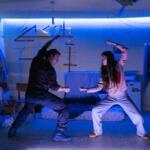
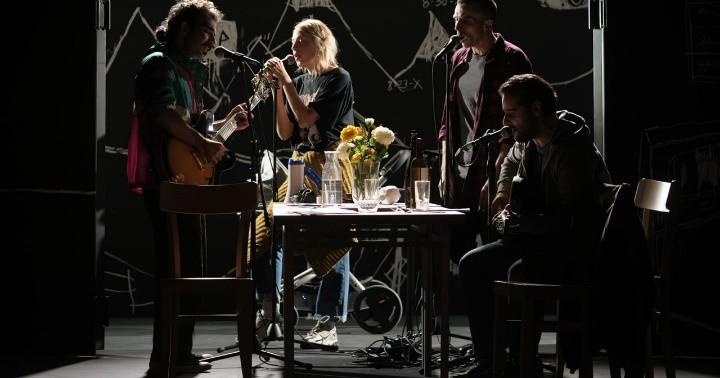
The adaptation by Florian Borchmeyer and Thomas Ostermeier of Henrik Ibsen’s text proved substantially revitalizing. An Enemy of the People resists classification into a single genre, carrying shades of satire, tragicomedy, drama, and more. This generic flexibility offered fertile ground for the adaptors, who did not hesitate to stretch its limits even further. Ostermeier dynamically incorporates a musical dimension into the staging, inserting several David Bowie songs and turning the Stockmann family into members of an active band alongside their close friends Hovstad and Billing.
Although the production has toured more than 40 countries in recent years, its staging in Greece does not feel like an “exotic” import tailored to local sensibilities. Instead, it engages directly with urgent domestic concerns.
From its opening through the second act, however, the performance feels rather conventional. A certain scenic monotony sets in, and the spectator struggles to latch onto isolated lines in order to maintain interest.
The third act marks a turning point. It is here that the Neos Kosmos Theatre’s decision to include this widely publicized Schaubühne Berlin production in its carefully curated repertoire begins to justify itself.
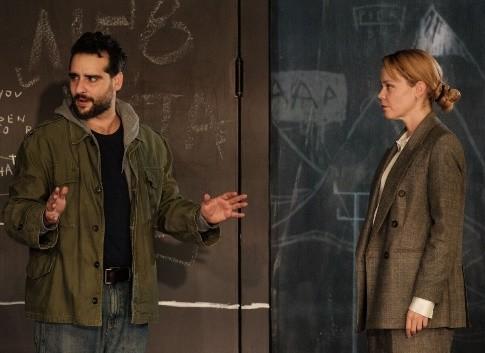
Suddenly, chamber theatre gives way to a vibrant, participatory event that meaningfully involves the audience. The house lights come up. After Dr. Stockmann’s fiery speech (Konstantinos Bibis), the cast urges spectators to raise their hands if they agree with the views expressed. The lion’s share sides with the doctor. While this interactive device has appeared before on the Greek stage, it undoubtedly works effectively here.
Allow me a brief digression to 1981, when Enemy was staged by the Semi-State Theatre of Central Greece, directed by Christos Tsagas. (As a curious footnote: Tsagas and his brother Lambros took over the Knossos Theatre in 1985, until it later became part of the Neos Kosmos Theatre.) Like Ostermeier now, Tsagas clearly delineated the fields of the “good” and the “bad”—not in a Manichaean way, but in popular terms. After Stockmann’s notorious speech, Tsagas had audience members vote with white cards (against) and blue cards (in favor) that had been distributed with the tickets. Spectators overwhelmingly supported the doctor.
Something similar happens now.
The doctor delivers a forceful speech brimming with revolutionary fervor, filled with references to contemporary socio-political ills. At the same time, he proclaims that “the majority is never right.” Yes, Ibsen pushes him into strange paths: elitism? Arrogance? Truth? Hubris? In vain does Hovstad—who has defected to the corrupt side—insist that “the majority always has right on its side.”
 In this way, the doctor calls the democratic system itself into question (a moment that brought to mind Cornelius Castoriadis’ remark in World in Fragments that “democracy is the only tragic regime […] that risks itself, that openly confronts the possibility of its own self-destruction”).
Naturally, in a political play, the very foundation of the democratic edifice cannot be absent. Thus, the microphone is unreservedly offered to the audience—“who wishes to speak?”—creating a process that directly recalls the Athenian Assembly and the principle of isegoria, the equal right to address the public.
We witness a striking contrast: the rhetoric urges skepticism toward democracy, while the procedure itself rests upon democratic foundations.
In this way, the director renders visible the Achilles’ heel of this political system. Yes, everyone has the right to free expression (in this case, the spectators), but the orchestration of the entire situation is carried out by a specific group—the ensemble—who know exactly how to pull the strings and when to bring the discussion to an end. They determine when this window of equality will close, a window opened just long enough to remind us of the regime it represents. After the lights go down, it is the ruling elite who will continue to steer the political course as they see fit.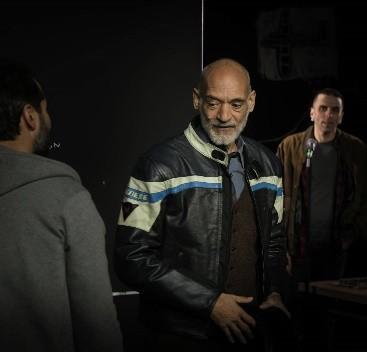
In attempting to avoid idealizing the protagonist, the director goes to the opposite extreme. He fashions a doctor without gravitas. His only weapon is truth; his personality lacks authority. Konstantinos Bibis, in the role of Thomas Stockmann, resembles an eternal student and never dons the mantle of the serious scientist—he stands on stage solely as an activist and truth-teller.
The politically naïve figure who ends up doubting the intelligence of the majority (as Ibsen conceived Thomas Stockmann) is transformed here into a revolutionary whistleblower. Rather than appearing anti-populist, he resembles the prisoner freed from Plato’s allegory of the cave. The audience never abandons him, and the Ibsenian ideological (and practical) rupture with the majority never truly occurs.
As a result, we see a character who does not evolve—he is simply attacked—and who reacts spasmodically, like a fish thrashing in the nets of the system. While the outcome of a critical situation hangs in the balance, the doctor remains the “guy” with the band fighting for his ideals. Bibis, confined within this narrow framework, not only fails to carry the production on his shoulders (as the title would demand), but smooths out the meanders of Stockmann’s trajectory, leaving spectators to seek dramatic interest in the other characters.
The icing on the cake is the dramaturgical choice to have only one baby instead of three older children, as we frequently see the exasperated young mother and substitute teacher, Katharina, on the verge of breaking down because her husband leaves most of the burden to her. Suddenly, the “guy” doctor becomes additionally an immature father and at times a negligent spouse.
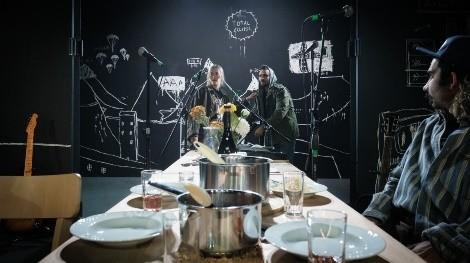
Jan Pappelbaum’s functional set design underscores the bohemian tone of the piece: black walls covered in chalk drawings create a cubicle reminiscent of a commune, through which members of the rock band drift in and out. In the end, the actors whitewash the graffiti, giving literal form to the notion of cover-up.
The costumes are contemporary and indicative of each character’s social “class” (Natassa Papastergiou, assisted by Marianthi Radou), though with a few notable anti-theatrical missteps (for instance, the doctor’s trousers create an asymmetrical torso). Nevertheless, the modern, somewhat loose styling of the band members (Thomas Stockmann, Katharina, Hovstad, Billing) faithfully serves the director’s vision, who stated about the production: “It is a critical commentary on leftists, liberals, hipsters—people who may ride bicycles, be vegan, practice yoga, but when it truly matters, may find themselves betraying the movement from within.”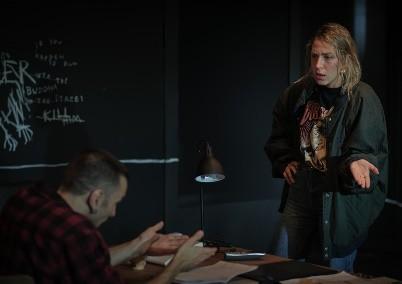
The lighting design (Erich Schneider) is excellent and precise, and Antonis Galeos’ translation is direct and contemporary.
All the actors stand firmly in their roles (Michalis Oikonomou plays Peter Stockmann, and Lena Papaligoura takes on the role of the moderate Aslaksen—rewritten here as a woman, perhaps for reasons of balance. Ieronymos Kaletsanos appears as Morten Kiil, Stelios Dimopoulos plays Hovstad, Alkistis Ziro portrays Katharina, and Iason Aly plays Billing).
Ultimately, this is a powerful production that raises profound questions about the functioning of the political system, delivered by a group of noteworthy collaborators.
This post was written by the author in their personal capacity.The opinions expressed in this article are the author’s own and do not reflect the view of The Theatre Times, their staff or collaborators.