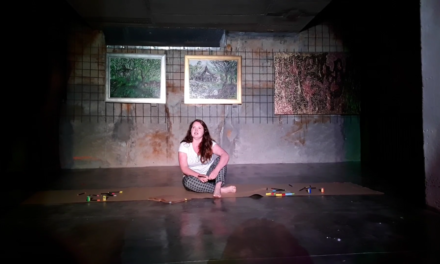

In 2016, Austrian director Christian Krönes and colleagues launched their two-hour documentary film Ein deutsches Leben, about Brunhilde Pomsel (1911 – 2017). To a large extent, the film features conversations with Pomsel about her life, especially her career as a stenographer and typist under the Nazi regime in Germany, culminating in three years in a leading position in the ministry of propaganda, working closely with Goebbels. The material of this film served as the basis for Christopher Hampton’s one-woman play A German Life, which was premiered on 12th April 2019, at the Bridge Theatre in London, directed by Jonathan Kent. Maggie Smith (1934 – 2024) had returned to the stage after 12 years to play the role of Pomsel. Plans for transfers to the West End and Broadway were abandoned due to the Covid pandemic, as were later considerations of a film version. The German translation of the play, by Sabine Pribil was premiered on 23rd September 2020 at Schlossparktheater in Berlin. The production was a collaboration between Schlossparktheater and Hamburger Kammerspiele, directed by Philip Thiedemann. Brigitte Grothum (b. 1935) played Pomsel.
The production drew attention in the UK because of Maggie Smith, and in Germany because of Grothum. In addition, the Berlin venue, Schlossparktheater, holds special critical and audience attention because of the advanced age of its current artistic manager, Dieter Hallervorden: the popular German actor and comedian was seventy-four when he took over the theatre in September 2009, and is continuing in post to this day.
Grothum fielded a wide range of nuances in her refined portrayal of Pomsel, bringing her 70 years of experience on stage and screen to bear. She rendered believable the notion that Pomsel was so politically naive that she genuinely did not realize and know about the crimes perpetrated by the Nazis. She presented the cheerfulness with which Pomsel took a Jewish friend with her to the party office to join the party. Her Pomsel did not sense any conflict in working part-time both for a Jewish and a Nazi employer. She was equally believable in her genuine horror at the Reichskristallnacht, and at her ability of blocking out that impression for her daily life. One of the coping mechanisms in a totalitarian society is to unconsciously ignore as much of its uncomfortable aspects, as long as it does not get uncomfortable for oneself. It is easy, with hindsight, to condemn people in that category for not having turned into active opponents against the regime. By making her Pomsel a rather likeable old woman, Grothum emphasized the complexity of lives in a totalitarian society, working clearly against simplistic black and white, bad or good opposites. The audience’s immediate standing ovation was fully justified.
This post was written by the author in their personal capacity.The opinions expressed in this article are the author’s own and do not reflect the view of The Theatre Times, their staff or collaborators.