Rok Vilčnik (b. 1968), also known as rokgre, is a prominent Slovenian author, poet, playwright, lyricist, and multidisciplinary artist working across theatre, literature, music, television, and radio. Widely recognized as one of Slovenia’s most distinctive contemporary playwrights, he is a three-time recipient of the prestigious Grum Prize for Best New Slovenian Play. Alongside his acclaimed dramatic writing, Vilčnik has published several poetry collections and novels, while remaining an influential figure in the Slovenian music scene as a lyricist, composer, and co-founder of notable musical projects such as Patetico and the Papir collective, associated with the movement Nova Slovenska Popevka. His works continue to travel internationally: recent productions include the premiere of Heretherewhere, based on his play Light Is a Lonely Wanderer, staged in Milwaukee and Ravenna, as well as the monodrama The King of the Street in Maribor. In 2024, he published his fourth novel, The Mechanism. (Theatre Plays (selection): Syrup of Happiness; A Dangerous Relationship: A Virtual Comedy; Keel Effect; Exhibition of Hearts: Tragedy; Single Parent: Monodrama; Mulch Watching You: Monocomedy; Spake: Puppet Musical; Little Handbook of Business: Full-Length Monocomedy; Tarzan: Exotic Drama; People’s Democratic Circus Sakeshvili…)
Ivanka Apostolova Baskar: Your plays often begin in familiar, seemingly simple situations, yet expand into profound reflections on human society and institutional absurdities. When you choose a thematic world whether Tarzan’s jungle paradox or the meta‑theatrical Our Theatre how do you conceive of the point where the familiar becomes unfamiliar, and comedy becomes critique? Is this shift deliberate from the start of writing, or something that emerges intuitively during composition?
Rok Vilcnik (rokgre): What matters most to me is not to preach. I want the viewer to recognize, through the situation itself, the abnormality, anomaly, or at least the strangeness surrounding the presented “problem.” Human beings and the world as a whole are dual in nature: we constantly try to balance between light and darkness, between nothingness and chaos, between love and greed. Yet around us there is a world that functions in a similar way, though always in favor of something larger, something we search for as meaning. Thus our small personal meanings repeatedly collide with that greater, “absolute” meaning which ultimately remains beyond our comprehension. Because of this, many of us turn to art, while others turn to philosophy, psychology, science, spirituality, or meditation. For that reason, I perceive even the simplest situation as extraordinarily complex and when it is so complex, it can easily become humorous. Complexity always carries the seeds of friction; one only needs to reveal the right elements and present them from the right perspective. If you want tragedy or drama, you focus on the philosophical meaning of the situation, on the psychological dimension of what destroys lives. If you want humor, you approach it more gently, less conclusively burdened, allowing the protagonists to live their everyday lives as if they were eternal. Absurdity contains both and that is why it feels so close to me.
IAB: In Tarzan, you place iconic cultural figures, human and animal, into a framework that interrogates contemporary human norms, identity, and materialism. What attracts you to these hybrid figures as dramatic protagonists, and how do they help you explore the boundaries between civilization and instinct?
RV: I believe the success of Tarzan lies in the fact that I stripped the protagonists of all the “civilizational” layers and placed them naked and barefoot in paradise which in this case is the jungle. After all, love triangles of every possible kind have been played out countless times on stage, in film, and in literature. Instead of the apple, I introduced the temptations of modern life; I removed God and added the devil, who in this case appears as a humanized hyena. Yet this hyena is nothing more than an everyman, someone who could be any of the spectators, anyone who lives comfortably off the gains of a democratic, civilized capitalist society that nevertheless always prospers through one form of exploitation or another. Once I established this solid mechanism of three protagonists, each driven by their own desires except for Tarzan, of course, who feels neither fully animal nor fully human, or perhaps both, and through this seeks his identity and tries to live with this confusion, which is essentially a question about artificially constructed normality, I was able to place upon this foundation all the key questions of our time. The most important question for me is whether the human being is truly no longer an animal. The conclusion? Some are more so, others less. Those who are “more” are often the more ridiculous ones. Yet the closer they are to the animal, the more they aspire to be human. And once again, we arrive at the absurd.
IAB: Our Theatre reflects not simply theatre as an art form, but the theatre as a mirror of society. How do you see the relationship between the institution of theatre and the society it inhabits as symbiotic, confrontational, or something else?
RV: God, one could say, is a multidisciplinary artist. His co-production with us is the most complete work that exists, the grand theatre of illusions that nourishes our confused souls. In a somewhat irreverent spirit, I allowed myself to explore precisely this theme. No society knows everything, yet in every society there are individuals who would like to know everything, or at least understand more: scientists, philosophers, and, of course, artists. What is space? Is every space already, in itself, a stage? Of course it is. If we possessed a time machine, we could organize audiences to witness the most important events in history. Would that not be one immense, magnificent theatre? The idea of theatre as the “mirror of society” will always remain only a mirror, because mirrors reproduce nothing more than a visual copy and even that reversed. Perhaps the phrase “mirror of society” is not entirely accurate. Perhaps it is closer to the essence of society. Yes, that is how I would describe it. In the play Our Theatre, the theatre director assumes a kind of godlike role, producing a performance with everything that exists. It may sound megalomaniacal, yet it is also deeply pragmatic, since everything is already “here” the entire stage and all the actors. Because his audience consists of highly educated spectators, he does not expect any difficulties. At the end of the day, symbolically speaking, this is all of us. Yet more than spectators, we are observers. Perhaps the difference lies only in the word but in essence it is about continuously watching this great performance we call the world.
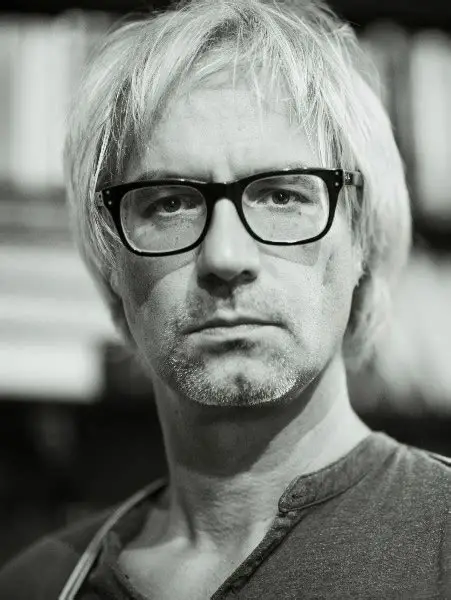
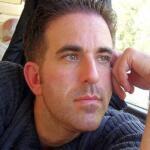
Rok Vilčnik. Photo Credit Urshka Lukovnjak.
IAB: Character action in your work frequently uses humor to expose social mechanisms from totalitarian absurdity in Sakeshvili to human vulnerability in Tarzan. How do you see human agency expressed or constrained in these dramatic worlds?
RV: The whole world is made of logos. They are not bound only to sight, because even a blind person can recognize them. We constantly exploit everything in order to enchant ourselves and others. Twenty-four hours a day we pull our tricks and try to sell something. Everything is for sale. “Find your light,” spiritual gurus tell us. And so we search. But the Sakeshvilis do not have to search, they have everything served on a platter. In that sense I envy them. In their world, their great president Sakeshvili is the sun, and the only love that is permitted is love for him. How peacefully simple things can be, don’t you think? And what if you have to sacrifice your dignity for it? Don’t we do the same for brilliant new phones, for instance? The pop-art saying that everyone has their five minutes of fame is over. Now we can remain in fame permanently, on online profiles where we can post ourselves every second. Some tribes once refused to be photographed because they believed it would steal their soul. What, then, is all of this taking from us? We pretend it is not so, yet we consciously cultivate a fragile balance of hunger, poverty, exploitation, humiliation, and ultimately the barely concealed stripping away of human dignity. Sakeshvili is the symbol of complete allegiance to a single way of thinking at least until one loses one’s own name. I most appreciate the kind of humor that emerges on its own, without intending my writing deliberately to be funny. So many tragic things are funny. One might say ‘unfortunately’, but that is not true. If something is funny, it is simply funny. A situation is not to blame if it is presented from a perspective that provokes a smile. On the contrary, that is its quality, its charm, its provocation, its surplus. And writing things in such a way that they are truly funny is not an easy task. When someone finds my work witty, it is a great compliment to me.
IAB: Many of your dramatic works have been nominated multiple times for the National Grum Award and have been staged internationally. How does this external reception influence your sense of the dramatic text as living performance or as a text that must adapt across cultures?
RV: Perhaps it is easier for me, because none of my texts are tied to the place where I live. Everywhere, people confront dictatorship as in The People’s Democratic Circus Sakeshvili, for example. The uniformity of dictatorship, the devaluation of individuality, and the stripping away of human dignity, these happen in a country named after its president, where every citizen is named likewise. Even the animals, rivers, and mountains share his name. The only love allowed is love for the great lifelong president. Anyone who preserves their human dignity must be sent to a camp. Everything is rationed. Even self-gratification. I should add five years ago, two friends of mine who run a theatre in the U.S. told me that their audiences would not understand such dramas. This year, they staged it. The world is changing. Yet this should not affect the theatre text itself unless, of course, the changes are such that theatre can no longer exist due to physical transformations.
IAB: You have written novels, short stories, children’s tales, and poetry alongside your dramatic texts. When you move between genres, from the embodied immediacy of theatre to the internal freedom of prose, how do you shift your creative mindset and tools?
RV: Hmm, interesting question. I don’t think so. I use the same tool all the time: words, sentences, writing itself, only the structure changes. A novel is written differently from a play: in a novel, meaning emerges between the sentences; in a play, it emerges within the sentences. In poetry, there is no such explicit meaning there is only the radiance of feeling.
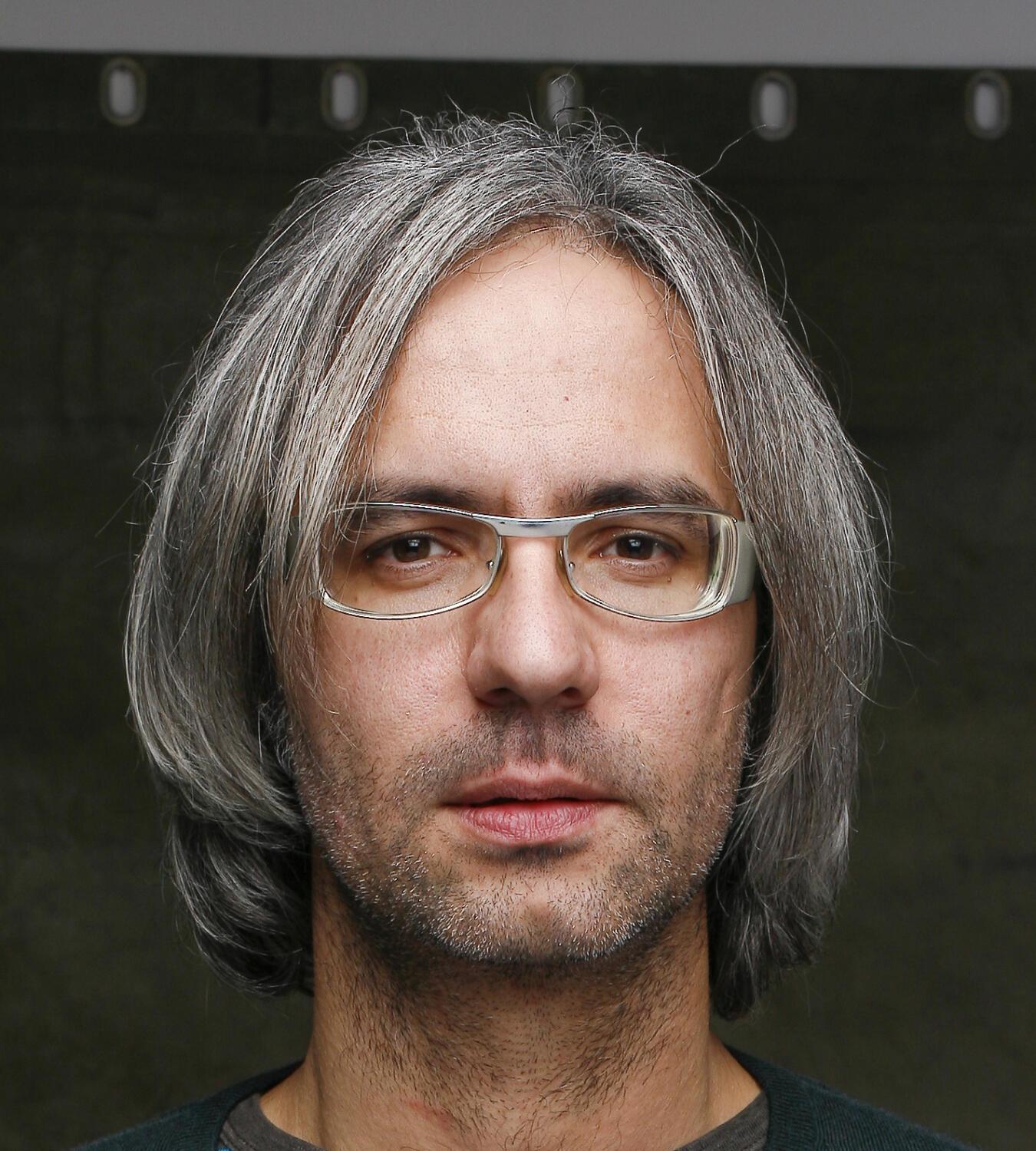
Rok Vilčnik. Photo Credit Damjan Shvarc.
IAB: Does prose allow you to articulate aspects of human experience that theatre cannot, or does each form reveal something the other conceals? How do you decide whether a concept must be a play rather than a novel or narrative text?
RV: The novel is king; it contains film, theatre, poetry, song, music, images, scent, everything in one. But if you describe too much, it becomes inflated. Theatre, however, has one major advantage over all other forms: the presence and therefore the experience of real people in real time. Nothing can pierce you as directly. These days, I would choose novel writing. Next year, my new novel will be published, a work I have been developing for several years. I did not write it; I worked on it. I wrote it quickly, but masochistically immersed myself in the meticulous polishing of each letter. When properly connected, they shine like a neon sign, impossible to ignore. I am not sure I succeeded with every sentence, and at one point I had to discard one entirely. Playwriting happens much faster. Sometimes it seems to me that the most beautiful part of my scattered creative process is the people I encounter along the way. Each of them carries so much knowledge, talent, hope, ideals, trust, courage, searching, mistakes, wandering, sacrifices, and bitten nails; also pure joy and delight, love and respect, and friendship. Perhaps that is what truly matters: the moments in which it all occurs. And if anything survives, it is the imprint of all of this. That is the metaphysics that can be transmitted through radio, stage, or printed page over time into the souls of others.
IAB: What threads thematic, stylistic, emotional do you see running across your work in different genres?
RV: There is a thesis that comedy arises when tragedy can no longer see a way out. Comedy nurtures hope and acceptance, while tragedy is constantly struggling. We keep cultivating that ancient metaphysical sense of tragedy, which is no longer truly ours. What is so shocking if you sleep with your mother, fail to punish an uncle you suspect of killing your father, or are driven by a friend into such furious jealousy that you destroy an innocent wife? Pragmatically speaking, what do these entanglements yield? Oedipus accidentally killed his father and slept with his mother. Coincidence! Why the outrage? Some ideas require instruments, others only the voice, acapella. We seek empathy, which brings layers of depth. One must always look for the causes of monsters. Some things can only be understood by not understanding them. Coming to terms with this is an essential part of our existence. Manipulating it is an essential part of creation. How a text presents itself to people depends solely on what suits it best. Not all texts or people have the same shape.
IAB: Some critics have noted that your plays don’t just depict events, they interrogate perception itself, often forcing the audience to question their ease of interpretation. When you write, are you conscious of the spectator’s gaze as a collaborator or a subject to be challenged?
RV: How would I analyze certain things for myself? If I want to know more about a particular problem I have to sink into it, explore all its tributaries, rapids, and waterfalls. I must navigate its bloodstream and extract from it a concentrate that, through the audience’s perception and, first, through placing the work on stage, transforms into something pleasurable, something that resonates. It must be as simple and delightful as tiramisu, something that people will remember for a lifetime. So the answer is this: when you cook or consider those who will eat the meal, do you think about how they will receive it, or do you simply aim to prepare the most delicious dish possible? A dramatic text is a recipe. The stage, the technical setup, the scenery, the actors, the director, they are the ingredients. The performance must feel fresh every time. Reheating theatre is worthless!
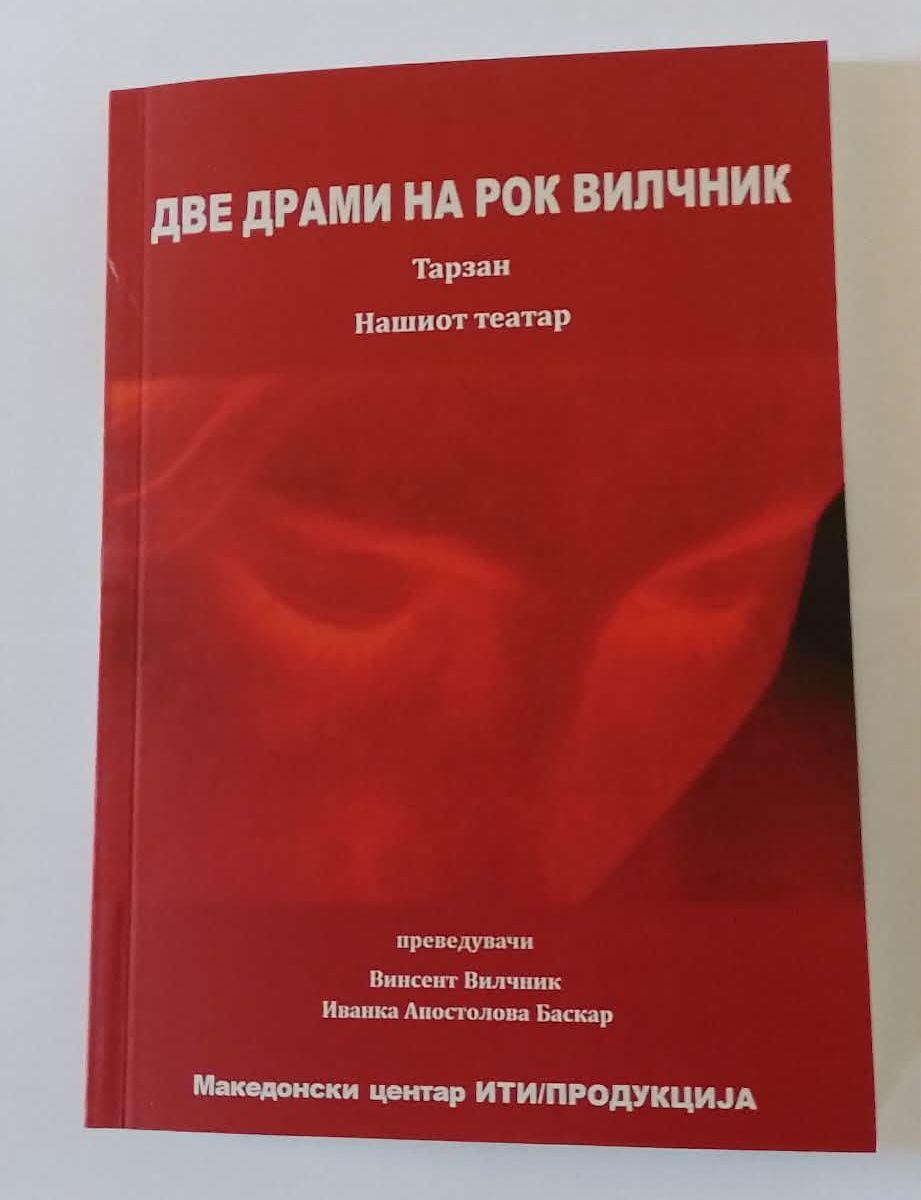
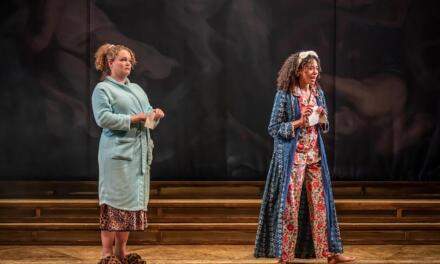
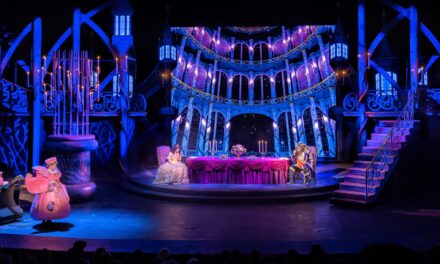
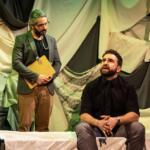
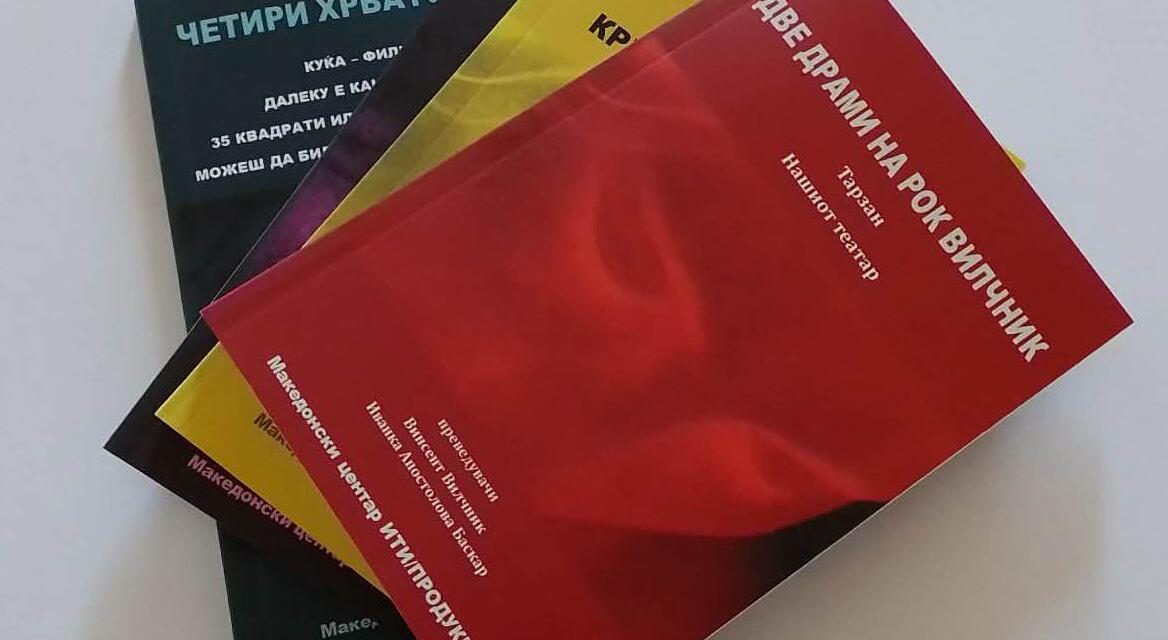
Two plays by Rok Vilčnik. Photo credits ITI Macedonia.
IAB: Humor in your plays often undoes seriousness only to reveal it more sharply. Do you view humour as a weapon of insight, a device of empathy, or a trap that reveals human contradiction?
RV: What I like about humor is that its individual components are often not funny on their own. When properly connected, they shine, and the effect works. The external framing of the situation is also crucial. I enjoy taking a radical position and exaggerating it so much that it tips into the absurd. And in the absurd, the matter reveals itself naked as it is nonsensical. I am always searching for ‘novelty’ in everything: how and what to say, how to show it differently; but never by force. Everything must pass through the work, properly integrated into the whole. The right measure depends on the framing, and measure itself is ultimately balance.
IAB: You began as a visual arts student and initially pursued painting before turning to writing. How did this background in visual arts shape your dramaturgical eye the way you conceive scenography, spatial relations, and the visible world on stage/in the plays?
RV: Once you start painting, you develop a kind of “visual disturbance”: you first see the world as a frame. Before anyone says anything, you are interested in what can be seen where the body stands, where the void is, where there is a compositional flaw. And above all: what the scene hides while pretending to be normal. In theatre, scenography is always part of the dramaturgy for me, not decoration. Space is the first character. If the space is wrong, the lines become nervous. If the space is too beautiful, it begins to perform instead of the actor. If it is overly realistic, the audience trusts the walls more than the people. That is why I am fascinated by the “visible world” as an event: how space behaves when a person enters it, and how a person changes when the space pushes them into a corner. I often do not believe the characters until I place them on the floor. Sometimes it is enough for someone to stand three centimeters too high for a tragedy or a comedy to unfold. Comedy is often just a poorly staged tragedy. And this is purely visual: the relationship between body and object, between head and ceiling, between the door and courage. My background in painting also gave me an obsession with “visible logic.” In a painting, nothing is accidental: if an object is there, it means something. If the light comes from the left, it reveals something. This is wonderful for drama as well: I like stage worlds where everything is tangible and yet slightly suspicious. Where it seems ordinary, but beneath the surface there is a symbolic crack. Like a kitchen where everything appears normal… except the fridge never opens all the way. And you know this is a story. One more thing: painting teaches you that you do not always need to “explain.” You can let the image speak. Sometimes it is more dramaturgically effective for someone to stand for ten seconds, unable to find the handle, than to deliver five pages of monologue about their helplessness. Space is a monologue – you simply cannot interrupt it.
IAB: Many dramatic artists describe turning moments like moments of crisis, injury, or transformation as catalysts for change. Has there been a defining personal transformation that shifted how you approach theatrical creation?
RV: As a graduate of visual arts, I discovered my true calling writing in 1992, when I injured my left hand in a sleepwalking accident and began writing with my right. The misfortune was followed by an outburst of creativity: within a single year, I wrote four plays, including It (1993), which a few years later earned me my first nomination and selection for the Grum Prize for the Best Original Slovenian Play.
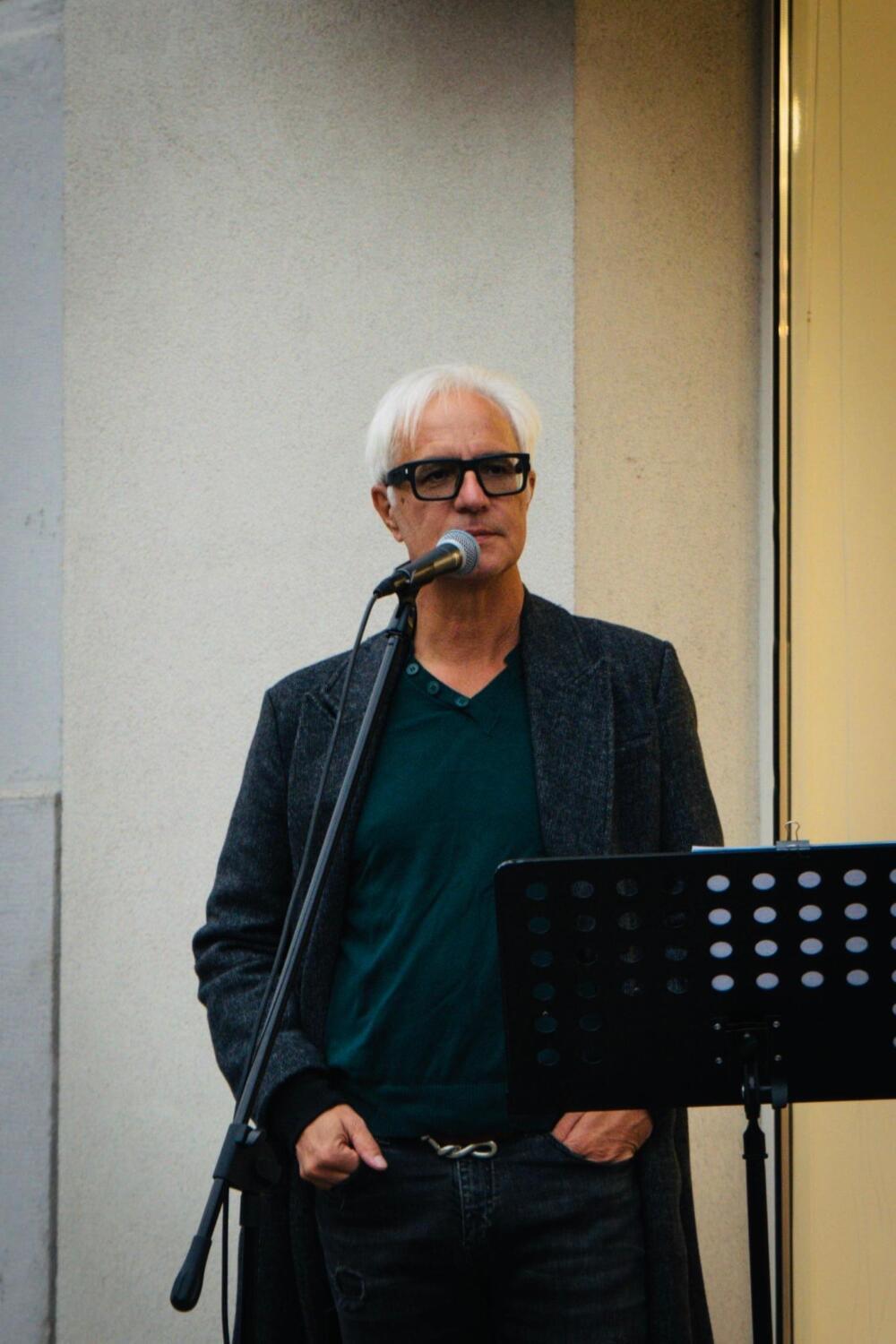
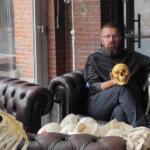
Photo Credit Rok Vilčnik.
IAB: Your plays often dwell in that intersection where absurdity illuminates real human vulnerability. Do you see the theatre of the absurd as a method of truth‑telling, or as a way to liberate audiences from conventional meaning?
RV: The absurd has never been escapism for me, but realism with the brakes off. If people truly spoke exactly what they think, and if the system fully acknowledged what it does, the world would long ago have been pure absurdity. We merely paste wallpapers of “normality” over it so we can drink our coffee in the morning. So, yes, the absurd is a method of truth. Not because it is “philosophically profound,” but because it is often the only way to say something honestly without immediately slipping into a sermon. When you speak directly, people become defensive. When you show it as absurd, they first laugh, then realize they are laughing at their own lives. And that is a very uncomfortable form of honesty but effective. Vulnerability… vulnerability is, for me, the heart of absurdity. When someone in the funniest situation suddenly becomes real. When their voice cracks in a joke. When their body fails them in a ritual. When they discover in the system that they are not the protagonist, but a footnote. In these moments, absurdity does not destroy meaning it destroys the illusion that we are safe from meaning. So, I would say: the absurd is not an escape from meaning, but an escape from false meaning, the kind that comes packaged with instructions on how to use it. Theatre, for me, is a space where, for one hour, we can admit that we have no instructions and that this is… utterly human; and sometimes even funny.
IAB: Looking forward, what unexplored dramatic territory calls to you thematically, structurally, or philosophically? Is there a form or subject you haven’t yet written but feel compelled to explore?
RV: No. Over the past twenty years, creating music has also been a significant part of my life, but I have a feeling that one day I will return to the meditative practice of visual art.
IAB: In a time of digital media, streaming, and fragmented attention, how do you imagine the future theatre experience both live and mediated should evolve?
RV: We are losing audiences because the generations coming up no longer have the patience for longer events. Theatre will have to adapt, especially drama.
IAB: Lastly, if you were to write a new play in response to the world today, socially fractured, technologically bound, yet yearning for connection, what central question would that play seek to ask?
RV: Is love energy or matter?
IAB: Thank you very much dear Rok Vilčnik.
Skopje/Maribor/Zanzibar, 2026
This post was written by the author in their personal capacity.The opinions expressed in this article are the author’s own and do not reflect the view of The Theatre Times, their staff or collaborators.
This post was written by Ivanka Apostolova Baskar.
The views expressed here belong to the author and do not necessarily reflect our views and opinions.